Which Minecraft Edition Is Best for Your Laptop? A Practical Comparison
A detailed, objective comparison of Minecraft Java and Bedrock on laptops, covering performance, modding, cross‑play, and setup to help you choose the right edition for your hardware and playstyle.


TL;DR: For most laptop players, Minecraft Bedrock Edition runs smoother on Windows 10/11 with better optimization and cross‑play, while Java Edition gives richer mods and a classic PC experience. If you want broad performance with minimal setup, start with Bedrock; if mods and customization are your priority, choose Java. On ultrabooks or legacy laptops, verify GPU drivers and game settings before deciding.
Why which minecraft for laptop matters
If you're deciding which minecraft for laptop to install, you're balancing portability, performance, and feature sets. Laptop hardware varies widely from ultra-portables to mainstream notebooks, so the edition you choose will shape fps, load times, and world size. In this Craft Guide analysis we break down the two dominant editions—Java and Bedrock—and explain how their design goals align with typical laptop configurations. The Craft Guide team emphasizes that the best choice depends on your playstyle, tolerance for tweaking, and whether you want cross‑play with friends on other devices. Understanding these factors helps you avoid wasting time on a setup that won’t run smoothly or meet your expectations. As you read, keep in mind that this guidance aims to help players from beginners to advanced pursue a satisfying Minecraft experience on a laptop in 2026.
The keyword which minecraft for laptop appears here to anchor intent and improve readability for search engines while guiding you toward practical decisions. The two editions differ in performance priorities, mod support, and multiplayer scope, which will influence how you configure settings and plan future upgrades on your gear.
Edition overview: Java Edition vs Bedrock Edition
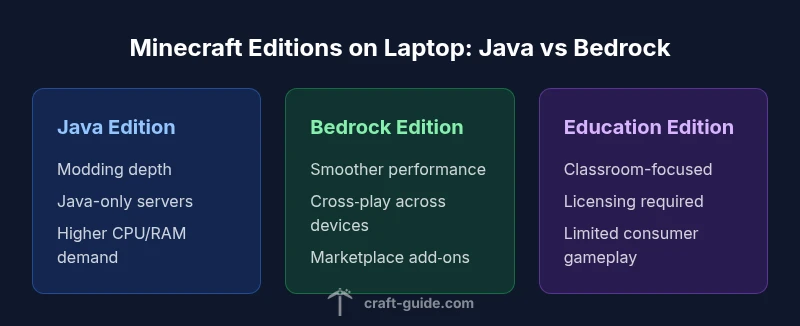
The two main editions, Java Edition and Bedrock Edition, share the same core visuals and mechanics but diverge in architecture, performance goals, and ecosystem. Java Edition is the traditional PC experience, built around a robust modding scene, open-world customization, and a large community of builders and speedrunners. Bedrock Edition is optimized for cross‑platform performance, smoother frame rates on a wide range of hardware, and a marketplace that streamlines add-ons and skins. If you’re asking which minecraft for laptop to prioritize, the key distinction is that Java emphasizes depth and customization, while Bedrock emphasizes stability and cross‑device play. Craft Guide analysis shows that Bedrock typically provides better stability on mid-range laptops and lighter GPUs, whereas Java can demand more RAM but rewards players with expansive mod support. In 2026, both editions continue to evolve, but the decision often boils down to whether you value mods and vanilla feel (Java) or smoother performance and cross‑play (Bedrock).
- Cross‑play considerations: Bedrock supports cross‑platform play across Windows, macOS, iOS, Android, and consoles, enabling friends with different devices to join the same world. Java does not cross‑play with Bedrock, and even Java servers are generally restricted to PC clients.
- Modding and ecosystems: Java’s Forge and Fabric ecosystems enable unlimited customization, but Bedrock’s add‑ons and Marketplace are more controlled yet simpler to install on laptops.
- UI and controls: Bedrock’s UI is tuned for modern devices and controllers, while Java’s keyboard/mouse focus is favored by traditional PC players.
How laptop hardware shapes performance
On a typical consumer laptop, performance hinges on CPU efficiency, RAM availability, GPU capability, and thermal management. The Java Edition generally benefits from having enough RAM to allocate to Java’s heap and keeping the world chunk loading smooth. Bedrock Edition leans on optimized code paths and a lighter rendering pipeline, which can yield steadier frame rates on the same hardware. The key question is whether your laptop can sustain acceptable frame rates at reasonable render distances while avoiding thermal throttling. Craft Guide recommends practical steps for assessing your system: monitor FPS, check temperatures during sustained play, and test both editions if possible. For 2026, the trend is clear: Bedrock suits a broader audience who want reliable performance with minimal configuration, while Java remains the playground for those who crave mods, world‑generation variety, and a classic PC feel.
- Practical test: Install both editions and compare fps in a standard seed with moderate complexity, then try a heavily modded Java world versus a Bedrock world with add‑ons to gauge relative load. The takeaway is to prioritize stability first, then feature depth, especially on laptops with limited cooling.
Java Edition: Pros and Cons
Java Edition offers unparalleled modding potential and a more traditional PC Minecraft experience, but it can be more demanding on memory and CPU. The modding community delivers vast architectural changes, visual enhancements, and quality‑of‑life improvements that can transform how you build and explore. However, running Java on a laptop often requires careful tuning of memory allocation, allocating enough RAM to Java while avoiding excessive background usage. Java also requires consistent updates to Forge/Fabric integrations when adding mods, which can complicate setups on laptops with limited storage or older GPUs. In short, Java is best for players who want customization and a purist vanilla feel, and who don’t mind investing time in optimization on laptop hardware. Craft Guide’s experience shows mod stability can vary, so test carefully before committing to a large mod pack or server that relies on Forge.
- Best for: Modding enthusiasts, builders who want custom tools, players who enjoy frequent world updates and community content.
- Caveat: Requires more RAM and careful optimization to avoid lag on weaker laptops.
Bedrock Edition: Pros and Cons
Bedrock Edition prioritizes smooth performance, reliable cross‑platform compatibility, and a streamlined add‑on system via the Marketplace. On most laptops—especially mid‑range or newer models—Bedrock tends to run more consistently at higher frame rates with fewer tweaks. It also enables cross‑play with friends on mobile and consoles, which is a major selling point for many players who want to play together regardless of device. The trade‑off is a more controlled modding ecosystem; while add‑ons exist, they don’t offer the same breadth and depth as Java’s modding scene. For laptop users who value stability, quick setup, and playing with a broader friend group, Bedrock is often the smarter choice. If you care deeply about custom mods and Forge‑style modifications, Java remains the better platform.
- Best for: Players who want cross‑play, stable performance, and easy access to add‑ons.
- Caveat: Fewer deep modding options and a more curated marketplace.
Modding, add-ons, and ecosystems
Modding ecosystems shape how you experience Minecraft on a laptop. Java Edition hosts Forge/Fabric ecosystems that empower players to overhaul mechanics, optimize performance, or create entirely new content. If you’re exploring which minecraft for laptop to adopt, Java’s modding depth is a strong draw for many players, albeit with additional setup and potential compatibility issues when game updates roll out. Bedrock Edition supports a curated marketplace with add‑ons and skins that are simpler to install and maintain—but with less depth for mechanical changes. Education Edition, while not a primary gaming focus, offers classroom‑oriented experiences and content locked to educational contexts and licensing. Craft Guide recommends beginning with Bedrock if you want a quick, stable experience, then exploring Java for expanded customization as you become more comfortable with laptop performance and mod management.
Cross‑play, servers, and multiplayer considerations
Cross‑play is a major factor for many laptop players. Bedrock Edition shines here, allowing friends across Windows, macOS (via Bedrock), iOS, Android, and various consoles to join the same world. Java Edition support relies on Java‑based servers and is generally limited to PC players; cross‑platform multiplayer in Java is not a standard feature. When you’re deciding which minecraft for laptop to adopt, think about your friend group and the servers you want to access. If you value wide player pools and consistent multiplayer performance, Bedrock is typically the safer bet. If you want a modded server with significant customization and a faithful vanilla feel, Java suits that niche—even if it means sacrificing cross‑platform multiplayer.
Settings and optimization tips for laptop performance
Optimizing Minecraft on a laptop involves a balance of in‑game settings, driver updates, and background processes. Start with baseline settings: turn down render distance, disable fancy graphics, and cap FPS to your monitor’s refresh rate to prevent GPU throttling. Allocate a reasonable amount of RAM to the game if you’re running Java, but avoid oversubscribing memory to leave room for the OS and other background tasks. On Bedrock, you can adjust visual effects and motion blur to reduce GPU load; keeping drivers current is crucial for stability. For both editions, closing background apps, using a cooling pad, and ensuring your laptop is on a hard surface can yield noticeable frame rate improvements. Craft Guide also suggests testing performance in both editions under similar conditions to identify the edition that yields smoother gameplay on your specific hardware.
Troubleshooting common laptop issues in Minecraft
If you encounter stuttering, crash loops, or freezing, first check for driver updates and ensure Java is allocated an appropriate amount of memory if you’re playing Java. Monitor temperatures during play to detect thermal throttling, which can dramatically reduce performance. Disable unnecessary startup programs to free system resources, and consider using a lightweight resource pack or neutral texture packs to reduce GPU load. If you’re using Java, try adjusting the garbage collector settings and allocate more RAM cautiously. If you’re on Bedrock, verify that Windows updates and store licenses are current, and consider reducing world complexity or render distances for sustained sessions. Regular maintenance and periodic testing across editions are essential to keeping Minecraft responsive on a laptop.
When to choose an edition based on playstyle
If your primary goal is modding, world customization, and a traditional PC experience, Java Edition is the best fit. If you want stability, cross‑play with friends on phones and consoles, and minimal setup, Bedrock Edition is typically the smarter choice for laptops. Education Edition should be considered only if you’re teaching or learning in a school context or along with classroom licensing. The choice hinges on hardware capability, playstyle, and the ecosystem you value most. Craft Guide emphasizes testing both editions if possible, especially on a device you’ll regularly use for other tasks.
Quick-start setup checklist for new laptop players
- Confirm which minecraft for laptop you want to install (Java or Bedrock).
- Check laptop hardware: RAM, GPU capabilities, and cooling setup.
- Install the edition with cross‑play in mind if you have friends on other devices.
- Update graphics drivers and Windows/macOS to the latest versions.
- Allocate RAM carefully for Java and adjust in‑game settings to balance visuals and FPS.
- Test a baseline world to assess performance; adjust settings as needed.
- Install only trusted add‑ons or mods from reputable sources (Java) or Marketplace (Bedrock).
- Keep backups of worlds before large updates or mod installations.
- Use a cooling pad for longer play sessions to prevent thermal throttling.
- Remember to verify server requirements when joining multiplayer worlds.
Realistic expectations and long-term planning
On laptops, Minecraft will generally run best with a balance between performance and visuals, especially when using Bedrock for its optimization and cross‑platform advantages. Java remains appealing for modding and a traditional PC feel, but may require ongoing tuning and occasional world adjustments. As hardware ages or games receive substantial updates, the optimal edition may shift. The Craft Guide team recommends revisiting the choice if you upgrade hardware or your friend group changes platforms, ensuring you’re still getting the best possible experience on your laptop.
Comparison
| Feature | Minecraft Java Edition | Minecraft Bedrock Edition (Windows) |
|---|---|---|
| Performance on typical laptops | Can be heavier on CPU/RAM; tuning needed | Generally smoother with fewer tweaks; optimized for lower specs |
| Modding ecosystem | Extensive mods via Forge/Fabric; high customization | |
| Cross‑play & multiplayer | Primarily PC-only; no cross‑play with Bedrock | |
| Market/add-ons ecosystem | Mods, shaders, and large community resources | |
| Recommended for | Players who want deep customization and world‑generation variety | Players seeking stable performance and broad device compatibility |
Benefits
- Bedrock Edition generally offers smoother performance on a wide range of laptops
- Java Edition unlocks extensive modding and customization
- Bedrock supports cross‑play across devices and platforms
- Java has a large, active modding community and frequent world updates
Negatives
- Java Edition can be resource-intensive on older laptops
- Bedrock Edition has a more limited modding ecosystem compared to Java
- Education Edition is not intended for consumer gaming and requires licensing
- Cross‑platform compatibility means version control and server settings can be complex
Bedrock edges out as the practical choice for most laptop players; Java remains best for modding and classic PC gameplay
Choose Bedrock for smoother performance and universal cross‑play. Opt for Java if you want expansive mods and a traditional PC experience; consider Education Edition only for classroom contexts.
People Also Ask
Which Minecraft edition runs best on a typical laptop?
Bedrock Edition generally provides smoother performance on most laptops due to optimization and cross‑platform support. Java Edition offers more depth through mods but can demand more RAM and processing power, especially on older hardware.
Bedrock usually runs smoother on most laptops, while Java offers more customization if your hardware can handle it.
Can I play cross‑platform between Java and Bedrock on a laptop?
No. Java and Bedrock editions do not cross‑play. You must pick one edition and play with others who have the same edition.
No, Java and Bedrock don’t cross‑play; pick one edition and stick with it for multiplayer.
Does Education Edition work on personal laptops?
Education Edition is designed for classroom use and requires school licensing. It is not ideal for standard consumer gameplay on personal laptops.
Education Edition is mainly for classroom use and needs a school license.
Will switching editions cause worlds to be unplayable?
Worlds created in Java cannot be opened in Bedrock and vice versa. You’d need to recreate worlds or use conversion options if available.
Worlds don’t transfer between editions; you’ll need to recreate or convert where possible.
What should I configure first to improve performance on a laptop?
Start with lowering render distance, turning off resource‑heavy options, and ensuring graphics drivers are up to date. For Java, allocate RAM carefully to prevent OS slowdowns.
Lower render distance, update drivers, and optimize memory for best results.
Is Minecraft on Windows cheaper than other platforms?
Prices vary by edition and store; check your platform store for current options and bundles. Bedrock on Windows is sold through the Windows Store, while Java is typically purchased from the official site.
Prices differ by edition and store; compare Bedrock on Windows Store vs Java on the official site.
The Essentials
- Assess hardware before choosing edition
- Bedrock is typically smoother on laptops
- Java rewards modding and customization
- Cross-platform play matters if friends are on other devices