Minecraft Java vs Bedrock: Which Edition Is Better in 2026
A balanced, data-driven guide comparing Minecraft Java and Bedrock editions—covering performance, mod support, cross-play, controls, and world features to help players pick the best fit.


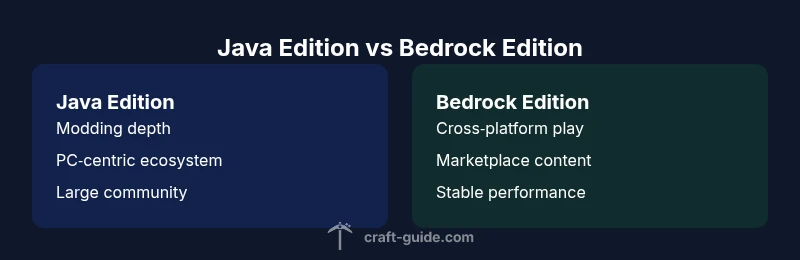
TL;DR: What is better minecraft java or bedrock depends on priorities. Java Edition excels in modding, customization, and a vast community, while Bedrock offers cross‑platform multiplayer and smoother performance across devices. If you prize mods and tinkering, Java is usually better; if cross‑play and consistent performance across platforms matter, Bedrock is typically the smarter choice.
Overview: what is better minecraft java or bedrock?
In the ongoing debate over editions, the central question what is better minecraft java or bedrock shapes how players evaluate their experiences. According to Craft Guide, the best choice hinges on your priorities: modding depth, cross‑platform play, a marketplace, or simply stability across devices. This section lays out the key axes where the two editions diverge, so readers can map their playstyle to the edition that fits best. We’ll compare core systems, content ecosystems, performance patterns, and access to communities. By the end, you’ll have a clear framework to decide which edition aligns with your gaming goals.
Core engine and codebase: why the distinction matters
Minecraft Java Edition runs on a Java-based engine, which offers profound flexibility for modders and a long history of community-driven tools. Bedrock Edition, by contrast, uses a cross‑platform engine designed for consistency across platforms (PC, consoles, and mobile). This fundamental difference underpins mod support, performance, and feature parity. For players who love experimenting with code and bespoke game rules, Java’s ecosystem is unmatched; for those seeking uniform behavior across devices, Bedrock’s engine provides more predictable performance. Craft Guide analysis shows how engine design influences update cadence, feature parity, and optimization opportunities across different hardware.
Performance and graphics realities: what to expect across devices
Performance is highly context-dependent. Java Edition can be more sensitive to the host computer’s hardware, JVM overhead, and memory configuration, which means FPS and stability can vary based on tuning and mods. Bedrock Edition tends to deliver smoother frame pacing on a wider range of devices due to its engine optimization and cross‑platform portability. In practice, players on slower machines or consoles often notice Bedrock’s consistency, while high-end PCs running rich mod packs may prefer Java for control over graphical settings and memory usage. The result is not a single “winner”—it depends on the device and the desired visual fidelity.
Modding, add-ons, and content ecosystems
Java Edition hosts a deep, long‑standing modding ecosystem with tools like Forge and Fabric, enabling dramatic gameplay changes and new content. This is a major draw for players who enjoy tinkering, scripting, and extensive customization. Bedrock uses a Marketplace and Add-ons approach, which offers curated content and easier distribution, but generally restrains the scope of custom mods and requires a different workflow. For modding enthusiasts, Java remains the preferred platform; for players who value ready‑to‑use packs and a stable content catalog, Bedrock’s approach can be more convenient.
World generation and feature parity: seeds, biomes, and updates
World generation is broadly similar in spirit across both editions, but there are nuances in seeds, biome distribution, and feature implementation. Java’s modding community can alter world generation with tools and data packs, while Bedrock emphasizes native behavior and platform‑native optimizations. Seed quality and terrain variety are typically strong in both, but players seeking maximum control over generation parameters may lean Java through mods and experimental packs. Updates often arrive with similar cadence, yet parity on new features can vary by edition in the short term.
Cross‑play, servers, and multiplayer realities
Bedrock Edition is designed for cross‑platform multiplayer, enabling players on Windows, console, and mobile to join the same worlds. Java Edition remains PC‑centric and does not natively support cross‑play with Bedrock. Server communities reflect these realities: Bedrock servers emphasize cross‑platform accessibility, while Java servers focus on customization, plugin ecosystems, and classic multiplayer experiences. If cross‑play is a priority, Bedrock is the clear choice; if you want a robust PC‑centric multiplayer scene, Java still shines.
Controls, accessibility, and platform footprints
Control schemes differ noticeably. Bedrock’s cross‑platform design brings uniform controls across devices, which helps players transition between PC, console, and mobile. Java’s keyboard and mouse focus offers precision for building and combat but can pose a steeper learning curve on non‑PC devices. Platform availability maps differ as well: Java is primarily a PC‑only edition, while Bedrock spans Windows, consoles, and mobile, expanding access. Accessibility features are evolving in both editions, but Bedrock’s broader device support often matters for family or casual players.
Updates, support, and longevity
Both editions receive ongoing updates, but their delivery and parity timelines can diverge. Java benefits from a long‑standing community update cycle and wide mod compatibility, while Bedrock benefits from centralized cross‑platform updates and a curated marketplace that accelerates feature delivery across devices. Across years, the community’s resilience and official support structures remain strong for both editions, with Craft Guide highlighting how longevity is tied to ecosystem vitality and platform strategy.
Deciding framework: how to choose your edition
A practical decision framework helps players pick between Java and Bedrock. Start with platform availability and modding interest: if you crave deep modding, at least some networked play on PC, and a robust PC‑native mod scene, Java is likely the better fit. If you value cross‑play, consistency across devices, and a streamlined content pipeline via the Marketplace, Bedrock is typically the smarter choice. Consider your hardware, how important mods are to you, and whether you play on consoles or mobile. A clean test approach—play for several weeks on each edition if possible—can provide the clearest personal verdict.
Comparison
| Feature | Minecraft Java Edition | Minecraft Bedrock Edition |
|---|---|---|
| Engine and codebase | Java Edition uses a Java-based engine with a long modding history | Bedrock Edition uses a cross‑platform engine designed for consistency across devices |
| Modding and content | Extensive modding with Forge/Fabric, deep customization | Add-ons and Marketplace content; limited traditional modding |
| Cross‑play and multiplayer | PC-only multiplayer, no official cross‑play with Bedrock | Cross‑platform multiplayer across Windows, consoles, and mobile |
| Performance on PC | Highly tunable with mods but varies with JVM and memory setup | Usually smoother on a wider range of devices due to engine optimization |
| World generation and seeds | Mature toolchain for world generation via data packs and mods | Native world generation with cross‑platform consistency |
| Platform availability | PC only (Windows, Linux, macOS) | Windows, Xbox, PlayStation, Nintendo, iOS, Android |
| Content marketplace | Community-driven content; no official marketplace | Official Marketplace with Add-ons and curated packs |
| Update cadence and parity | Updates can bring rapid modding changes; parity depends on mod ecosystem | Faster cross‑platform parity for new features in Bedrock |
Benefits
- Clear decision framework based on priorities (modding vs cross‑play)
- Java edition unlocks deep customization and modding potential
- Bedrock edition provides cross‑platform play and stable performance across devices
- Marketplace and supported content on Bedrock simplify access and sftware updates
Negatives
- Java’s modding environment can be version‑ and mod‑manager dependent
- No cross‑play between Java and Bedrock limits shared worlds
- Bedrock’s modding scope is narrower and content can feel curated
- Performance and visuals can vary by device and edition, making expectations uneven
For players prioritizing modding and PC customization, Java Edition remains the stronger choice; for those who want cross‑platform play and consistent performance across devices, Bedrock Edition is the smarter option.
Java excels in customization and a rich modding community, while Bedrock shines with cross‑platform multiplayer and stable performance. Your best edition depends on whether you value mods over cross‑play—and this guide aims to help you pick accordingly.
People Also Ask
Can Java and Bedrock players play together?
No. Java Edition and Bedrock Edition do not support cross‑play with each other. If you start on one edition, you’ll typically need separate communities and servers for the other edition.
They can’t play together directly—Java and Bedrock operate in separate ecosystems.
Which edition is better for modding?
Java Edition has the most mature modding scene with Forge and Fabric, offering unparalleled customization opportunities. Bedrock supports addons and a curated marketplace but has fewer options for deep, system‑level mods.
Java edges out Bedrock for mods.
Is Bedrock better for performance on consoles?
Bedrock generally provides more consistent performance across platforms, including consoles and mobile, thanks to its unified engine and optimizations.
Bedrock tends to run smoothly on many devices.
What about world generation?
Both editions generate similar core worlds, but seeds, biomes, and cave systems can vary due to engine differences and mod support. Java offers more customization paths for world generation through mods.
Worlds feel similar but can differ based on edition and mods.
How should a new player choose between editions?
Assess your platform, modding interest, and cross‑play needs. If you want PC‑centric modding, choose Java; if you want cross‑play and broad device support, choose Bedrock.
Think about your devices and whether mods or cross‑play matter more.
Is modding still possible on Bedrock?
Bedrock uses addons and the Marketplace, which offer curated content but restrict traditional modding compared to Java.
Bedrock focuses on addons and marketplace content.
The Essentials
- Choose Java if mods and deep customization are your priority
- Choose Bedrock for cross‑platform play and consistent performance
- Expect different mod ecosystems and content pipelines between editions
- Cross‑play is not available between Java and Bedrock; pick one path to avoid friction