Minecraft Java vs Bedrock: Edition Showdown
In-depth comparison of Minecraft Java and Bedrock Editions, focusing on performance, modding, cross-platform play, updates, and content access. A practical, analytics-driven guide by Craft Guide.


Minecraft Java Edition and Bedrock Edition offer distinct playstyles and ecosystems. The best pick depends on your goals: modding freedom and PC-centric play vs cross-platform multiplayer and broad device support. This quick comparison helps you decide which edition matches your hardware, social circle, and preferred gameplay approach for your playstyle.
Understanding the two editions
Minecraft Java Edition and Bedrock Edition share the same core game but diverge in codebases, performance philosophies, modding ecosystems, and how players access content. This section explains the fundamental differences, including how each edition handles worlds, commands, and social ecosystems. According to Craft Guide, the Java edition emphasizes customization, wide-mod support, and a PC-centric experience, while Bedrock prioritizes cross-platform play, smoother performance on a range of devices, and a streamlined content store.
In practical terms, if you primarily game on a high-end PC and enjoy tinkering with mods and server setups, Java is usually the natural fit. If you prefer playing with friends across consoles or mobile and want consistent performance across different hardware, Bedrock is often the better starting point. The distinction matters not only for gameplay but also for the modding surface, community resources, and update cadence. The next sections compare these choices along concrete criteria to help you decide whether minecraft java vs bedrock is the right pick for you.
Update cadence and feature parity
Both Java and Bedrock editions receive updates, but cadence and parity vary. Java often leads with new mechanics first in mod-friendly cycles, while Bedrock tends to align updates with a broader cross‑platform audience. This difference affects how quickly players see new biomes, blocks, and gameplay tweaks in practice. Craft Guide analysis shows that while feature parity improves over time, timing and availability can differ between editions, so your choice may hinge on which edition you want to be current with first.
Modding, customization, and tooling
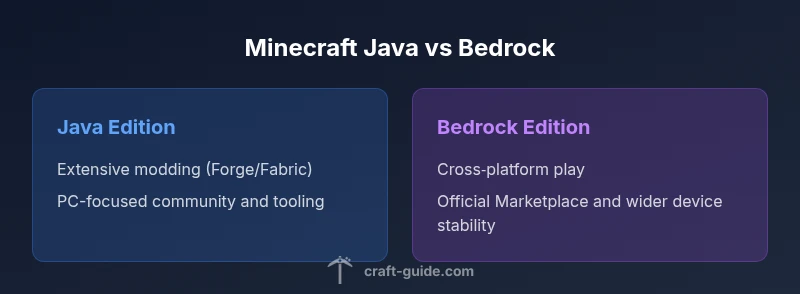
Java Edition remains the pinnacle for customization. The open JVM architecture and robust modding APIs (Forge, Fabric) empower players to alter gameplay, add new tech trees, and create wholly new experiences. Bedrock, by contrast, emphasizes stability and a curated ecosystem; modding exists mostly through addons and community packs, with an official content storefront that favors paid packs. This difference defines how you approach world-building, automation, and redstone complexity in each edition.
Cross‑play, servers, and multiplayer ecosystems
Cross‑play is a core differentiator. Bedrock offers native cross‑platform play across Windows, consoles, and mobile, along with official Realms and a growing set of cross‑device servers. Java offers a vibrant, sprawling multiplayer scene but remains mostly platform‑specific to PC ecosystems; community servers and launchers define the experience rather than a unified store. If your group spans devices, Bedrock is typically the smoother choice for multiplayer.
Performance, hardware considerations, and device classes
Bedrock’s engine is optimized for a broader spectrum of hardware and runs well on lower-end devices, phones, and consoles. Java can push higher frame rates on a capable PC, especially with well-optimized mod packs but demands more RAM and careful resource management. For players with limited hardware or planning to play on laptops and tablets, Bedrock often provides a more consistent baseline experience.
Content access, marketplaces, and monetization
Content access diverges here: Java relies on community-created mods, resource packs, and standalone launchers. Bedrock offers an official Marketplace with paid add-ons and texture packs, simplifying procurement but sometimes limiting free alternatives. This distinction matters for players who value ease of access versus freedom to customize at no cost.
Decision flow: a practical guide to choosing
To pick the right edition, map your priorities directly: Modding and desktop power? Choose Java. Cross‑platform play and broad hardware support? Choose Bedrock. Consider your existing hardware, your friends’ devices, and whether you value free mods or curated Marketplace content. A practical next step is to test both editions in a small, controlled session with friends to experience performance, modding options, and cross‑play behavior firsthand.
Comparison
| Feature | Minecraft Java Edition | Minecraft Bedrock Edition |
|---|---|---|
| Platform availability | Windows, macOS, Linux | Windows 10/11, Xbox, PlayStation, Nintendo Switch, Mobile |
| Performance on hardware | CPU-intensive with heavy mod packs; best on capable PCs | Optimized engine; smooth on diverse devices including lower-end hardware |
| Modding and customization | Extensive modding via Forge/Fabric; JVM tooling and scripting | Limited mods; Marketplace content; cross-platform addons |
| Cross-play & servers | Primarily Java ecosystem; community servers | Native cross-platform play; official Realms and Bedrock servers |
| Content access/marketplace | Community content; no official storefront | Official Marketplace; paid addons and packs |
| World generation parity | World gen features and blocks may differ by edition | Parallels exist but some tweaks show up earlier in one edition |
Benefits
- Java Edition offers unmatched modding freedom and a vast community
- Bedrock Edition provides cross‑platform play and strong performance on lower-end devices
- Updates and features arrive regularly for both editions, with edition-specific parity improving over time
Negatives
- Modding on Bedrock is limited compared with Java; reliance on addons
- Java can demand more RAM and robust hardware for large mod packs
- Bedrock's Marketplace content can require purchases and ecosystem fragmentation
Java Edition is best for modders and PC power users; Bedrock suits cross-platform play and broad device support
Choose Java for customization and modding depth. Choose Bedrock for cross-platform play and consistent performance across devices; your choice should align with your social playgroup and hardware.
People Also Ask
What is the main difference between Minecraft Java and Bedrock editions?
The Java Edition runs on PCs with a JVM and offers extensive modding. Bedrock is a cross‑platform engine optimized for consoles, mobile, and PC, with a curated marketplace.
Java is the PC-focused edition with mods; Bedrock is cross‑platform and optimized for many devices.
Can you play Java and Bedrock together?
No, they run on separate codebases. Bedrock supports cross‑platform play across devices, while Java does not natively cross‑play with Bedrock.
Bedrock supports cross‑device play; Java cannot cross‑play with Bedrock.
Which edition has better performance?
Bedrock generally runs smoother on a wider range of hardware due to its optimized engine. Java can outperform on high-end PCs with minimal modding, but demands more RAM and robust hardware.
Bedrock is typically smoother on more devices; Java can be faster on strong PCs without mods.
Is the Marketplace exclusive to Bedrock?
Yes, Bedrock includes an Official Marketplace with paid add-ons. Java relies on community mods and free texture/resource packs.
Bedrock's Marketplace is official and paid; Java uses community mods.
How often do updates occur in each edition?
Both editions receive regular updates, but timing and content parity vary. Java leads with new mechanics often first in modding cycles, while Bedrock aligns more with cross‑platform features.
Updates come on both, with different timing; Java may lead in new mechanics, Bedrock in cross‑platform features.
Do seeds generate identically across editions?
Seeds can produce similar-looking worlds, but terrain and biome generation can differ between Java and Bedrock, so results may vary.
Seeds aren't identical across editions; expect variations.
The Essentials
- Prioritize mods and PC power? Choose Java Edition.
- Cross-platform play and broad device support? Choose Bedrock Edition.
- Asset availability differ: free community content vs. paid Marketplace content.
- Plan hardware and device mix before deciding to minimize friction.