How to Build a Medieval Minecraft Village
Learn to plan, design, and build a cohesive medieval minecraft village with authentic materials, period-inspired structures, and functional layouts. This guide covers planning, layouts, building styles, key structures, infrastructure, lighting, and expansion ideas for a thriving settlement.


You will learn how to plan, design, and build a cohesive medieval minecraft village, with authentic materials, defensive elements, and thriving town life. Start from a clear theme and scale, define districts (homes, farms, market, church), and use a simple color palette of stone, wood, and earth tones. You’ll learn layout, building styles, and practical crowd management for a lively settlement.
Planning Your medieval minecraft village
Before placing a block, outline the story you want your village to tell. Decide on a time period (late medieval, early renaissance) and a core theme (stone-arched towns, timber-framed houses, farmland outskirts). The medieval minecraft village concept guides every choice from palette to road placement. Create a rough map that shows where farms, houses, trade posts, and defensive features will sit relative to the terrain. Consider the landscape: gentle hills, rivers, and resource nodes shape placement. A strong plan saves time and keeps features cohesive as you expand. Start with a compact core and radiate roads outward to villages and outbuildings. Remember: consistency in materials, color, and form creates believable architecture.
Core design principles
Authenticity matters. Limit your palette to stone, wood, earth tones, and period-appropriate textures to make buildings feel aged and lived-in. Aim for human-scale proportions—doors, windows, and rooflines should be comfortable to traverse and visually balanced. Design defensibility into the layout with a simple perimeter, watchtowers, and choke points where mobs could be contained. Balance practicality with beauty by planning wells, farms, and markets that integrate with traffic flow. Finally, consider the narrative: every building should hint at its role in village life, whether it’s a smithy or a tavern.
Layout and district zoning
Plan a central plaza or market square as the village’s heart, with radiating streets leading to housing clusters, a church or chapel, and a town hall. Separate functional districts—farmland on the outskirts, trade posts near the market, craftsman rows between the square and walls. Use interlacing paths that feel organic rather than perfectly grid-like to mimic historic growth. Elevation differences add depth: place taller structures on higher ground and taller towers at key corners. Map out water sources and arable land early to ensure future expansion remains coherent.
Building styles and materials
Choose a cohesive material palette first—stone or cobblestone walls with timber framing and plaster infill looks authentic, while terracotta accents can signify wealth or guild signs. Roofs use wooden shingles or dark stairs to suggest weight and age. Windows should be narrow and framed, with lattice ledges or shutters for character. Enrich textures with mossy cobble, cracked bricks, and garden walls. Use variation in beam thickness, doorway shapes, and balcony placements to make each house unique while preserving the medieval vibe.
Key structures in a medieval village
A thriving village isn’t just houses; it needs institutions. Include a town hall or guild house, a blacksmith, a chapel or church with a bell tower, and an inn or market hall. A granary or storage warehouse controls food flow, while houses house villagers and travelers. Small details matter: signs, banners, and cloth awnings give personality. For realism, vary the scale: large public buildings contrast with compact homes. Place a central well or water trough to serve as a practical focal point.
Infrastructure and daily life
Roads should be compact and well-trodden; use cobblestone borders and dirt paths to show wear. Add functional farms nearby with organized fields, crop rows, and animal pens. Include a water source: a well or pond with a simple fence to keep mobs out. Lighting is essential: lanterns on posts, torches at corners, and glowstone accents inside larger interiors reduce hostile spawns. Public spaces like a market or tavern invite social activity, while storage huts and trading posts support daily life. Keep accessibility high for villagers to move between buildings.
Preservation, lighting, and safety
Lighting dramatically reduces mob spawns, especially along walkways and inside houses. Use a layered lighting approach—low-level ground lighting near paths and brighter interior lighting for buildings. Defensive features such as low walls, arrow slits, and watchtowers deter raiders. Period-accurate banners, shutters, and iron doors give a sense of security without over-modernizing. Regularly revisit layouts to ensure new builds match the village’s aesthetic and do not disrupt the overall flow.
Extending your village with modular expansions
Plan for growth by designing modular blocks—new houses, a larger marketplace, or a chapel complex—that can be added later without reworking existing streets. Use consistent modules: a 5x5 or 6x6 footprint for homes, with shared roofs and similar timber details. Theme each module around a district function (residential, religious, crafts) to maintain narrative cohesion. Keep a running list of material requirements and a repeatable texture palette to ensure future expansions blend with the original village.
Tools & Materials
- Stone bricks(Main walls, accents, and pavements.)
- Cobblestone blocks(Foundations, roads, and lower walls.)
- Oak logs(Framing, beams, and texture.)
- Oak planks(Building walls and floors.)
- Stairs (stone brick)(Create access between levels.)
- Fences and fence gates(Define fields and safe yards.)
- Torches or lanterns(Lighting to prevent mob spawns.)
- Hay bales(Suggest fields and market vibe.)
- Doors (wooden or iron)(House entrances and security.)
- Glass panes(Windows for aerial light and detail.)
- Wool (for banners/trim)(Decorative accents.)
- Trapdoors / shutters(Exterior detailing for houses.)
Steps
Estimated time: 6-9 hours
- 1
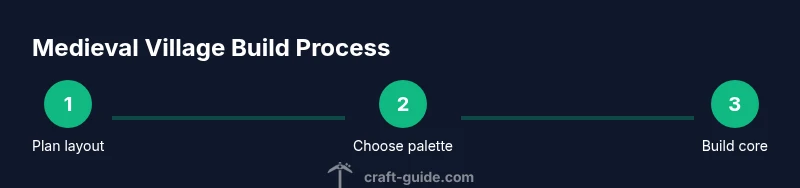
Plan the village layout
Draft a rough map showing the central plaza, key buildings, and the road network. Mark water sources, farming areas, and defenses. Validate that paths connect important sites with reasonable walking distances.
Tip: Start with a 5x5 core block for the plaza to anchor the design. - 2
Gather resources and establish palette
Collect your stone, wood, and terracotta options. Decide on a limited color palette to keep the village cohesive across builds. Create a small resource depot near the plaza for convenience.
Tip: Use mossy accents sparingly to imply age without clutter. - 3
Build the central plaza and town hall
Construct a focal public space with a clear center, perhaps a well or fountain. Add a modest town hall nearby with a timber frame and stone base to set the medieval tone.
Tip: Keep the plaza open to invite NPC villagers and players. - 4
Erect perimeter walls and towers
Lay a low defensive wall around the core village and add one or two watchtowers at strategic angles. Use a mix of cobblestone and stone bricks for texture.
Tip: Position towers to overlook roads and field edges. - 5
Construct starter houses
Build a row of timber-framed houses with plaster infill and steep roofs. Add a shop or inn at a corner to signal activity.
Tip: Vary door and window sizes to create variety within cohesion. - 6
Add key structures
Place a blacksmith, chapel, and granary in distinct corners of the village to anchor districts. Include period-appropriate signage and banners.
Tip: Keep entrances facing the plaza for social flow. - 7
Lay roads and infrastructure
Create cobblestone roads with dirt paths cutting through residential blocks. Install wells, fences, and farms outside the walls to reflect rural life.
Tip: Use slight elevation changes to avoid flat monotony. - 8
Lighting, population, and refinement
Add lanterns at key intersections and doorways. Populate houses with villagers or decorative NPCs and refine textures for a lived-in feel.
Tip: Iterate quickly; small changes can significantly improve realism.
People Also Ask
What materials best fit a medieval Minecraft village?
Stick to stone, wood, and earth tones for walls, roofs, and accents. Limited textures help the village feel historically coherent while allowing for visual variety through detailing like banners and shutters.
Use stone and wood as your main palette to keep a medieval feel. Add banners for color variety without breaking the look.
How can I protect villagers in a village?
Position a defensive outer wall and watchtowers, and illuminate roads and living spaces. Place doors and fences to control access, and design entry points that traders and villagers can navigate safely.
Defensible walls with good lighting keep villagers safe and mobs out.
How do I design a medieval village layout?
Start with a central plaza, define districts, and route streets organically. Use elevation to create focal points and connect important buildings. Keep a consistent palette to ensure unity across the village.
Begin with a strong center and grow outward with purpose.
What size should I start with for a village?
Begin with a core of 8–12 houses around public buildings, then expand as you add farms and additional structures. This manages scale while maintaining a believable medieval feel.
Start small and grow as needed to maintain style.
What are the best lighting strategies?
Layer lighting by placing lanterns on posts along streets and brighter interior lights. Avoid uniformly bright spaces; shadows add depth and authenticity.
Light streets and interiors to keep mobs away and mood right.
How do I seed and map for a medieval village?
Use terrain with gentle slopes and access to water and farmland. Map out the plaza first, then drop key buildings on the grid and adjust as you explore the land.
Choose land with natural features to drive layout decisions.
Watch Video
The Essentials
- Plan before placing blocks to guide growth.
- Maintain a cohesive material palette for realism.
- Anchor the village with a central plaza and public buildings.
- Light strategically to deter mobs while preserving atmosphere.