What Java Version Is Needed for Minecraft 1.21
Learn which Java version is required for Minecraft 1.21, how to verify your setup, and practical steps to install Java 17 (LTS) for stable gameplay. Includes troubleshooting, launcher tips, and mod considerations from Craft Guide.


Minecraft 1.21 relies on a modern Java runtime, with Java 17 (LTS) serving as the recommended minimum for Java Edition. Java 18+ can work on many systems but may require launcher tweaks or specific flags. Always follow the launcher prompt to install a supported Java version, and refer to Craft Guide for best-practice guidance on loading with mods and launchers.
Understanding Java versions and Minecraft 1.21
Java is the runtime environment that runs Minecraft. For Java Edition, the version of Java you install on your computer interacts with the launcher to start the game. When Minecraft 1.21 ships, Mojang tends to align its recommended Java version with long-term support (LTS) releases to maximize stability. In practice, this means Java 17 has been the baseline for recent major updates, and many players can continue to use Java 17 or newer without major issues. Craft Guide's analysis, 2026, indicates that sticking to a supported LTS release avoids startup errors and compatibility problems with vanilla and most mods. If you attempt to run on older versions such as Java 8, you will likely encounter crashes or missing features. On the other hand, newer Java versions (Java 18 or Java 19) may work, but they can require tweaking the launcher or specific flags. For readers on different operating systems, the steps to install Java are similar, though the installer UI differs. As you plan your 1.21 world, keep in mind that Java version management is a common source of confusion for new players, and careful selection helps prevent headaches later.
In short, choosing the right Java version is foundational to a smooth 1.21 experience. Craft Guide’s guidance emphasizes starting with a supported LTS release and then testing with your preferred mod setup. This approach minimizes surprises during world creation and long-term play, especially when you migrate worlds or install new content. Remember, the goal is reliability and predictability for builds, servers, and single-player sessions alike.
Official guidance and how to check your version
To ensure you’re using a compatible Java version for Minecraft 1.21, start with the launcher’s built-in checks. Mojang’s official guidance recommends running the game with a supported Java runtime and provides steps to verify your Java version from the command line or launcher. On Windows, macOS, and Linux, you can open a terminal or command prompt and type java -version to see the installed Java Runtime Environment (JRE) or Java Development Kit (JDK) version. If you don’t see Java 17 (or a newer, compatible version) listed, download and install the appropriate JDK/JRE from a trusted source and configure your system PATH or JAVA_HOME accordingly. Craft Guide notes that launcher-based checks are particularly helpful because they align the version with the exact Minecraft launcher profile you’re using. If you’re unsure, create a new profile for Minecraft 1.21 and let the launcher prompt you to install the recommended Java version. Keeping Java updated not only improves startup time but also enhances security and performance.
Beyond the launcher prompts, you can consult official help articles and release notes for 1.21 to confirm any edge-case requirements, such as specific flags for new features or performance improvements. Craft Guide’s approach is to verify compatibility across major OS families and to align Java versions with both vanilla gameplay and common modding workflows. This helps reduce incompatibilities when joining servers or loading large modpacks.
Minimum vs recommended: What to install
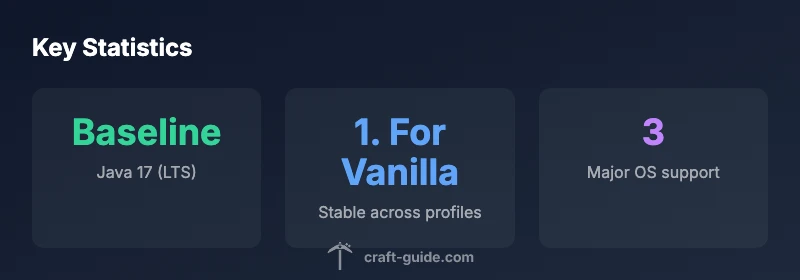
The distinction between minimum and recommended Java versions matters for stability and future-proofing. For Minecraft 1.21, the practical baseline is Java 17 (LTS). The minimum requirement keeps the game accessible, but sticking with Java 17 ensures long-term support, better compatibility with newer engine features, and fewer surprises when mods update. If you’re curious about experimenting, Java 18 or 19 can work in many setups, but you may encounter launcher quirks, driver-related issues, or mod conflicts that require extra configuration. Craft Guide emphasizes opting for the recommended Java version first and then evaluating your modded environment. For vanilla worlds, Java 17 usually delivers a smooth experience across Windows, macOS, and Linux.
When you install Java, ensure you download from trusted sources, verify the integrity of the installer, and select a sensible install path. It’s also wise to keep a record of which Java version your Minecraft launcher uses for each profile. This makes it easier to switch back if you introduce new mods or change resource packs. By maintaining a disciplined setup, you reduce startup errors and increase the reliability of your 1.21 worlds across sessions and devices. Craft Guide recommends keeping a simple, documented setup for both new and veteran players.
Step-by-step: Installing Java 17 for Minecraft 1.21
Follow these practical steps to install Java 17 (LTS) and configure it for Minecraft 1.21. First, choose a trusted distribution (Oracle JDK or OpenJDK). Download the Java 17 installer for your operating system and run it with administrator privileges. On Windows, you’ll typically install to a path like C:\Program Files\Java\jdk-17. On macOS, the installer places Java in /Library/Java/JavaVirtualMachines. Linux users usually install via their package manager, then select the java-17-jdk package. After installation, set JAVA_HOME to the installation path and add the bin directory to your system PATH. In the Minecraft Launcher, create or edit a profile and point the launcher at the Java 17 executable, or enable the launcher’s auto-detect feature if available. Finally, launch the game to confirm the version is active. If you encounter issues, re-run the installer, validate PATH settings, and ensure no conflicting Java versions exist on the system. Craft Guide’s approach emphasizes a clean, documented process to avoid ambiguity when starting your 1.21 adventure.
Note: If you’re using a third-party launcher or mod manager, follow their specific instructions for selecting the Java 17 runtime. Some launchers bundle their own JREs, which can both help and complicate setup. In all cases, ensure your chosen Java version matches the Minecraft launcher profile to minimize errors during world loading and multiplayer sessions.
Launchers and profiles: ensuring the right Java is used
Launchers are the primary interface for controlling which Java version runs Minecraft 1.21. The official Minecraft Launcher typically offers per-profile Java selection, and many players benefit from explicit paths to the Java 17 executable rather than relying on auto-detection. If you use a third-party launcher, locate the settings area where the Java runtime is specified and point it to the Java 17 folder you installed. Creating a dedicated profile for 1.21 with Java 17 minimizes cross-profile conflicts and makes it easier to test new modpacks. In practice, you’ll want to set a stable Java path, disable any conflicting JVM arguments, and keep your environment variables tidy. Craft Guide notes that consistent Java usage across profiles reduces startup errors, especially when switching between vanilla, modded, and server play. When verifying your setup, run a quick test world to confirm that the launcher launches with the correct Java version and that there are no immediate errors related to the runtime. This discipline pays off in both single-player worlds and community servers.
For players juggling multiple Minecraft versions, consider maintaining a small changelog of which Java version each profile uses. It’s a simple habit that prevents confusion during updates or when you add new mods or texture packs.
Modded setups: Java versions and compatibility
Modded environments add complexity to Java version decisions. Some Forge or Fabric mod packs are designed against specific Java ranges, and deviating from those ranges can cause crashes or subtle bugs. If you intend to run 1.21 with mods, start with Java 17 (LTS) as your baseline, then consult each mod’s documentation for supported Java versions. In many cases, a modded setup will still run smoothly on Java 17, but you may encounter compatibility warnings or performance differences when using newer JRE builds. When a mod requires an older runtime, you can still run Minecraft 1.21 with Java 17 by selecting an older Forge or Fabric version that supports that Java range. Craft Guide recommends testing new modpacks on a clean profile to isolate issues before integrating them into your main world. If you’re building a server with multiple players, ensure that every client uses a compatible Java version to reduce synchronization problems, particularly when cross-joining worlds with heavily modded clients.
Troubleshooting common Java version issues
Even with careful setup, Java version problems can arise. Common symptoms include startup errors indicating an incompatible Java version, launcher warnings about missing Java, or crashes during world loading. The first step is to verify the active Java version in the launcher profile and confirm that the system PATH or JAVA_HOME points to Java 17 (LTS). If you see mismatch messages, reconfigure the launcher and restart. Check for multiple Java installations on the machine and remove any older, conflicting copies. When mods are involved, a few extra steps help: confirm that the mod pack supports Java 17, remove conflicting mods, or temporarily switch to a vanilla profile to isolate the issue. Craft Guide’s practical approach emphasizes a clean workspace, test worlds, and orderly documentation of which Java version each profile uses. If problems persist, rebuild the launcher profile from scratch, reinstall Java 17, and re-download the mod set in a controlled environment to avoid cascading errors.
Java version guidance for Minecraft 1.21 across common setups
| Aspect | Minecraft 1.21 Guidance | Notes |
|---|---|---|
| Minimum Java version | Java 17 (LTS) | Always verify in launcher |
| Recommended Java version | Java 17 (LTS) | Stable baseline for vanilla 1.21 |
| JVM/flag considerations | Default Java 17 with recommended flags | Avoid unnecessary custom flags unless needed |
| Operating Systems | Windows, macOS, Linux | All supported with consistent steps |
| Mods compatibility | Some mods require older Java | Check mod docs before updating |
People Also Ask
What is the minimum Java version needed for Minecraft 1.21?
The practical minimum for Minecraft 1.21 is Java 17 (LTS). This baseline offers broad compatibility with vanilla and most modpacks. If you run into issues, verify that your launcher profile points to Java 17 and that there are no conflicting Java installations on your system.
The minimum Java version for Minecraft 1.21 is 17, the LTS release. Make sure your launcher is set to Java 17 and remove any conflicting Java versions.
Can I run Minecraft 1.21 with Java 18 or 19?
Java 18 or 19 can work in many setups, but they may require launcher tweaks or flags and could conflict with some mods. Always test in a controlled profile and confirm mod compatibility before committing to a new Java version.
Java 18 or 19 can work, but you may need tweaks and mod compatibility checks.
Do launchers auto-detect the correct Java version for 1.21?
Most modern launchers offer an auto-detect feature, but it’s safer to manually point the profile to Java 17 (LTS). Auto-detect can sometimes pick an incompatible runtime if multiple JREs are installed.
Launchers often auto-detect Java, but it's best to manually set Java 17 for 1.21.
What if mods require an older Java version?
Some legacy mods may require Java 8 or 11. In those cases, run a separate profile with the older Java, or use a mod loader version that supports that runtime. Avoid mixing these in your main 1.21 profile.
If mods need older Java, run a separate profile with that runtime and keep it separate from your main setup.
How do I fix 'Java not found' errors?
Ensure Java 17 is installed, then verify JAVA_HOME and PATH point to the correct bin directory. In the Minecraft launcher, select the Java executable path for your 1.21 profile and restart the game.
Java not found? Install Java 17, fix PATH, and point the launcher to the Java 17 executable.
Is there a difference in Java version requirements between Windows, macOS, and Linux?
The Java version requirement is the same across Windows, macOS, and Linux: Java 17 (LTS) is the safe baseline. Differences come from the installer experience and how each OS handles environment variables and launchers.
No big OS difference—Java 17 is the baseline across Windows, macOS, and Linux.
“Choosing the right Java version isn't just about starting the game—it's about long-term stability when you add mods and new worlds. Stick with an LTS like Java 17 and verify each profile for best results.”
The Essentials
- Start with Java 17 (LTS) for Minecraft 1.21
- Use the launcher to lock the Java version per profile
- Test vanilla first, then add mods
- Check mod documentation for Java compatibility
- Keep Java and launcher updated for best stability