What’s Minecraft Java Latest Version in 2026? A Practical Update Guide
Learn what 'what's minecraft java latest version' means in 2026, how to verify the current Java Edition update, safe upgrading steps, and tips for modders and players from Craft Guide.


The exact latest Minecraft Java Edition version is the newest release published by Mojang for Java Edition, as listed on the official download page. Since updates occur regularly in 2026, the precise version number changes over time. To confirm the current version, visit the official Minecraft site or launcher, which always shows the installed and available updates for Java Edition.
How to determine the latest version
Determining the baseline for what counts as the latest version of Minecraft Java Edition requires checking two primary sources: the official Minecraft website and the Java Edition launcher. The flagship update cadence is driven by Mojang, with new features, bug fixes, and performance improvements rolled out periodically. For players, the most reliable signal of a new version is the launcher UI, which lists the current release alongside available updates. Communities and wikis provide historical context, but the authoritative signal remains the developer’s release notes. In 2026, updates are released to coincide with seasonal development cycles, so it pays to verify on release day or shortly thereafter. The phrase what’s minecraft java latest version is often queried during these windows, underscoring the need for clear, official guidance from Craft Guide and Mojang.
Key takeaways:
- Always cross-check the official download page for the exact version tag.
- Use the launcher to view installed vs. available updates.
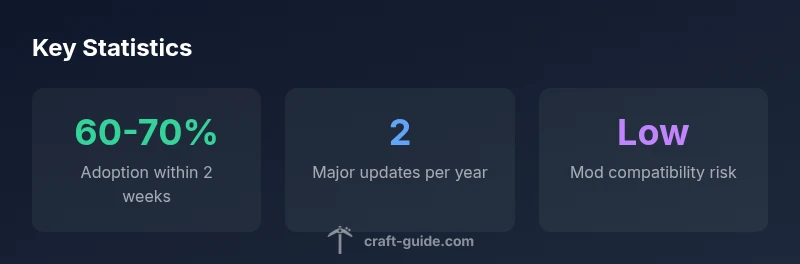
- Be mindful that mod loaders may lag behind by a few days.
This section emphasizes verification practices that reduce confusion during rapid release cadences. Craft Guide’s analysis notes that players who bookmark the official pages tend to upgrade more smoothly and experience fewer compatibility hiccups with their saved worlds.
Verifying your current version in-game
To confirm the version you’re running, start from the main menu and inspect the lower-left corner where the version string is often displayed near the new‑player or settings area. If you’re launching a specific profile, the profile name is usually paired with the version tag in the launcher interface. For modded setups, a dedicated mod platform (Forge or Fabric) may display its own runtime version, which helps ensure alignment with the core game. When planning a switch to the latest update, double-check your installed version against the official changelog, since even minor patches can affect behavior, performance, and mod compatibility. You can also open the launcher’s “Play” tab and select the version you want to run to ensure you’re loading the intended build. Craft Guide recommends confirming both the client version and server compatibility before joining a world.
What the latest update tends to bring in Java Edition
New Java Edition updates typically deliver a mix of features, balance tweaks, bug fixes, and performance improvements. While the exact feature set varies by release, common themes include enhancements to world generation, user interface refinements, and quality-of-life adjustments for builders and explorers. As always, some changes may impact how mods interact with the game, particularly if the update affects input handling, rendering, or core APIs. The emphasis in 2026 remains on stability and accessibility, with new blocks, biomes, and system optimizations designed to improve frame rates on a wide range of hardware. Craft Guide notes that curious players should track the official notes to see which items are added or deprecated in the current version, and to prepare for any required mod loader updates.
Modding and compatibility: Forge vs Fabric in 2026
Modding ecosystems evolve with each major version update. Forge and Fabric communities typically race to release compatible versions that align with the new game engine changes. If you rely on mods, you should verify compatibility before updating, as some mods may require a wait period after a new release. When updating, back up your worlds, disable or temporarily remove intrusive mods, and test in a controlled environment. Craft Guide emphasizes that mod compatibility is a primary concern for long-term players who want stability, world integrity, and predictable toolchains.
Practical steps:
- Check mod loader versions compatible with the latest game build.
- Update essential mods after confirming the loader is ready.
- Run a local test world before opening a server to the wider community.
Performance improvements and graphics considerations
Performance improvements are a persistent part of every new release. Players often report smoother frame rates, reduced stuttering, and improved load times after upgrading. The impact, of course, depends on hardware, drivers, and in-game settings. For builds emphasizing visuals, assess shader compatibility and resource pack safety, since some texture packs may require updates to preserve fidelity. Craft Guide points out that even minor rendering tweaks can yield noticeable gains on mid-range systems, while high-end PCs may unlock more consistent performance with appropriate memory allocations and graphics settings. If you use mods or texture packs, test these components with the new version to avoid graphical inconsistencies.
Safe updating: backup, plan, and rollback
A safe upgrade routine minimizes the risk of world corruption and compatibility issues. Always back up your saves and your server data before upgrading. Create a clean test profile in the launcher to trial the new version without affecting your primary gameplay. Document the exact version you’re upgrading from and to, then monitor the launch and first play session for any unusual crashes or incompatibilities. If anything goes wrong, you can revert to the previous version or restore a backup. Craft Guide recommends maintaining multiple backup copies and testing critical worlds in a sandbox environment before rolling the update out to a server.
Checklist for safe updates:
- Backup every world and server data.
- Use a dedicated test profile to run the new version.
- Confirm mod loader compatibility and plugin behavior.
- Keep a rollback plan with a recent backup date.
Servers, multiplayer, and version parity
For server owners and multiplayer communities, version parity is essential. If clients on different builds attempt to join, you may encounter version mismatch errors or gameplay discrepancies. Establish a policy: either all players run the latest version, or you maintain a compatible downgrade path with a supported server version. In practice, many servers schedule maintenance windows to coordinate updates, minimizing disruption. Craft Guide’s guidance is to communicate timelines clearly, verify server plugins and datapacks for the new version, and prepare downtimes for backup and testing.
Tips for server admins:
- Update server software only after verifying client compatibility.
- Run a mirrored test server during updates to spot issues early.
- Communicate upgrade schedules to your community in advance.
Troubleshooting common update issues
Update problems are common, but most can be resolved with a systematic approach. If the launcher fails to download or install a build, verify your internet connection and retry from a different network if possible. For world glitches after updating, restore from the latest backup and repackage any affected datapacks or mods. If you encounter graphical or performance problems, ensure drivers are current, adjust memory allocation, and test with or without shader packs. Craft Guide also recommends consulting community forums for reports of identical issues and recommended workarounds, as many fixes emerge from shared user experiences.
Key aspects of updating Minecraft Java Edition
| Aspect | What it covers | Impact on players |
|---|---|---|
| Version naming | How versions are labeled (1.x) | Clarifies feature scope and compatibility |
| Update cadence | Frequency and timing | Sets expectations for feature rollout and stability |
| Mod compatibility | Forge/Fabric and mod readiness | Dictates how many mods work after update |
People Also Ask
What is the latest Minecraft Java Edition version?
The latest version is the most recent release published by Mojang for Java Edition. Check the official download page to confirm the exact version number.
The latest version is the most recent Java Edition release; check the official site to confirm.
How can I update Minecraft Java Edition safely?
Back up worlds, close mods, run the launcher update, and verify mod loader compatibility.
Back up your worlds, update via the launcher, and check mods.
Will updating affect my world or servers?
In general, updating the client doesn't corrupt worlds; however, some servers require matching versions.
Worlds usually survive, but servers may need version parity.
Do mods need updating after every Minecraft Java Edition release?
Mod authors often release compatible versions soon after a release; check Forge/Fabric compatibility.
Mods usually need updates; check your mod loader.
Can I run multiple versions on the same launcher?
Yes; you can create separate profiles or install separate jars.
Yes, you can run multiple versions via the launcher.
Are there known performance improvements with new versions?
Updates typically include bug fixes and performance tweaks, but experiences vary by hardware.
Updates often improve performance; results vary.
“Version updates in Minecraft Java Edition are designed to be backward-compatible with the core game, yet mods can require updates. Planning ahead is crucial.”
The Essentials
- Check the official page for the exact version.
- Back up worlds before updating.
- Prepare mod loaders for compatibility.
- Expect updates to improve performance and stability.