What is wrong with Minecraft right now? A Practical Troubleshooting Guide (2026)
Urgent troubleshooting guide for Minecraft issues affecting players in 2026, covering outages, login, server status, and mod compatibility with practical fixes and step-by-step methods.


Most likely, the current issues with Minecraft stem from server outages or launcher/auth hiccups, not your PC. Quick fix: check the official Minecraft status page, verify your network connection, restart the launcher, and try a fresh profile or new installation. If problems persist, monitor for updates and apply any available patches from Craft Guide.
What is wrong with Minecraft right now?
What is wrong with Minecraft right now? The short answer is that players are encountering a mix of service outages, launcher/login hiccups, and performance irregularities rather than a single universal fault. According to Craft Guide, several parallel issues are affecting Java and Bedrock editions in 2026, with different regions experiencing varying symptoms. The consequence is a jumbled sense of instability: some players can load a world but cannot connect to a server, others suffer from frequent disconnects, and a few see crashes during world loading or when mod configs are read. The goal of this guide is to help you quickly isolate your symptom, verify a trio of root causes (status, connectivity, and version), and apply targeted fixes that minimize data loss. Start by acknowledging that issues may be temporary and multi-faceted, then follow the diagnostic flow to determine whether the problem is on your end, with your network, or on the server side.
Keyword integration note: this section embeds the phrase what is wrong with minecraft right now to align with the SEO goal while staying practical for readers.
Quick diagnostics you can run today
If you want a fast read on what is wrong with Minecraft right now, begin with a few baseline checks that cover both client and server sides. First, confirm you have a stable internet connection with low latency, then visit the official status site for Minecraft and Mojang services to see if there is a known outage. Next, try launching Minecraft with a clean profile or a fresh install to determine if the issue is caused by corrupt files or a conflicting mod. Finally, compare your version (Java edition, Bedrock, or cross-play) against the current build recommended by the launcher. This is the core triad: status, connection, and version. If any of these are misaligned, you will likely see the symptoms described in the rest of this guide.
Practical tip: document exact error messages or crash logs to speed up troubleshooting and help support teams.
Core issues impacting players: connectivity, login, realms, and mods
Many of the current problems fall into four buckets: connectivity and latency, login/auth failures, Realms and cross-platform play, and mod/snapshot compatibility. Connectivity and latency issues commonly manifest as rubber-banding, long load times, or partial world data loading. Login failures, including account verification and two-factor prompts, disrupt access but are typically resolved by status checks and launcher resets. Realms outages or cross-play mismatches can prevent friends from joining or syncing progress. Mod and snapshot incompatibilities frequently cause crashes or corrupted saves after an update. Understanding which bucket fits your case helps you pick the right fixes and reduces wasted time. Craft Guide notes that regional server congestion and cache issues can amplify these symptoms, so it pays to test from different networks when possible.
Performance and stability: frames, memory, and packs
Performance issues often show up as reduced frame rates, stuttering, or longer world-generation times. Memory pressure from large texture packs, shader mods, or resource packs can exacerbate problems on lower-end PCs or devices with less available RAM. Ensure your graphics drivers are up to date, keep your game updated to recommended builds, and avoid enabling experimental features while debugging. If you use shaders or high-resolution texture packs, test with their settings dialed down to determine if the issue lies with a particular mod or add-on rather than the core game. Craft Guide recommends balancing visuals with performance and monitoring RAM allocation to avoid swapping to disk, which can cause noticeable lag.
Modding and snapshot compatibility: what’s changing
Modding communities adjust rapidly to updates, and snapshot releases frequently introduce breaking changes. If you’re running Forge, Fabric, or other mod loaders, verify mod versions align with the current game build. Incompatibilities can lead to crashes, missing blocks, or world corruption. When what is wrong with Minecraft right now includes a mod-related symptom, either disable mods temporarily or revert to a clean vanilla profile to confirm the issue. Always back up worlds before testing, and consult the mod author pages for compatibility notes and recommended versions. Snapshot users should be aware that many mods do not immediately support new builds.
How to verify if the issue is on your end vs. server
Distinguishing between client-side and server-side faults speeds up resolution. Start by checking your own network: run a quick ping test, try a wired connection if you’re on Wi-Fi, and perform a traceroute to the server to spot hops causing latency. Check the Minecraft status page for outages and review recent patch notes. If you’re seeing consistent timeouts or login errors, the problem is more likely server-related. If the same symptoms appear on a freshly installed vanilla profile, the issue may be launcher-related or an uncommon compatibility problem with your hardware. In either case, you’ll have a clear path forward once you identify the source.
Immediate fixes you can apply (easy to hard)
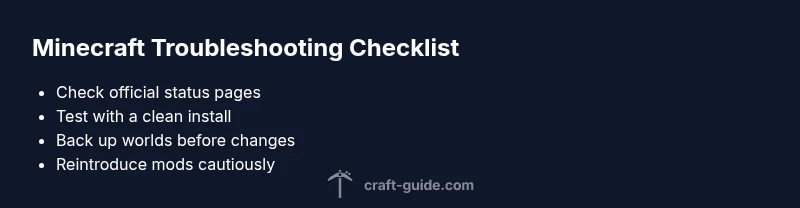
- Check status pages and confirm there’s no known outage affecting your region. 2) Restart the launcher and your router to clear temporary network glitches. 3) Create a fresh profile or a clean install to isolate corrupted files or a misconfigured mod. 4) Update Minecraft to the latest stable build and ensure you’re using supported launcher versions. 5) If you have mods or texture packs, disable them and test vanilla. 6) Reintroduce mods one by one after confirming vanilla runs smoothly. If the problem persists, consider rolling back to a previous backup and monitor official patch notes for a fix.
Safety, backups, and best practices
Always back up your worlds before making major changes. Store backup copies on an external drive or cloud storage to prevent data loss. Use a separate profile for testing changes and avoid running untrusted mods or utilities. Be mindful of storing login credentials and avoid sharing crash dumps publicly; use official support channels when seeking help.
Long-term prevention and monitoring
Set a regular backup schedule for worlds and save files. Keep mod loaders and packs aligned with the latest compatible game version, monitor patch notes, and join community status channels for early warnings. Establish a small testing routine: after every major update, test vanilla first before reintroducing mods. Craft Guide stresses that preparedness and a staged approach reduce downtime and frustration when issues arise.
Steps
Estimated time: 45-60 minutes
- 1
Check status and baseline symptoms
Start by noting the exact error messages and confirming whether Mojang/Minecraft servers report issues for your region. Use a second device on the same network to see if the problem is network-wide or device-specific. This establishes a baseline before you modify settings.
Tip: Document any error codes to speed up support discussions. - 2
Back up worlds and configs
Create a safe backup of your primary worlds and important config files. Store copies externally so you can revert if a test causes issues. Backups protect you during testing of fixes and mod changes.
Tip: Use a dedicated backup tool or copy folders to an independent drive. - 3
Test with a clean vanilla profile
Launch Minecraft with a fresh profile or a clean install. Run the vanilla version to determine if the problem persists without mods or resource packs. If the issue disappears, a mod or pack is likely at fault.
Tip: Avoid copying mods into the test setup to keep it clean. - 4
Verify version and launcher integrity
Ensure you are on the version recommended by the launcher and that the launcher itself is up to date. Reinstall the launcher if necessary to fix corrupted launcher files.
Tip: Check for multiple launcher instances that may be running in parallel. - 5
Check network stability
Run a quick network test: ping tests, traceroute, and compare results across devices if possible. If latency spikes or packet loss occur, work with your network provider or router settings to improve stability.
Tip: Wired connections tend to be more stable than Wi‑Fi for gaming. - 6
Reintroduce mods one by one
If vanilla works, re-add mods gradually and test after each addition. This helps identify the problematic mod or configuration. Keep a log of the mod versions and their compatibility notes.
Tip: Install one mod at a time to isolate issues quickly.
Diagnosis: Players report login failures, world loading timeouts, or gameplay stuttering after latest update.
Possible Causes
- highPlatform/server outage or Mojang service disruption
- mediumWeak or unstable local network connectivity
- lowCorrupted game data, mods or faulty resource packs
Fixes
- easyCheck official status pages and launcher messages
- easyRestart router and test a wired connection
- easyRun a clean install or new profile
- mediumUpdate graphics drivers and allocate RAM conservatively
People Also Ask
What should I do first when Minecraft won't start?
Start by checking the official status pages and launcher messages, then try a safe restart of the launcher and a clean profile. If the problem persists, move to a clean install as a last resort.
First, check server status and restart the launcher, then test with a clean profile. If needed, perform a clean install.
Could my hardware be the cause?
Hardware can influence performance, especially if there’s overheating or insufficient RAM. Check system specs against game requirements and monitor temperatures while playing.
Hardware can be a factor if you’re overheating or running out of memory. Check specs and temps.
Are Minecraft Realms down right now?
Realms outages can occur due to server-side issues. Check the official status pages and Realm forums for real-time updates and possible workarounds.
Realms outages happen from time to time. Check status pages and Realm forums for updates.
Do mods or snapshots cause crashes after updates?
Yes, incompatible mods or outdated snapshots often crash. Remove or update mods to match the current game version, and test with vanilla to confirm.
Mods can cause crashes if they aren’t compatible. Update or remove them and test vanilla.
How long do outages usually last?
Outage duration varies. Monitor status pages and patch notes for estimated timelines and fixes from the developers.
Outages vary; watch official status pages for timelines.
Where can I report issues and get help?
Use official forums, bug trackers, or Craft Guide troubleshooting pages and include crash logs or error messages to help diagnose faster.
Report issues on official pages and include logs to help diagnose.
Watch Video
The Essentials
- Check status pages first to confirm an outage.
- Back up worlds before applying fixes or mods.
- Test with a vanilla profile to isolate issues.
- Match mods and snapshots to the current game version.
- Stay updated with Craft Guide for patched guidance.