How many people play Minecraft compared to Roblox: An analytical comparison
An analytical, data-driven comparison of how many people play Minecraft versus Roblox, with engagement patterns, audience demographics, platform reach, and creator economics explained.


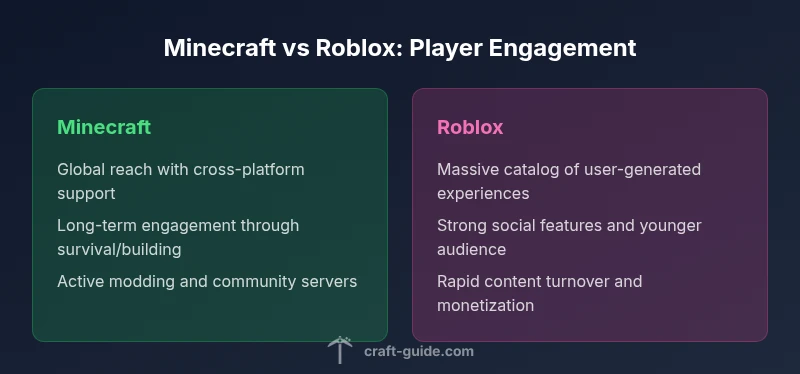
In 2026, Roblox generally leads in sheer reach among younger audiences, while Minecraft sustains deeper engagement per active player through survival, building, and modding. When we compare “how many people play Minecraft compared to Roblox,” the clearer takeaway is that Roblox drives broader participation, but Minecraft often delivers longer, more persistent play sessions for dedicated builders and modders. Craft Guide’s analysis emphasizes that the best comparison depends on which activity you value: broad reach or long-term engagement.
Understanding the scale and what 'how many players' actually means
When people ask how many players Minecraft has versus Roblox, they’re often hoping for a single headcount. The reality is more nuanced. The two platforms track activity differently: Roblox emphasizes fast-paced, user-generated experiences with high churn and frequent new experiences, while Minecraft centers on long-term engagement through survival gameplay, creative builds, and community servers. According to Craft Guide, the most meaningful comparison isn’t a raw sign-up tally but a synthesis of MAU (monthly active users), DAU (daily active users), session length, and regional/device mix. In practice, this means asking: how many players are actively using each platform in a given month, how long do they stay engaged per session, and how deeply do they participate in community content? These lenses help translate “how many people play” into actionable insights for players and creators.
As we unpack these questions, it’s important to recognize that Roblox’s platform design encourages constant discovery, short-form participation, and social interaction. Minecraft, by contrast, rewards steady participation, persistent worlds, and collaborative projects that can span weeks or months. The Craft Guide team emphasizes framing the data around meaningful engagement rather than counting heads alone; this approach reduces misinterpretation when comparing two very different multiplayer ecosystems.
From a methodological perspective, we treat MAU and DAU as mutually informative but not interchangeable. Regional popularity, device usage (mobile vs PC vs console), and monetization models all shape the numbers you’ll see in reports and dashboards. So when you see a headline like “Minecraft vs Roblox player counts,” use it as a starting point to explore deeper metrics such as active time per user, new user velocity, and the size of the creator ecosystem behind each title.
Comparison
| Feature | Minecraft | Roblox |
|---|---|---|
| Global reach & platform mix | Cross-platform presence with PC/console/mobile; strong modding communities. | Massive mobile and PC audience; optimized for quick social play with varied experiences. |
| Core gameplay focus | Survival, exploration, creativity, and modding culture; open-ended play. | User-generated experiences and social hubs; fast-to-jump-in gameplay. |
| Content creation model | Mods, mod packs, and custom servers; player-driven worlds with community economies. | Roblox Studio enables rapid creation of experiences; built-in monetization through virtual goods. |
| Monetization & creator earnings | Marketplace for skins, mods, and content packs; traditional game sales and add-ons. | Robux currency with revenue sharing for developers; strong creator income through in-game purchases. |
| Audience demographics | Broad age range including teens and adults who enjoy deep-building or gameplay modding. | Skews younger with high social interaction and rapid content turnover. |
| Engagement pattern | Longer average session length for core survival/building activities; deep engagement over time. | Higher MAU due to constant new experiences; shorter, more frequent sessions are common. |
| Cross-platform accessibility | Strong cross-platform support, including console and mobile in addition to PC. | Accessible on PC and mobile; experiences can be mobile-first but vary by title. |
| Modding vs Studio tooling | Rich modding culture with community tools; older, but deeply influential. | Roblox Studio enables rapid iteration and sharing with built-in monetization channels. |
Benefits
- Roblox offers broad participation and rapid content turnover, which keeps the ecosystem buzzing.
- Minecraft provides long-term engagement and deep creative appeal through mods and servers.
- Both platforms support vibrant creator economies and diverse player communities.
- Cross-platform access expands reach for players and creators across devices.
Negatives
- MAU and DAU capture different behaviors, potentially misleading if not interpreted carefully.
- Roblox’s younger-leaning audience can affect content maturity and moderation needs.
- Minecraft’s modding scene can require significant setup and learning curves for new players.
Roblox dominates in sheer reach and rapid content turnover, while Minecraft excels in depth and longevity of engagement.
Choose Roblox for broad participation and social experiences; choose Minecraft for sustained creativity and long-tail engagement. The best choice depends on what you value: breadth of players or depth of play.
People Also Ask
What do MAU and DAU mean, and why do they matter when comparing Minecraft and Roblox?
MAU stands for monthly active users and shows how many unique players engage with a game in a month. DAU is daily active users, reflecting day-to-day engagement. Comparing the two across Minecraft and Roblox requires careful context because Roblox emphasizes quick-turnover experiences and social activity, while Minecraft emphasizes longer-term participation and building projects. Craft Guide analyses suggests using both metrics to gauge reach and depth of engagement.
MAU shows how many people touch the game in a month, while DAU shows daily engagement. Roblox tends to score higher on MAU due to quick experiences, and Minecraft often wins on engagement depth.
Which game has more daily players, Minecraft or Roblox?
Direct daily counts vary by region and platform, and official numbers are rarely apples-to-apples. Roblox typically records high DAU due to its continuous stream of new experiences, while Minecraft’s DAU fluctuates with updates, servers, and mod events. Looking at trends, Roblox often sustains more daily activity among its youngest audience, but Minecraft maintains strong daily engagement among dedicated builders and server communities.
Roblox often has more daily players in broad terms, but Minecraft remains strong among players who log in regularly for survival and building.
How do audience demographics differ between Minecraft and Roblox?
Roblox skews younger, with many players in their early teens and pre-teens who participate in social experiences and short-form games. Minecraft attracts a broader age spread, including teens and adults who invest in long-form projects, modding, and large collaborative builds. These demographic differences influence content production, moderation needs, and monetization strategies on each platform.
Roblox skews younger; Minecraft has a wider age range with long-term projects and mods common among players.
Can I monetize content on both platforms, and how does it differ?
Both platforms offer creator monetization: Roblox uses Robux with a revenue-sharing model for developers, while Minecraft offers a marketplace for official content and community-generated mods/packs. The revenue mechanics differ—Roblox emphasizes in-game purchases tied to individual experiences, and Minecraft centers on mod packs, skins, and server economies. Earnings potential depends on audience size, engagement, and the quality of the experiences.
Roblox monetizes through Robux for creators; Minecraft offers in-game content sales and mods, with earnings tied to player engagement.
Are there official numbers published by the developers about player counts?
Both developers publish occasional milestones and engagement metrics, but comprehensive, apples-to-apples, up-to-date monthly counts are not always publicly disclosed. Analysts often triangulate using official updates, press releases, and third-party trackers. When comparing, rely on multiple sources and understand the counting methods behind each report.
Official counts exist in milestones, but comprehensive monthly numbers aren’t always published; use multiple sources when comparing.
What should players prioritize when choosing between Minecraft and Roblox?
If you value deep, long-term building projects and mods, Minecraft is often the better fit. If you enjoy social experiences, quick-turnover games, and a broad creator ecosystem, Roblox may offer more immediate entertainment. For developers, Roblox provides rapid content creation and monetization pathways, while Minecraft supports extensive customization and long-term community-building.
Choose Minecraft for depth and modding; choose Roblox for social play and rapid content variety.
How should I interpret these numbers as a player or creator?
Treat player counts as a guide to scale and opportunity, not as an exact forecast of your experience. Look at engagement quality, community activity, and monetization mechanics to understand potential outcomes. Use metrics like average session length, active creators, and the size of the marketplace to tailor your expectations.
Treat counts as a guide; focus on engagement quality and creator opportunities to gauge potential success.
The Essentials
- Roblox offers broader reach with rapid content turnover.
- Minecraft delivers deeper engagement per active user.
- Group size and engagement type should guide your expectations.
- Creator tools and monetization strategies differ materially.
- Always interpret counts with platform-specific definitions in mind.