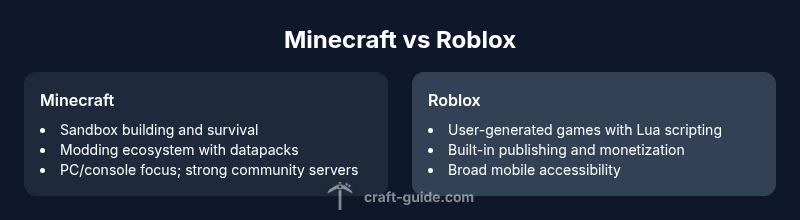
Minecraft vs Roblox: An Analytical Comparison
A rigorous, analytical comparison of Minecraft and Roblox, covering gameplay, tools, safety, accessibility, and learning curves to help players decide which platform suits their goals.


In the minecraft vs roblox landscape, two very different playgrounds exist. Minecraft emphasizes deep building, survival, and modding depth, while Roblox focuses on user-generated games and social play on a shared platform. If you want enduring creative control and modding potential, choose Minecraft; if you prefer rapid variety and a built-in creator community, Roblox is your best option.
minecraft vs roblox: Framing the Comparison
According to Craft Guide, the most practical way to approach minecraft vs roblox is to align your choice with your goals. If you crave expansive creative freedom, enduring world-building, and modding potential, the Minecraft ecosystem offers a deep, moddable canvas. Conversely, Roblox prioritizes a vibrant marketplace of user-generated experiences and social interaction, making it easier to explore a wide range of gameplay styles without a steep learning curve. The Craft Guide team wants players to understand that the choice is not about graphics or price alone, but about the type of creative expression you want to foster with your friends and communities.
This article digs into core competencies, creator tools, safety considerations, and practical use cases to help you decide where your time and talents might shine. By contrasting minecraft vs roblox along concrete axes like creativity, accessibility, and monetization, we provide a framework for making an informed decision.
According to Craft Guide, your decision should prioritize what you aim to build or explore first, not just which game looks more appealing on a thumbnail.
Core Gameplay Philosophies
At a high level, minecraft and roblox embody two different philosophies of play. Minecraft emphasizes sandbox creativity within an overarching survival framework: gather resources, craft tools, manage hunger, and protect your territory. The loop is deliberate, with emergent challenges that encourage planning and experimentation. Roblox emphasizes rapid onboarding into a multitude of user-created games, each with its own rules and social dynamics. Players hop between experiences, often with goals that are not cross-linked, which makes discovery a constant feature.
The key distinction is intent: minecraft invites players to build their own worlds, while roblox invites players to explore worlds built by others. This has implications for how you spend your time: if you love meticulous world-building and long-term projects, Minecraft rewards persistence; if you enjoy trying many different game genres with friends, Roblox offers quick, diverse options. Designers often use this lens to set expectations about progression, skill development, and social interaction.
For teachers and families, the contrast translates into different approaches to collaboration and safety, with both platforms offering opportunities to learn by doing.
Creation Tools and Modding Ecosystem
Creation tools define what you can build and how easily you can iterate. Minecraft’s primary creative engine centers on a sandbox world that players expand with mods, datapacks, and resource packs. On PC, the modding community provides thousands of gameplay tweaks, new biomes, and technical improvements that can dramatically alter how you play, from simple quality-of-life changes to full overhauls. Console editions, by contrast, typically restrict or limit mod access, which can constrain long-term customization.
Roblox uses Roblox Studio, a dedicated development environment that teaches Lua scripting and game design concepts inside an accessible interface. The studio integrates publishing tools, asset marketplaces, and built-in tutorials, enabling developers to publish playable games with relative ease. Roblox’s creator economy is tightly woven into the platform, offering built-in monetization paths and cross-promotional opportunities. In short, Minecraft favors deep customization and a thriving modding culture, while Roblox emphasizes rapid iteration, practical learning, and an integrated revenue pipeline for creators.
Content Diversity, Discovery, and Curation
Both ecosystems feature vast libraries, but discovery mechanics shape the user experience. Minecraft worlds and modpacks are curated by players and modders, with comprehensive mod loaders and recommended configurations guiding newcomers. Roblox hosts thousands of games created by independent developers, each subject to platform guidelines and rating systems. The breadth of Roblox content means new players can find experiences that match almost any interest within minutes, while Minecraft rewards long-tail engagement through mods, texture packs, and community servers.
Quality varies widely in both ecosystems, so careful evaluation through reviews, developer reputation, and in-game feedback is essential. Players who value consistent curation may lean toward Roblox’s structured discovery, whereas those seeking persistent, evolving worlds may prefer Minecraft’s ecosystem of ongoing mods and world-building projects.
Accessibility, Learning Curve, and Onboarding
Getting started with either platform is straightforward, but the path diverges quickly. Roblox is free to start, with optional purchases that unlock cosmetics and enhanced abilities; onboarding is designed to be intuitive, guiding players into new experiences rapidly. Minecraft typically requires a one-time purchase and a basic familiarity with inventory and crafting mechanics; the initial learning curve can be steeper, but the payoff is enduring creative power.
Both platforms offer extensive tutorials and community guides, but Roblox often excels at lower-risk experimentation and immediate, shareable results. If you’re teaching kids or new players, Roblox’s built-in scaffolding can reduce initial frustration, while Minecraft’s depth fosters patient problem solving, planning, and long-term project management.
Community, Safety, and Moderation
Community norms and safety infrastructure shape the user experience. Roblox relies on broad moderation, reporting tools, and age-appropriate filters to manage a high-velocity, social ecosystem. This helps younger players stay safe but can limit certain experiences. Minecraft’s community spans official servers and countless user-run realms, each with its own moderation policy. Some servers police behavior strictly, while others emphasize open collaboration and experimentation. Both ecosystems require proactive safety practices, especially when younger players participate with friends or classmates.
The takeaway is to select environments with clear rules, trusted communities, and accessible reporting channels. Parents and educators should establish boundaries around chat, trading behavior, and content sharing to ensure a positive experience.
Monetization, Economy, and Ownership
Monetization models diverge notably. Roblox centers its economy on Robux, a platform currency that supports a creator payout program and in-game purchases. Developers can earn revenue based on engagement and purchases within their experiences. Minecraft’s monetization typically revolves around game sales, DLCs, and optional add-ons, with a more traditional approach to ownership and content access. Roblox offers ongoing revenue potential for creators; Minecraft emphasizes ownership of your world and long-term project evolution.
From an ownership perspective, Minecraft saves progress in local or cloud-based worlds, whereas Roblox maintains a persistent ecosystem where user profiles, saved assets, and cosmetics travel with the account. This distinction matters for players who want portable progress or long-term personal asset libraries versus those who prefer a broader, platform-driven marketplace.
Performance, Platform Availability, and Cross-Play
Performance and compatibility depend on hardware, network conditions, and the scope of the project. Minecraft with heavy mods and large worlds can demand more CPU/GPU power, but settings can be tuned to fit mid-range machines or consoles. Roblox is designed for broad accessibility, including mobile devices, and typically runs smoothly on lower-spec hardware thanks to streamlined game design and efficient rendering. Cross-platform play is supported in both ecosystems, but the fidelity and capabilities of cross-play experiences vary by title. If your group spans PC and mobile, Roblox’s accessibility can help keep everyone connected; for complex, custom-built worlds with deep gameplay systems, Minecraft’s modding and world-building capabilities offer more expansive possibilities.
Practical Scenarios: Which to Choose
To help players decide, consider your goals. If you want long-term cooperative builds, deep crafting, and advanced redstone-like systems, Minecraft is the more suitable choice. If your aim is to launch quick-to-play experiences, explore a wide variety of genres, or learn game development in a supportive ecosystem, Roblox offers a faster, more approachable path. For classrooms or family settings, Roblox’s built-in safety tooling and scalable onboarding can be advantageous, but Minecraft’s hands-on world-building provides rich opportunities for engineering, architecture, and collaborative problem-solving. Importantly, many players enjoy both ecosystems across different phases of their gaming journey.
Authority Sources
Minecraft and Roblox have associated official documentation and broad coverage in major publications, which provide context for platform design and user-generated content. Readers can consult the following sources for additional perspective:
- https://www.theverge.com
- https://www.wired.com
- https://www.nytimes.com
wordCountForBlock9":0
Comparison
| Feature | Minecraft | Roblox |
|---|---|---|
| Core Premise | Sandbox building and survival in a procedurally generated world | User-generated games and experiences on a shared platform |
| Accessibility/Onboarding | One-time purchase with traditional crafting mechanics | Free-to-start with in-game purchases and scripting-based creation |
| Creation Tools | Mods, datapacks, and community mods; deep customization | Roblox Studio with Lua scripting and built-in publishing |
| Monetization | Sales, DLCs, and optional add-ons; ownership of worlds | Robux-based economy with creator payouts |
| Content Moderation | Server-based moderation with community rules | Platform-wide guidelines and age-appropriate filters |
| Learning Curve | Steeper early learning for crafting/redstone; reward in-depth worlds | Gentler onboarding for game creation and publishing |
| Best For | Long-term world-building, modding communities | Quick-to-play experiences and social game design |
| Performance/Platform | Variable; modding can affect performance | Broad accessibility; optimized for mobile and PC |
Benefits
- Encourages long-term creativity and problem solving
- Large, passionate communities and extensive tutorials
- Both offer robust content ecosystems and learning pathways
- Cross-platform play in many experiences enhances social reach
- Flexibility for creators to express ideas in multiple ways
Negatives
- High learning curve for advanced modding in Minecraft
- Quality of user-generated content varies widely
- Minecraft mods can cause compatibility issues between versions
- Modding and content enforcement can slow access to updates
- Monetization dynamics differ, which may impact player expectations
Minecraft is the more robust choice for players who want deep, enduring world-building and modding potential; Roblox excels for players seeking fast access to diverse, user-created games and a strong creator economy.
If you value modular, long-term construction and a moddable canvas, Minecraft delivers. If you want variety, quick starters, and a built-in creator marketplace, Roblox is the practical pick. Craft Guide recommends aligning your choice with your goals: creativity and persistence vs rapid exploration and monetization opportunities.
People Also Ask
Which platform is easier for beginners to pick up?
Roblox generally offers a gentler onboarding with quick win experiences, while Minecraft’s crafting and survival loop can be more intimidating at first but pays off with deeper creative control.
Roblox is usually easier to start with; Minecraft has a longer learning curve but richer long-term growth for builders.
Can you play together across platforms?
Yes, both ecosystems support cross-platform play in certain experiences, but the scope and quality of cross-play vary by title and server. Roblox tends to have broader mobile support for cross-play.
Yes, cross-play is possible in many experiences, though it depends on the game you choose.
Which platform is better for education?
Both have educational potential: Roblox for project-based learning and rapid prototyping, Minecraft for engineering concepts, architecture, and collaborative problem-solving. The choice depends on the learning goals.
Both can be great in education; Roblox for quick, collaborative projects, Minecraft for long-term engineering and design.
Is modding essential to enjoy Minecraft?
Not essential, but mods significantly expand Minecraft’s possibilities and can extend the game’s lifespan. Vanilla play is still enjoyable without mods.
Mods add depth, but you can enjoy the base game without them.
Which has a larger content library?
Roblox offers a vast and varied library of user-generated games. Minecraft’s modding scene provides depth and customization through mods and packs.
Roblox has lots of games; Minecraft offers deep mods for customization.
What about safety for younger players?
Roblox provides strong parental controls and filters; Minecraft servers vary in moderation, so choosing trusted servers and setting chat controls is important.
Roblox has built-in safety tools, while Minecraft safety depends on server choices.
The Essentials
- Define your goal first: building/engineering vs exploration/experimentation
- Choose Minecraft for depth, Roblox for speed and variety
- Evaluate safety features when teaching or gaming with others
- Consider monetization and ownership models before committing
- Test both ecosystems when possible to maximize learning outcomes