Difference Between Minecraft and Roblox: An Analytical Comparison
Analyze the key differences between Minecraft and Roblox, from core goals to creation tools and communities. A practical, analytical guide for players choosing where to start and how to level up.


Minecraft centers on voxel-based building, exploration, and survival in procedurally generated worlds, while Roblox is a game-creation platform where users design, publish, and play user-made experiences. The two ecosystems diverge in tools, communities, and monetization models, making each suitable for different playstyles. This comparison highlights core differences in gameplay, creation tooling, and long-term goals to help you choose.
Context and Scope
The question difference between Minecraft and Roblox isn't just about icons and logos; it's about two distinct ecosystems with different design philosophies, user communities, and development pipelines. According to Craft Guide, understanding these differences helps players direct their time toward the platform that matches their goals. Minecraft began as a survival-focused sandbox built on voxel blocks that you mine, craft, and explore. Roblox, by contrast, positions itself as a game-creation system where the core product is user-generated experiences built with Roblox Studio and Lua. The contrast isn't only about who has more players or nicer graphics; it's about how each environment structures creation, delivery, and discovery. Minecraft rewards patience, exploration, and inventive problem solving within procedurally generated worlds, while Roblox rewards rapid iteration, collaboration, and audience-focused experiences that can be published across devices. If you're deciding where to invest your hobby time, map your interests to these structural differences. This section introduces the key axes you'll see revisited in more detail later: creation tools, community norms, monetization, and platform strategy.
Core Philosophies: Building, Creation, and Play
Minecraft and Roblox emerge from distinct design philosophies. Minecraft emphasizes a tactile, hands-on approach to building and surviving in a persistent world where your choices carry weight over long stretches of play. The game rewards long-term planning, resource management, and creative problem-solving within a system of procedural generation. Roblox, conversely, centers on accessibility for creators—providing an integrated toolkit that lowers entry barriers for designing games, dashboards for publishing, and a social ecosystem where players become developers, testers, and marketers. This bifurcation shapes every subsequent decision: where to invest time, what skills to learn, and how to engage with communities. Craft Guide notes that the best creators often blend both mindsets—leveraging Roblox Studio's rapid iteration while pulling in Minecraft-inspired world-building concepts when appropriate.
Gameplay Systems and World Design
The core difference in gameplay systems is the way worlds are generated and interacted with. Minecraft uses a block-based universe with a strong emphasis on survival mechanics, resource collection, crafting, and combat. Its worlds are infinite (in practice) and procedurally generated, yielding a sense of discovery as you navigate biomes, caves, and temples. Roblox worlds, by contrast, are user-authored experiences with scripted logic and goal-driven gameplay. The engine is designed to support a diverse catalog of games—from obbies and simulators to role-playing adventures—so the variety comes from the creators rather than a single, shared rule set. This leads to a more varied player experience across titles, but also means consistency across experiences is lower than in a single, canonical game. Both ecosystems encourage exploration and creativity, but the path to mastery looks different depending on your preferred problem-solving style and project scope.
Creation Toolchains: Minecraft Mods vs Roblox Studio
Modding and content creation sit at the heart of why players choose Minecraft. On Java Edition, modding is a vibrant hobby with ecosystems like Forge and Fabric, allowing code-level changes to gameplay, new blocks, and complex automation. Bedrock Edition introduces add-ons and marketplace content with a more curated approach. Roblox Studio, in contrast, is an integrated development environment built to empower creators from day one. Lua scripting, event-driven logic, and a streamlined publishing workflow make it possible to ship experiences quickly to a global audience. The learning curve differs: Minecraft modding demands patience and programming comfort, whereas Roblox Studio emphasizes rapid iteration, asset creation, and social deployment. Both paths require a community mindset—learn from tutorials, share your work, and iterate based on feedback from players.
Community, Economy, and Moderation
Community dynamics are a defining difference. Minecraft’s community is built around servers, mods, and fan-made maps, fostering a culture of collaboration, challenge runs, and large-scale builds. Monetization in Minecraft typically involves game purchases, optional subscriptions like Realms, and community-driven marketplaces for maps and skins. Roblox centers its economy on Robux, creator earnings, and a robust publishing platform that rewards popular titles with visibility, engagement, and revenue share. Moderation and safety policies vary, with Roblox placing strong emphasis on family-friendly experiences and reporting tooling, while Minecraft relies heavily on server moderators and community governance. The outcome is two distinct ecosystems: one oriented toward enduring, personal worlds and long-tail projects; the other toward rapid game development, broad discoverability, and a marketplace-driven economy.
Accessibility, Learning Curve, and Education
Both platforms offer broad accessibility but through different avenues. Minecraft provides cross-platform play on many devices, though the experience may shift between Java and Bedrock editions. Its learning curve centers on mastering crafting recipes, redstone logic (the in-game circuitry system), and survival strategies. Roblox lowers the barrier to entry for aspiring developers with its turnkey tools and a social feed that encourages sharing and feedback, making it an excellent educational platform for game design, storytelling, and collaboration. The Craft Guide team notes that classrooms and clubs increasingly leverage Roblox Studio for project-based learning, while Minecraft is valued for its spatial reasoning, resource planning, and teamwork on large builds. Prospective players should weigh how they want to grow: as a builder, coder, or teacher.
Performance, Platform Availability, and Cross-Play
Platform performance and cross-play capabilities shape day-to-day experiences. Minecraft supports PC, consoles, and mobile, with performance heavily influenced by world size, mods, and device power. Cross-play is most seamless on Bedrock, while Java offers robust modding but limited cross-platform parity. Roblox supports a broad hardware spectrum and a strong emphasis on cloud-based, cross-device experiences; players can jump between PC, mobile, and consoles with consistent access to their favorite titles. Each ecosystem has trade-offs: Minecraft’s performance hinges on world complexity and mod choices, whereas Roblox’s performance centers on the complexity of a single user-created game and the efficiency of scripting within the Roblox engine. Understanding these nuances helps you pick a platform that matches your hardware and play expectations.
Choosing Between Them: Best Use Cases
If your goal is to build long-term, survival-focused worlds with deep crafting systems and extensive modding, Minecraft remains the best choice. If you want a fast, collaborative space where you can design, publish, and monetize experiences with a built-in audience, Roblox shines. Both platforms encourage community engagement, creative problem-solving, and iterative learning. The best approach is to try both to understand which workflow, audience, and ecosystem align with your motivations. Craft Guide’s practical tip: start with a small project on Roblox Studio to learn the basics of scripting and publishing, then supplement with Minecraft to explore large-scale building and third-party modding communities.
Comparison
| Feature | Minecraft | Roblox |
|---|---|---|
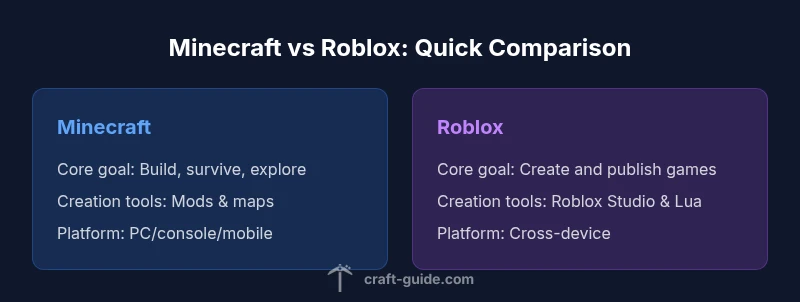
| Core goal | Voxel-based survival, building, and exploration in procedurally generated worlds | User-generated experiences with built-in game development toolkit |
| Creation tooling | Java/Bedrock modding via Forge/Fabric, add-ons, and traditional maps/servers | Roblox Studio with Lua scripting for publish-ready games |
| Engine and scripting | Standalone engine with emphasis on block-based physics and automation through mods | Integrated engine designed for rapid game creation and cross-title scripting |
| Monetization | Base game purchase with optional Realms/subscriptions; community-made content varies | Robux-driven economy; developers earn through experiences and items |
| Platform availability | PC, Mac, Linux, consoles; strong PC modding culture | PC, mobile, consoles with wide cross-platform support |
| Best for | Players who enjoy deep survival mechanics, modding, and long-term builds | Creators who want quick publishing and a broad audience |
Benefits
- Massive, active communities and expansive content libraries
- Strong creative freedom: building, scripting, and modding options
- Cross-platform reach and long-term viability
- Diverse learning resources and community-shared tutorials
- Clear pathways for education and informal learning
Negatives
- Variable quality and safety of user-generated content
- Steeper learning curve for advanced modding or scripting
- Performance depends on device and complexity of experiences
- Monetization mechanics can influence player expectations
- Content moderation policies vary, requiring vigilant safety practices
Minecraft for deep building and modding; Roblox for rapid game creation and social reach
Choose Minecraft if you value crafting depth and world-building; choose Roblox if you want to design, publish, and iterate games with an active community.
People Also Ask
What is the main difference between Minecraft and Roblox?
Minecraft emphasizes sandbox building and survival in voxel worlds, while Roblox centers on user-created games built with Roblox Studio. The design goals, tooling, and communities diverge in ways that shape every play session. Both offer expansive content, but the path to mastery and the output you create differ dramatically.
Minecraft is about building and surviving in a voxel world, Roblox is about making and sharing games with Roblox Studio.
Is Roblox free to play?
Roblox is free to play at the base level, with optional purchases through Robux. Some experiences inside Roblox may require payments, but you can start exploring without spending any money. Developer earnings come from popularity and in-game purchases across titles.
Yes, you can start playing Roblox for free; optional purchases exist in many games.
Can you install mods in Minecraft?
Yes, mods are a hallmark of Minecraft, especially on the Java Edition. Modding tools like Forge and Fabric enable deep gameplay changes, new blocks, and automation. Bedrock supports add-ons but has a different ecosystem and official mod support constraints.
Minecraft supports mods, especially on Java Edition, using Forge or Fabric.
Which platform is better for kids?
Both can be appropriate for younger players with supervision. Roblox offers a social, game-creation environment that can be engaging and educational but requires safety controls. Minecraft provides structured building and survival play that can be equally kid-friendly with the right servers and settings.
Both platforms can be kid-friendly with proper settings; Roblox needs supervision due to user-generated content.
Do both games support cross-platform play?
Yes, both support cross-platform experiences, but the specifics vary. Minecraft offers cross-play primarily through Bedrock Edition and certain editions, while Roblox standardizes cross-platform access across PC, mobile, and consoles through its own engine and account system.
Both support cross-platform play, though details depend on the edition and device.
How much content is user-generated in each?
Minecraft centers on user-created worlds, mods, and servers with a long history of community projects. Roblox hosts a vast library of user-created games and experiences, driven by creators and monetization. The scale and nature of content differ, but both offer expansive, evolving catalogs.
Minecraft has vast user-made worlds and mods; Roblox has a huge library of user-created games.
The Essentials
- Assess your goals: build/survive vs create/publish
- Learn the tooling: mods/Java vs Roblox Studio/Lua
- Consider monetization, moderation, and audience reach
- Check device compatibility and equal access to features
- Experiment with both platforms to confirm fit