How Popular Is Minecraft Compared to Other Games in 2026
An analytical comparison of Minecraft's popularity against other major titles, using global engagement, platform reach, and community activity data from Craft Guide, 2026.


Minecraft remains among the most popular games worldwide, with broad, lasting engagement that outpaces many peers. Seasonal titles like Fortnite and Roblox spike briefly, but Minecraft sustains interest through constant updates, expansive modding, and a thriving server ecosystem. When you ask how popular is Minecraft compared to other games, the answer is: it sits in the top tier for 2026, across generations and platforms.
How to interpret popularity in gaming today
To understand how popular is Minecraft compared to other games, we must look beyond simple player tallies and consider sustainability, platform reach, and community involvement. According to Craft Guide, popularity is a multi-dimensional construct that blends active players, ongoing engagement, and content creation velocity. This means that two titles might share a large audience, yet differ in how that audience participates over time. By triangulating metrics like daily active users, search interest, and streaming presence, we get a clearer picture of lasting impact. This section avoids hype and emphasizes reproducible signals across regions and platforms. It also recognizes that data from different regions may reflect diverse playing habits, which is why a global perspective is essential when evaluating popularity.
Core metrics used to gauge popularity
Readers often ask which numbers matter most when judging popularity. The core signals include daily and monthly active users, average session length, and the breadth of platforms where a title is available. Social and streaming metrics—such as search volume, video views, and influencer attention—also matter. Monetization models and community ecosystems influence how long a game remains relevant. Craft Guide's analysis in 2026 highlights that broad cross‑platform access and a thriving content ecosystem are strong predictors of long-term popularity. In addition, sustained community events, modding activity, and educational use cases reinforce Minecraft’s staying power in the broader gaming landscape.
Minecraft's enduring appeal across generations
Minecraft's design emphasizes creativity, exploration, and iterative learning, which makes it accessible to new players while rewarding long-term makers. The game supports a vast array of mods, datapacks, and server variants, enabling continual discovery long after initial release. Across generations, families, streamers, and educators incorporate Minecraft into play and learning, reinforcing familiarity and attachment. Craft Guide notes that this generational pull is a key reason the title remains highly visible in discussions about overall gaming popularity. The accessibility of block-building concepts paired with open-ended goals helps Minecraft maintain relevance even as new titles enter the market.
How Minecraft stacks up against top competitors
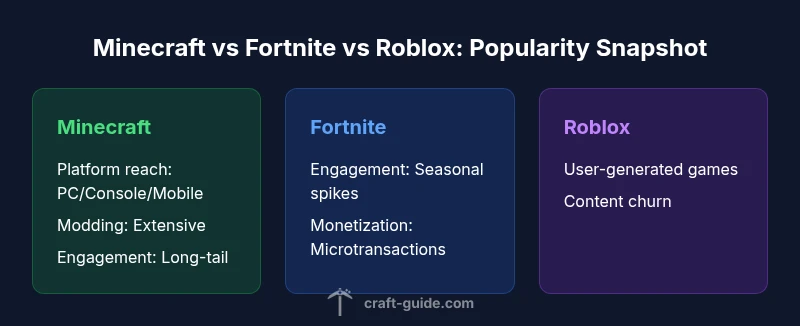
When we compare Minecraft to top peers like Fortnite and Roblox, several contrasts emerge. Fortnite often dominates in seasonal events and fast-paced interaction, delivering spike-like engagement. Roblox thrives on user-generated content and rapid content turnover within a shared ecosystem. Minecraft, by contrast, emphasizes long-tail engagement through mods, servers, and community-built worlds. Together, these dynamics create a diversified popularity landscape where all three titles maintain strong presence, but for different reasons and time horizons. The Craft Guide team emphasizes that popularity is not a single metric but a tapestry of engagement signals that evolve with platform policies, community norms, and developer support.
Platform and regional dynamics in popularity
Platform breadth matters for how widely a game is perceived as popular. Minecraft is widely accessible on PC, consoles, and mobile, with cross‑play and community-driven hosting expanding its reach. Regional differences can skew how popularity manifests; some regions favor mobile access and localized servers, while others prioritize PC ecosystems and modding communities. The result is a mosaic in which Minecraft often shows the most enduring footprint, even where other games surge in localized moments. Cross‑platform parity reduces regional volatility, helping Minecraft stay consistently relevant across diverse markets.
The role of community content and servers in popularity
A central driver of Minecraft's enduring status is its community content—mods, packs, servers, and world seeds—that keep the game fresh. Server networks, custom maps, and marketplace-inspired content create an ever-renewing stream of experiences. While Fortnite and Roblox rely heavily on official ecosystems and in-game monetization, Minecraft's open-ended approach invites independent creators to contribute long after release. This ecosystem strengthens retention and word-of-mouth growth. For players, this means endless discoveries; for creators, it means opportunities to build lasting communities that outlive individual game updates.
Practical implications for players and creators
For players, the takeaway is to explore community-driven modes and servers that suit your playstyle, while staying mindful of updates and security considerations. For creators, the most reliable path is to foster a varied portfolio: mod packs, resource worlds, and server communities that can grow beyond a single release cycle. The goal is to build a loyal audience that participates over years, not just weeks. Practical steps include joining active servers, subscribing to creator channels, and contributing to modding ecosystems with well-documented releases that ease onboarding for newcomers.
Limitations and caveats in popularity measurements
Popularity signals vary by data source, region, and platform. Public dashboards often differ in how they count active players, and seasonal spikes can distort short-term trends. Therefore, any comparison—especially one addressing how popular is Minecraft compared to other games—should be interpreted as directional rather than absolute. Craft Guide emphasizes triangulating signals to avoid overreliance on a single metric, and reminds readers that language like "popularity" can incorporate qualitative perceptions, such as brand affinity and cultural relevance, in addition to numerical indicators.
Feature Comparison
| Feature | Minecraft | Fortnite | Roblox |
|---|---|---|---|
| Platform reach | PC/Console/Mobile | PC/Console/Mobile | PC/Mobile |
| Modding/Customization | Extensive modding ecosystem | Limited official modding; cosmetic focus | Open user-generated experiences |
| Engagement signals | Long-tail engagement; continual updates | Seasonal spikes around events | Constant content churn by creators |
| Monetization model | One-time purchase with optional DLC | Free-to-play with microtransactions | Free-to-play with microtransactions |
| Global reach | Very broad; across age groups | Global with event-driven peaks | Global with beginner-friendly onboarding |
Benefits
- Shows long-term sustainability across generations
- Supports diverse play styles and creator ecosystems
- Strong cross-platform accessibility and server communities
- Valuable for education and creative industries
Negatives
- Popularity can be flighty for event-driven peers
- Data sources differ by platform, complicating apples-to-apples comparisons
- Open ecosystems may introduce quality variability
Minecraft dominates long-term popularity; rivals excel in bursts
Minecraft remains a benchmark for sustained engagement, while Fortnite and Roblox captivate audiences during events and content bursts. The craft‑driven ecosystem underpins Minecraft's staying power.
People Also Ask
How does Minecraft's popularity compare to Fortnite and Roblox?
Minecraft maintains a durable, year‑over‑year presence thanks to mods, servers, and a creative community. Fortnite and Roblox see rapid spikes tied to events and new user experiences. Collectively, they define a three‑pillar landscape of popularity.
Minecraft shows durable popularity through creativity and community, while Fortnite and Roblox surge during events and new content.
Do regional differences affect Minecraft's popularity more than other games?
Regional preferences influence where Minecraft shines the most, with mobile-first regions often driving growth and PC-dominant areas expanding modding and server activity. However, Minecraft's cross‑platform availability helps mitigate regional gaps.
Regions shape popularity, but Minecraft's cross‑platform presence keeps it widely engaged.
How do updates and mods influence popularity?
Regular updates and a thriving modding community extend Minecraft's relevance by delivering fresh experiences. This ongoing development contrasts with titles that rely primarily on new content drops.
Ongoing updates and mods keep Minecraft fresh and engaging over time.
Is Minecraft more popular on PC than mobile?
Minecraft enjoys broad appeal across PC, console, and mobile, though regional preferences may tilt usage toward certain platforms. Cross‑play and persistent servers help balance platform-specific popularity.
Minecraft is popular on all platforms, with regional variations in usage.
What metrics should I use to measure popularity?
Use a mix of active user counts, engagement duration, and content ecosystem activity (mods, servers, uploads). Include search interest and streaming metrics for a fuller picture.
Track active users, engagement, and community activity for a complete view.
Can popularity rise or fall quickly for Minecraft?
Popularity can surge with major updates or events, but Minecraft's long‑term attraction often dampens sharp declines, thanks to its durable ecosystem.
Yes, but long-term engagement helps stabilize popularity.
The Essentials
- Monitor multiple signals, not just player counts
- Cross-platform reach correlates with lasting popularity
- Creator-driven content sustains engagement over years
- Seasonal peaks do not erase long-tail strength