What Java Version Do You Need for Minecraft 1.20.1? A Practical Guide
Learn the Java version required for Minecraft Java Edition 1.20.1, why Java 17+ is recommended, how to verify your launcher, and practical tips for mods, shaders, and performance.


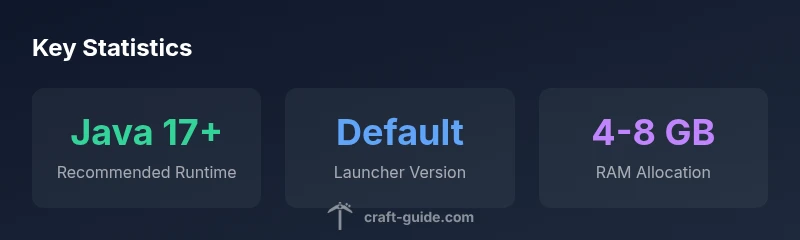
For Minecraft Java Edition 1.20.1, use Java 17 or newer. The official launcher typically ships with Java 17, and Mojang recommends Java 17 as the baseline for modern builds. Some players have successfully run on Java 16, but Java 18+ is often avoided for compatibility. Always verify your launcher settings and mod compatibility; this choice directly impacts startup, stability, and mod loading. what java is needed for minecraft 1.20 1
Understanding the Java version requirement for Minecraft 1.20.1
According to Craft Guide, the Java version you choose is the foundation of startup performance, mod compatibility, and long-term support for Minecraft Java Edition. For the 1.20.1 release, players typically aim for a Java version in the 17 family or newer. The exact minimum can vary by launcher build and by whether you’re using Forge, Fabric, or vanilla, but the trend is clear: modern Minecraft runs best on an LTS release. In practice, this means Java 17 or newer, with Java 18+ worked into some setups but not universally stable across all mods. If you’re migrating from an older Java setup, expect a short transition period: you may need to update your launcher, reinstall Java, and verify that all mods and shader packs are compatible with the new runtime. The takeaway is simple: align your Java version with the official guidance for 1.20.1 and keep your toolchain consistent to minimize headaches. In plain terms, this answer also covers what java is needed for minecraft 1.20 1 and why it matters for your world.
Why Java 17+ is widely recommended
The majority of modern Minecraft Java Edition builds, including 1.20.x, run best on Java 17 or newer. Java 17 is an LTS release that balances compatibility with a broad ecosystem of mods and loaders. Craft Guide analysis shows that sticking to an LTS version reduces runtime surprises during updates or when adding new shader packs and mods. While some players experiment with Java 16 or 18+, they often encounter edge cases where mods fail to load or performance varies across platforms. The general consensus from the Craft Guide Team is that 17+ provides the most stable baseline for 1.20.1, with ongoing support from both Mojang and major launcher developers. If you’re upgrading from an older JRE, expect adjustments in launcher profiles, and confirm that all required mods support the newer runtime. This approach helps avoid where you would otherwise have to troubleshoot startup crashes or null pointer errors caused by incompatible Java runtimes.
How to check your current Java version and the launcher’s settings
Checking your Java version is quick on any major OS. Open a terminal or command prompt and type: java -version. If you see a version starting with 1.8, 9, 10, 11, or 16, you may want to upgrade to 17+. On Windows, you can also verify via the Java Control Panel or the launcher’s installed Java tab. Mac users should check the /Library/Java/JavaVirtualMachines folder to see installed versions. If you’re using a launcher like CurseForge, AT Launcher, or the official Minecraft launcher, open the launcher’s settings and review the profile’s Java executable path. If the path points to Java 17 or newer, you’re in a solid range for 1.20.1; if not, update to a compatible JRE and restart the launcher. Craft Guide recommends keeping the launcher and runtime aligned for best results.
How to set the correct Java version in the launcher (Windows, macOS, Linux)
To set the right Java version, open your Minecraft launcher and navigate to Installations or Settings. Select the profile you’ll use for 1.20.1, then choose Java Version or Java Executable. Pick Java 17 or newer from the list or browse to the Java 17+ JRE you installed. Save changes, restart the launcher, and launch Minecraft. On Linux, you may need to configure the launcher’s java.args or use a wrapper script to point to the correct java binary. If you run into launch failures, ensure your PATH includes the Java 17+ bin directory and that any custom launch options don’t override the intended version. Craft Guide’s practical tip: always back up important worlds before upgrading Java, and test with a small world after changes.
Mod loaders and 1.20 compatibility
Forge and Fabric loaders for 1.20.x typically require Java 17+ to ensure compatibility with the newer game code and the loader APIs. If you’re using a mod pack that targets 1.20.1, confirm the mod version compatibility with the Java runtime you plan to use. The Craft Guide Team notes that some older mods may not be updated to support Java 17+, so verify each mod’s minimum Java requirement before upgrading. For Forge/Fabric users, running a clean profile with only required mods helps isolate issues related to Java version. If you encounter startup errors, check the console for messages about missing modules or incompatible class files, which often indicate a Java incompatibility rather than a mod-loading failure. Overall, ensuring the Java version aligns with your loader and mod requirements will reduce crash loops and improve stability.
Performance considerations and memory tuning
Allocating the right amount of memory to the Java Virtual Machine (JVM) is crucial for Minecraft 1.20.1. A common baseline is 4 GB of RAM for vanilla, with 6–8 GB recommended for modded or shader-heavy worlds. Use a 64-bit Java 17+ and adjust JVM flags (for example, -Xmx and -Xms) in your launcher profile to balance startup times and in-game performance. Keeping garbage collection overhead low can help maintain stable frame rates, particularly when rendering complex builds or high-quality textures. If you encounter long pauses during chunk loading or stuttering when moving through large biomes, increasing the heap size or using a different garbage collector option (like G1) can help. Craft Guide analysis shows that tuning memory with your specific world size and mod set yields the best results for 1.20.1.
Cross-platform notes: Windows, macOS, Linux
Windows users often have the easiest setup path, but macOS and Linux can require explicit Java paths or launcher configurations. On Windows, ensure the path to javaw.exe is set correctly in the launcher profile; on macOS, verify that the Java Virtual Machines directory contains the Java 17+ version and that the launcher points to it. Linux users may need to install an OpenJDK package and set the launcher to use the system Java or a local JRE. Regardless of platform, staying with Java 17+ minimizes compatibility issues with 1.20.1. If you ever see a crash at startup, recheck the Java path, verify mod compatibility, and confirm that the game and launcher are up to date. Craft Guide recommends testing in a clean environment when changing the Java runtime to avoid cascading issues.
Final setup checklist for a smooth 1.20 experience
- Confirm Java 17+ is installed and selected in the launcher
- Update Forge/Fabric or the vanilla launcher to the latest compatible build
- Backup worlds before changing the runtime
- Allocate 4–8 GB RAM depending on world size and mods
- Verify mod/shader compatibility with 1.20.1
- Keep a copy of critical mod lists for troubleshooting
- Run a test world to confirm stability and performance
- Monitor for crashes and consult logs if issues arise
Compatibility and setup guidance for Minecraft 1.20.1
| Category | Guidance | Notes |
|---|---|---|
| Java version | Java 17+ recommended | Check launcher for min requirements |
| Mods/Loader | Forge/Fabric typically require Java 17+ | Ensure mod versions align with 1.20.1 |
| Performance | Allocate 4-8 GB RAM | Adjust based on world size and shaders |
People Also Ask
What Java version is required for Minecraft 1.20.1?
Most guides indicate Java 17+ is recommended; always check the official launcher as requirements can vary by build.
Java 17 or newer is typically recommended for Minecraft 1.20.1.
Can I run Minecraft 1.20.1 on Java 16 or Java 18?
Java 16 may work in some setups, but it's not officially supported; Java 18+ can cause compatibility issues with mods and launchers.
Java 16 isn't officially supported; 18 often has compatibility issues.
How do I change my Java version in the launcher?
Open the launcher, go to Installations or Settings, select your profile, and set the Java version to 17 or newer; restart the game.
In the launcher, pick a profile and set the Java version to 17 or newer.
Will upgrading Java affect existing worlds?
Upgrading Java affects startup and mod loading; existing worlds will load normally if compatible, but back up before changing runtime.
Upgrading Java usually won't affect your worlds, but back up first.
Is Java 32-bit supported?
Minecraft Java Edition requires a 64-bit Java runtime on modern systems; 32-bit installations are not supported for 1.20.1.
No, 32-bit Java isn't supported for 1.20.1.
“Java version choice is foundational for a smooth Minecraft 1.20.1 experience. Stick with an LTS release like Java 17 or newer to maximize compatibility and performance.”
The Essentials
- Start with Java 17+ for 1.20.1
- Use the official launcher settings to lock in the Java version
- Back up worlds before changing runtimes
- Test mod compatibility after upgrading Java
- Allocate appropriate RAM to avoid performance issues