Scratch Minecraft Paper: Scratch-style Scripting on a Paper Server
Discover how to use Scratch-style scripting on a Minecraft Paper server. This guide covers setup, plugin choices, sample scripts, and best practices for safe, efficient prototyping and teaching.


With this guide, you’ll learn how to run Scratch-inspired automation on a Minecraft Paper server. You’ll set up Paper, install a visual scripting plugin, and create simple, block-based scripts that interact with worlds, mobs, and items. By the end, you’ll prototype gameplay ideas quickly without heavy Java coding.
What is Scratch Minecraft Paper?
Scratch Minecraft Paper blends the high-performance Paper server with visual, Scratch-like scripting to prototype in-game behaviors without deep Java coding. Paper provides a scalable foundation for plugins, while scripting lets you express logic with blocks, events, and commands. This approach is ideal for educators, modders, and curious builders who want fast iteration and clear feedback from their experiments. Throughout this guide, we’ll use the phrase scratch minecraft paper to emphasize the combined concept and to help you find related resources quickly.
Why integrate Scratch-style scripting with a Paper server?
The core idea is to separate game logic from core server code. Scratch-style scripting lowers the barrier to creating new gameplay ideas, automation, and world rules. On a Paper server, you can run multiple scripts simultaneously, keep server performance predictable, and avoid rewiring core plugins each time you test a new concept. The result is faster prototyping, easier sharing of ideas, and a more approachable path from concept to in-game result. Craft Guide team notes that this approach aligns with practical learning and iterative design.
Core concepts and architecture
Understanding the building blocks helps you design safer, more maintainable scripts. The architecture typically includes a visual script layer (the Scratch-like editor), a scripting runtime (plugin), and the Minecraft world itself. Scripts listen for events (e.g., player interactions, block changes) and emit actions (spawn entities, modify blocks, grant items). On Paper, plugins run in Java, while the Scratch-style layer translates block-based commands into server-safe actions. This separation keeps performance stable and makes debugging easier.
Prerequisites and setup overview
Before you touch code, verify you have a compatible environment: a properly configured Paper server, a supported Java version, and a scripting plugin such as Skript or ScriptCraft. Plan a small, test world to minimize risk. Once fundamentals are in place, you can start with simple scripts that respond to a command or event, then expand into more complex automations. Craft Guide recommends keeping a changelog and backups as you iterate.
Example projects you can build
Here are several beginner-friendly Scratch Minecraft Paper projects to spark ideas:
- A chat-based helper that gives players a random resource when they type a command.
- A simple farming automation that plants crops when a player steps on a farmland tile.
- A mob-spawner puzzle that spawns friendly mobs when players complete a sequence of actions. Starting with small scripts helps you learn the scripting syntax, event handling, and how to translate real-world ideas into in-game outcomes.
Best practices for performance and security
Keep scripts focused and small to avoid hotspots on the server. Use event filtering to ignore unnecessary triggers, debounce frequent actions, and log script activity for debugging. Always validate inputs and sanitize commands to prevent abuse. Regular backups, world separation for testing, and clear permissions reduce risk when sharing scratch minecraft paper projects with others.
Common pitfalls and how to avoid them
Common issues include incompatible plugin versions, syntax errors in scripts, and scripts that trigger too often, causing lag. Start with simple, well-documented scripts and test in a controlled environment. Check server logs for errors, update plugins to compatible releases, and keep your test world isolated from your main world to avoid unintended changes.
Tools & Materials
- Minecraft Paper server(Latest stable Paper build; ensure Java compatibility)
- Java Runtime Environment (JRE/JDK 17+)(Install on host OS; verify JAVA_HOME)
- Skript plugin (or ScriptCraft)(Choose one approach for Scratch-style scripting)
- Scratch-like script editor files(Place scripts in the Skript/scripts folder or ScriptCraft directory)
- Backups and test world(Regular backups before enabling automation)
- Local testing world (optional)(Separate world for experimentation)
- Basic firewall and security plan(Limit external access and monitor logs)
Steps
Estimated time: 2-3 hours
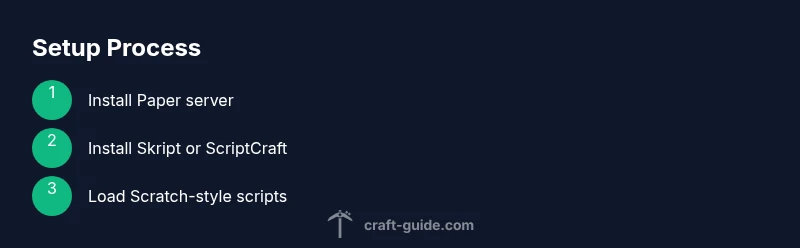
- 1
Install Paper server
Set up a fresh Paper server on your host OS and ensure it starts cleanly with a test world. This creates the foundation for all subsequent scripting work.
Tip: Back up the world before enabling plugins to prevent data loss. - 2
Add Skript plugin
Download and install the Skript plugin (or ScriptCraft). Restart the server to load the scripting environment used for Scratch-style blocks.
Tip: Check the server console for startup messages indicating Skript is ready. - 3
Load Scratch-style scripts
Place your first .sk (or .js) script into the appropriate folder and ensure the file has correct syntax. Start with a simple command-based action.
Tip: Use small, well-documented examples to avoid confusion. - 4
Create a basic automation
Write a script that responds to a command or event and performs a straightforward action, such as placing a block or giving an item.
Tip: Test in a safe area and monitor timing and resource usage. - 5
Test and iterate
Run the server, connect with a Minecraft client, and verify your automation behaves as intended. Refine logic and add safeguards as needed.
Tip: Keep a changelog and log outputs for easier debugging. - 6
Document and share projects
Document your Scratch Minecraft Paper projects with notes, diagrams, and sample scripts so others can recreate them.
Tip: Publish versions and provide a minimal readme to guide others.
People Also Ask
What is Minecraft Paper and why use it with Scratch-style scripting?
Minecraft Paper is a high-performance server fork designed for plugins. Using Scratch-style scripting on Paper lets you prototype gameplay ideas quickly while keeping the server responsive.
Paper is a high-performance Minecraft server that's ideal for plugins. Scratch-style scripting lets you prototype ideas quickly.
Is Scratch compatible with Minecraft?
Scratch itself isn’t built into Minecraft. You can achieve Scratch-like behavior using plugins like Skript or ScriptCraft that translate visual logic into in-game actions.
Scratch isn’t inside Minecraft, but you can mimic it with Skript or ScriptCraft.
Do I need coding experience to use this approach?
Basic familiarity with writing scripts or using command blocks helps, but Skript’s syntax is designed to be approachable for beginners. You can learn as you go.
You don’t need heavy coding experience; Skript makes scripting approachable.
Is this safe for public servers?
Begin with a private testing world and implement permissions and rate limits. Public servers require strong backups, monitoring, and restricted script capabilities to prevent abuse.
Start in a private world with proper protections before going public.
Where can I find sample scripts to get started?
Look for starter Skript projects or ScriptCraft examples in trusted community resources. Adapt examples to your own ideas and gradually expand.
Find starter scripts from trusted sources and adapt them.
What are common performance issues and how can I avoid them?
Common problems include unoptimized events and frequent actions. Debounce triggers, limit event scope, and monitor server logs to catch spikes early.
Watch for spikes and optimize event handling to prevent lag.
Watch Video
The Essentials
- Plan scripts before coding to reduce backtracking.
- Use a test world to isolate experiments from your main world.
- Skript/ScriptCraft unlock Scratch-style automation on Paper without deep Java knowledge.
- Backups and logs are essential for safe iterations.
- Start small, then gradually expand your scratch minecraft paper projects.