When Was Minecraft Pocket Edition Released? A Comprehensive Timeline
Explore the release history of Minecraft Pocket Edition, from mobile-first launches in 2011 to its Bedrock Edition unification. Craft Guide analyzes milestones, platform shifts, and how the mobile edition evolved across devices.


Pocket Edition first released on Android in 2011, with the iOS version following soon after. Over time, the mobile edition evolved into Bedrock Edition, unifying mobile, PC, and console versions under a single codebase. This timeline helps players place the mobile experience within the wider Minecraft ecosystem.
The Birth of Pocket Edition: Mobile-First Strategy
In the earliest days of mobile adaptations, Minecraft Pocket Edition (often abbreviated as PE) emerged as a mobile-first companion to the Java and Console editions. The goal was not to imitate every block or feature perfectly, but to deliver a stable, bite-sized Minecraft experience on phones and tablets. This required a leaner engine, simplified world sizes, touch controls, and a user interface scaled for small screens. The Craft Guide team notes that PE's release in the early 2010s marked a turning point: Mojang acknowledged consumer demand for Minecraft on the go, and developers prioritized accessibility and performance on mobile hardware. The result was a version designed around efficiency and portability, rather than feature parity with PC and console editions. As players began to explore deserts, caves, and biomes on handheld devices, a broader ecosystem formed—one that would eventually unify with Bedrock Edition to support cross‑play across platforms.
Android Launch and Early Limitations
The Android release opened the doors to a new audience. Early PE builds were lean and constrained by touchscreen controls, limited world size, and performance issues on aging devices. Players learned to manage performance by choosing smaller seeds and shorter render distances. Updates arrived slowly, but the mobile edition benefited from ongoing optimization, texture pack support, and eventually cross‑play features. During this period, many players referenced the Pocket Edition's iterative upgrades as a stepping stone toward the more feature-rich Bedrock Edition. The mobile edition's lifecycle reflected broader industry shifts toward on‑the‑go gaming and cloud‑like cross‑platform play.
The iOS Release and Expanding Features
The iOS version of Pocket Edition followed after Android, expanding the audience to dedicated iPhone and iPad users. This brought additional touch‑friendly controls, improved UI scaling, and continued world generation refinements. Developers optimized performance for a wider range of devices, and updates introduced new biomes, mobs, and gameplay mechanics that set the foundation for later Bedrock features. The iOS era also highlighted the importance of cross‑device synchronization, a theme that would become central as Bedrock Edition emerged.
Evolution through Updates: World Size, Modes, and UI
Over successive updates, Pocket Edition expanded its feature set, often in a staggered fashion compared to the Java edition. World sizes gradually grew, the UI was refined for touch screens, and game modes like Creative and Survival gained parity with some of the PC counterparts. Texture packs and early marketplace content began to shape the mobile experience as more players explored vast biomes, constructed complex redstone machines, and experimented with resource packs. These changes demonstrated how PE served as a testing ground for mobile‑first design while keeping an eye on cross‑platform aspirations.
Bedrock Edition: The Unification Approach
A pivotal shift occurred as Mojang moved toward Bedrock Edition, a cross‑platform engine designed to unify mobile, PC, and console gameplay. The transition preserved beloved PE worlds and features while enabling true cross‑play, synchronized progress, and a single update cadence across devices. This unification addressed fragmentation concerns and opened doors for developers to deliver unified marketplaces, mods, and world seeds. For builders and players, Bedrock meant a more seamless Minecraft experience, regardless of device.
Cross‑Platform Compatibility and Storage Considerations
Cross‑platform play required careful handling of saves, cloud storage, and world serialization. Pocket Edition’s lineage into Bedrock simplified many of these concerns, enabling cloud saves and cross‑device continuity. Players could share builds across mobile and PC without re‑creating worlds from scratch. The ecosystem also encouraged better performance tuning and graphics options on mobile devices, allowing players to enjoy intricate builds on smaller screens. Storage management became a practical topic as larger worlds and more complex redstone systems demanded efficient data handling.
Developer Perspective: Modding and Marketplace Impact
As PE evolved toward Bedrock, the ecosystem for add‑ons, texture packs, and marketplace content grew more formal. The Bedrock ecosystem offered standardized add‑ons and an emerging marketplace, making it easier for creators to monetize and distribute content across platforms. This shift influenced how players approached building, resource packs, and custom gameplay experiences on mobile devices. It also raised questions about compatibility and the scope of mods, particularly for players who previously relied on Java‑Edition modding communities.
Common Misconceptions About Release Dates
Many players assume Pocket Edition had a single, well‑defined launch date. In reality, the mobile edition rolled out in stages, with Android first and iOS following, and updates arriving over a span of years. The Bedrock unification added another layer of complexity, often leading to confusion about when a given feature appeared on PE versus Bedrock. Understanding the phased release approach helps clarify why certain features appeared on mobile later than on PC, and why cross‑platform parity took time to achieve.
Final Thoughts for Builders and Players
For builders, PE’s evolution provides a roadmap for how mobile tools, texture packs, and marketplace content matured into a unified platform. For players, recognizing the Bedrock transition helps set expectations for cross‑play, saves, and world sharing. The history highlights the importance of staying current with updates and understanding device capabilities, especially when planning large-scale builds or explorations across devices.
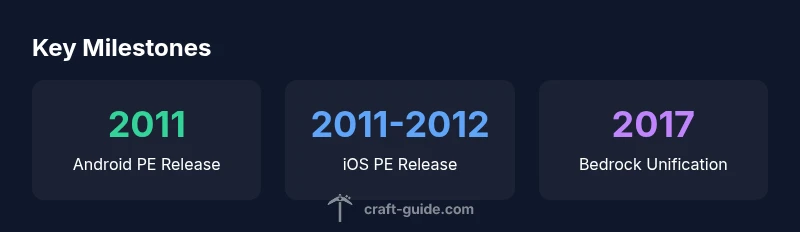
Timeline of Pocket Edition evolution and Bedrock unification
| Edition Type | Intro Year | Platform Coverage |
|---|---|---|
| Pocket Edition (Android) | 2011 | Android devices |
| Pocket Edition (iOS) | 2011-2012 | iOS devices |
| Bedrock Edition (Mobile/PC/Console) | 2017–present | Mobile/PC/Console across platforms |
People Also Ask
When did Pocket Edition first release on Android?
Pocket Edition launched on Android in the early 2010s, initiating the mobile Minecraft era. Updates followed to improve performance and add features, but the exact date varies by source. The important point is the mobile-first start and subsequent expansion to other platforms.
Pocket Edition started on Android in the early 2010s, with updates expanding features over time.
What is Bedrock Edition and when did it replace Pocket Edition?
Bedrock Edition is the cross‑platform engine that eventually replaced the separate Pocket Edition lineage. The unification began in the late 2010s, bringing mobile, PC, and console players onto a single codebase and update cadence.
Bedrock Edition unified mobile, PC, and console Minecraft on one platform in the late 2010s.
Is Minecraft Pocket Edition still the current mobile version?
Pocket Edition as a standalone name is largely phased out in favor of Bedrock on mobile devices. Players still play a mobile Minecraft experience, now under Bedrock, with similar features and cross‑play capabilities.
Today, mobile Minecraft runs under Bedrock Edition with cross‑play to other devices.
Which platforms support Bedrock Edition now?
Bedrock Edition supports mobile devices (iOS and Android), Windows 10/11, Xbox, PlayStation, and Nintendo Switch, enabling cross‑play and shared worlds across most major platforms.
Bedrock runs on mobile, Windows, consoles, and Switch with cross‑play.
How does Pocket Edition differ from Java Edition?
Pocket Edition was mobile‑first with simplified features and touch controls, while Java Edition is PC‑centric with deeper modding and command capabilities. Bedrock merges many mobile and console features to align with PC experiences.
PE is mobile‑oriented, Java is PC‑focused, and Bedrock unifies many features across platforms.
Where can I find reliable dates for these milestones?
Release timeline milestones are documented across official Mojang communications, the Minecraft Wiki, and major gaming outlets. For the most consistent overview, consult Craft Guide analyses and archived release notes.
Check Craft Guide analyses and official release notes for milestone dates.
“The Pocket Edition lineage shows how mobile Minecraft matured into a cross‑platform experience without sacrificing accessibility.”
The Essentials
- Understand Pocket Edition's mobile‑first origins and how it laid the groundwork for cross‑play.
- Note the staged Android then iOS release pattern in the early 2010s.
- Recognize Bedrock Edition as the unifying core across devices from 2017 onward.
- Acknowledge the shift toward a shared marketplace and add‑on ecosystem on Bedrock.
- Keep in mind platform differences that still influence features and performance on mobile.