When Did Minecraft Bedrock Come Out? A Timeline and Guide
Explore the release timeline of Minecraft Bedrock Edition, how it unified Pocket and Console editions, and how cross‑platform play evolved. A data-driven look by Craft Guide.


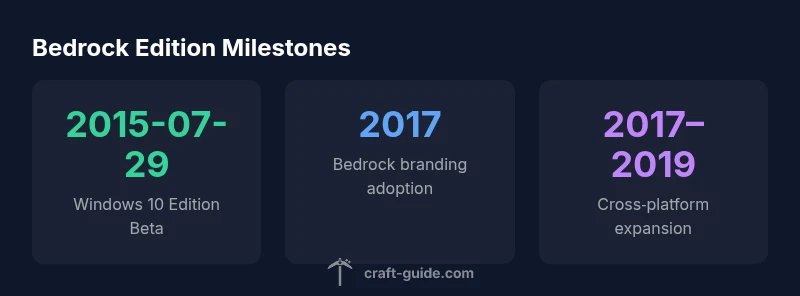
Minecraft Bedrock Edition originated as Windows 10 Edition Beta, released on July 29, 2015. It later unified Pocket Edition and console editions under a single codebase and branding, evolving into the Bedrock Edition with updates through 2017 and beyond, enabling cross‑platform play across Windows 10, consoles, and mobile devices.
Timeline of Bedrock Edition: From Windows 10 Beta to a Unified Codebase
If you're wondering when did minecraft bedrock come out, the earliest form of Bedrock originated as the Windows 10 Edition Beta, released on July 29, 2015. This version was designed to run across a broader set of devices than the classic Java Edition, laying the groundwork for a unified codebase. Over the next couple of years, Mojang and later Microsoft phased in updates that integrated Pocket Edition and console editions under a single Bedrock umbrella. By 2017 the branding solidified into Bedrock Edition across major platforms, enabling a more cohesive multiplayer experience. According to Craft Guide, the move to Bedrock reflected a shift toward cross‑device compatibility and a shared feature set, even as platform-specific differences persisted. The evolution wasn't a single date but a series of milestones that gradually merged code paths and features.
Throughout 2016 and 2017, the team worked to harmonize controls, world formats, and gameplay mechanics so players on Windows, mobile, and console stores could play together. This is why many players refer to Bedrock as the “unified edition”—a term that reflects both the technical consolidation and the growing ecosystem of cross‑platform content.
Craft Guide analysis shows that while Bedrock started in 2015, its public identity as a single ecosystem truly took shape between 2016 and 2017, when a dedicated cross‑platform update cadence began to emerge. This shift positioned Bedrock as the primary engine for new features moving forward, even as Java Edition continued to diverge on certain updates and performance paths.
What Bedrock Is and Why It Matters
Bedrock Edition represents a single, cross‑platform codebase designed to run on multiple devices with a consistent set of rules and mechanics. In practice, this means players on Windows 10, Android, iOS, Xbox, PlayStation, and Nintendo Switch can join the same worlds and share content in many cases. The core idea is compatibility and accessibility: developers and players no longer face a platform‑by‑platform gap for most features. It is important to note that Bedrock is not a perfect one‑to‑one replica of Java Edition—some features and commands differ, and performance can vary by device. For builders, breeders, and redstone enthusiasts, this distinction matters when porting maps or using platform‑specific blocks. The Craft Guide team emphasizes understanding these differences to maximize your creative and survival experiences across devices.
As Bedrock mature, the platform has emphasized performance improvements, input options, and marketplace support, which has driven a broader and more consistent user base. The shared codebase accelerates bug fixes and feature parity across devices, making it easier for players to transition between platforms without losing their progress or features. This unity underpins the modern Minecraft experience and explains why many players refer to Bedrock as the “cross‑platform edition.”
Platforms and Cross-Play: How Bedrock Connects Devices
Bedrock Edition is built to run on a wide range of platforms, including Windows 10/11, Xbox One and Xbox Series X|S, PlayStation 4/5, Nintendo Switch, iOS, and Android. The cross‑play capabilities were introduced progressively, with core synchronization across Windows and mobile devices first, followed by console support. While players can share most worlds and realms, some platform‑specific content and performance optimizations mean that experiences may vary by device. The marketplace, introduced in 2017, further broadened shared experiences by providing cross‑platform content that could be used across Bedrock devices. For players, this means a more unified multiplayer ecosystem, with fewer barriers when joining friends on different hardware.
For builders, this cross‑platform stability translates to more reliable seed sharing, map conversions, and a larger audience for custom content. The ongoing cadence of updates ensures that parity isn’t guaranteed in every release, but the general trajectory is toward a more seamless cross‑device experience. Craft Guide notes that staying on the latest Bedrock build is often the best way to access new features and cross‑play improvements.
The key takeaway is that Bedrock’s platform breadth supports diverse playstyles, from collaborative build projects on PC to quick adventures on mobile, all within a single, evolving ecosystem. This aligns with broader trends in gaming toward inclusive, cross‑platform play.
Milestones in the Bedrock Journey
From its inception as Windows 10 Edition Beta in 2015 to its broader cross‑platform roll‑out, Bedrock’s journey is defined by a steady cadence of milestones. One major milestone was the 2017 rebranding and expansion of the Bedrock codebase to include additional platforms. This shift laid the groundwork for the official Marketplace introduction in the same year, enabling creators to publish content that could reach a wider audience. Subsequent updates focused on performance, stability, and input options across devices, as well as continued improvements in world generation and biome variety. Craft Guide analysis highlights that these milestones collectively expanded Bedrock’s reach while maintaining a consistent core experience for players who switch between devices.
Additionally, Microsoft’s ongoing support for cross‑play meant that friends on different devices could join forces in multiplayer worlds, albeit with occasional device‑specific caveats. By 2019 and beyond, Bedrock had become the default engine for new features on most platforms, with Java Edition continuing to diverge on specific updates. For players, this evolution means more robust multiplayer opportunities, a thriving content marketplace, and easier location of friends across devices. The overarching lesson is that Bedrock’s milestones reflect a deliberate strategy to harmonize gameplay while preserving the unique strengths of each platform.
As a practical note, always verify your game version and platform compatibility when joining a cross‑platform session, because minor feature differences can affect how a seed or map behaves across devices. The Craft Guide team’s conclusion is that staying informed about platform support and update cadence is crucial to making the most of Bedrock’s cross‑play advantages.
How to Identify Bedrock vs Java and Your Version
Distinguishing Bedrock from Java Edition is straightforward if you know where to look. Bedrock Edition runs on Windows 10/11 as a separate app from the Java Launcher. It is also the edition that supports cross‑play across Windows, consoles, and mobile devices. If you see a “Bedrock” label on your launcher or in your store, you’re dealing with the unified edition. Conversely, Java Edition remains a distinct codebase primarily for PC players on Windows, macOS, and Linux, with its own set of optimizations and features that do not always appear in Bedrock. The differences extend to world formats, command syntax, and certain blocks or items that are Bedrock‑exclusive.
To determine which edition you’re playing, check the launcher icon or the game version in the main menu. If you’re on a platform like Android or iOS and you see “Minecraft” with Bedrock features (cross‑play and Marketplace access), you’re in Bedrock. The Craft Guide team suggests confirming on the official store page for your platform to avoid confusion when purchasing or updating.
When in doubt, run a quick cross‑check by loading a familiar world in both editions to observe any feature discrepancies or performance differences. This practical approach helps players tailor their expectations and ensure a smooth experience across devices.
Common Misconceptions About Bedrock’s Release Timeline
One common misconception is that Bedrock appeared fully formed in one release. In reality, Bedrock was built through a series of phased updates that began with the Windows 10 Edition Beta in 2015 and gradually expanded across platforms and features, culminating in a unified branding by 2017. Another misconception is that Bedrock and Java Edition share all features identically; while many updates are aligned, some content and mechanics remain platform‑dependent, which can affect how worlds transfer or how commands behave. The Craft Guide team emphasizes that the Bedrock journey is better understood as an evolving cross‑platform platform rather than a single launch moment.
Finally, some players assume that Marketplace content is exclusive to Windows, but by late 2017 it became a cross‑platform feature, allowing content creators to publish for Bedrock editions on multiple devices. Understanding these nuances helps players set realistic expectations when building, exploring, or competing in shared worlds.
Key milestones in Bedrock Edition timeline
| Milestone | Platform(s) | Approx. Date |
|---|---|---|
| Windows 10 Edition Beta launched | Windows 10 | 2015-07-29 |
| Branding unified to Bedrock Edition | Windows 10, Pocket Edition, Console | 2017 |
| Cross-platform play enabled | Windows 10, Xbox One/Series, iOS, Android, Switch | 2017–2019 |
| Marketplace introduction | Windows 10, Mobile | 2017 |
People Also Ask
What is Bedrock Edition and how does it differ from Java Edition?
Bedrock Edition is a cross‑platform codebase designed for Windows 10, consoles, and mobile devices, offset by some feature and command differences from Java Edition. Java remains a distinct edition with its own modding ecosystem and world formats. The two editions share many core mechanics, but certain updates and optimizations appear on Bedrock later or not at all on Java.
Bedrock is the cross‑platform edition; Java is a separate version with its own specifics.
When did Bedrock Edition first release?
Bedrock originated as Windows 10 Edition Beta released on July 29, 2015. The branding consolidated into Bedrock across platforms around 2017, with ongoing updates since.
Bedrock started as Windows 10 Edition Beta in 2015 and unified around 2017.
Which platforms support Bedrock Edition?
Bedrock runs on Windows 10/11, Xbox One and Series, Nintendo Switch, PlayStation 4/5, iOS, and Android. Cross‑play is supported across many of these, though some platform features may vary.
Bedrock supports Windows, Xbox, Switch, PS4/5, iOS, and Android.
Is Bedrock updated the same as Java Edition?
Updates are released on Bedrock across platforms with a cadence tied to platform certification. Some features arrive at different times compared to Java, so parity isn’t exact in every update.
Updates are coordinated but not identical to Java across all features.
What is the Bedrock Marketplace and when did it launch?
The Bedrock Marketplace launched in 2017, providing a shared store for skins, textures, and community content across Bedrock devices.
The Marketplace started in 2017 for Bedrock devices.
How can I tell if a world works on Bedrock or Java?
Bedrock and Java use different world formats. Worlds created in Java may not be directly compatible with Bedrock without conversion or re‑creation.
Java worlds often need conversion for Bedrock or recreation.
“Bedrock's unification across devices reshaped how players experience Minecraft, making cross‑play more accessible and content sharing more seamless.”
The Essentials
- Bedrock began as Windows 10 Edition Beta in 2015.
- The Bedrock branding unified across platforms by 2017.
- Cross‑platform play expanded to multiple devices over years.
- The Marketplace arrived in 2017 to support Bedrock content.
- Always check platform specifics to maximize Bedrock features.