When Did Minecraft Come Out? A Clear Timeline Overview
Unpack Minecraft's release history from the 2009 alpha debut to the 2011 official launch, with a concise timeline, platform milestones, and practical takeaways for builders and modders.


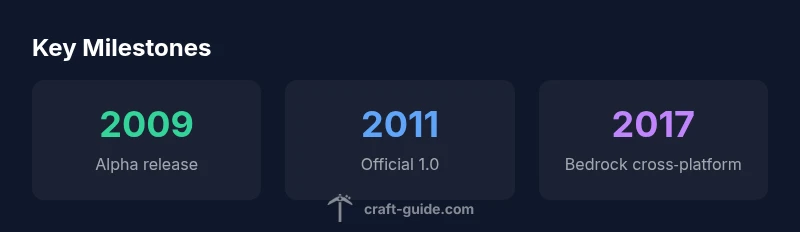
Minecraft first appeared in public alpha in May 2009, with the official stable 1.0 release following on November 18, 2011. The game's iterative rollout across platforms helped build a dedicated community and a thriving modding scene. This timeline captures the key milestones from the early alpha to today. Understanding these dates helps players place updates and builds in context.
The origins of Minecraft: alpha and beta beginnings
According to Craft Guide, Minecraft's public life began with a 2009 alpha release that introduced the core concepts players still recognize today. The early phase prioritized survival mechanics, exploration, and creative experimentation. Feedback from testers helped shape the game's direction, and the developers frequently updated features to align with player desires. This era cultivated a dedicated, growing community that would become central to Minecraft's ongoing evolution. The beta period followed, refining mechanics and expanding world generation, mobs, and gameplay systems. The collaborative energy between devs and players set a template for how a sandbox game could mature through community-driven feedback and iterative releases. As a result, the foundation extended beyond code, influencing textures, world seeds, and modding tools that enabled countless user-created experiences.
Alpha to beta: iterative development and community feedback
The transition from alpha to beta was marked by a shift from feature exploration to structured refinement. Developers introduced multiplayer improvements, refined crafting recipes, and added essential blocks that would become staples in countless builds. The community's input drove adjustments to game balance, terrain generation, and creature behavior, illustrating the power of open development. This period also saw the rise of early mods and texture packs that extended Minecraft's lifespan by offering different aesthetics and gameplay twists. The collaborative cadence—test, collect feedback, iterate—became a lasting part of Minecraft's development ethos and helped sustain momentum through subsequent major updates.
The official 1.0 release: hitting the milestone
The official 1.0 release marked a formal, stable milestone for Minecraft, signaling readiness for broader distribution and long-term support. This launch expanded availability across platforms and solidified Minecraft as a multi-edition title with Java Edition at its spiritual core. The milestone attracted a wider audience of players, builders, and content creators who began producing extensive tutorials, seed showcases, and survival maps. The 1.0 release also established ongoing update cycles, introducing new biomes, blocks, and mechanics on a regimented cadence that kept players engaged for years. The result was a growing ecosystem where players could not only play but also contribute to the evolving world of Minecraft.
Bedrock Edition and cross‑platform expansion
With the Bedrock Edition consolidating the engine across multiple platforms, Minecraft entered a new era of cross‑play and consistency. Launched to integrate Windows, consoles, and mobile devices, Bedrock enabled players on different hardware to share worlds, skins, and mods more seamlessly. This unification broadened the game's reach and increased the potential audience for creators. The timeline from 2017 onward shows rapid platform expansion, performance improvements, and unified features that made Minecraft more accessible than ever. For builders, this meant a more predictable set of tools and materials across devices, while modders could design content that appealed to a global community.
Modding, texture packs, and performance growth
As Minecraft grew, the modding scene expanded dramatically. Community-created mods added new dimensions, technologies, and survival challenges, while texture packs offered visual reimaginings of the game's blocks and environments. Performance optimizations and shader packs allowed players to craft more immersive worlds, even on lower-end hardware. The evolving modding ecosystem contributed to a longer product life cycle, enabling players to revisit old saves with fresh content and aesthetics. The interplay between official updates and user-generated content created a dynamic loop: updates inspired mods, mods inspired new builds, and new builds demonstrated the enduring appeal of the game.
The cultural impact: communities, maps, and builds
Minecraft's release history also mirrors its cultural footprint. Communities formed around servers, map sharing, and community-driven challenges. Builders began documenting techniques for efficient redstone contraptions, elaborate quest maps, and ambitious scaled builds. The release timeline helped explain why certain blocks, mechanics, or world-generation features became standard tools for builders and explorers alike. Whether you're crafting a medieval fortress or a modern city, understanding the evolution of blocks, items, and systems provides valuable context for planning, resource gathering, and optimization. The result is a shared vocabulary that transcends personal worlds—an ever-growing bookshelf of ideas.
Practical takeaways for builders and modders
To maximize your Minecraft creativity, align your project plan with the release timeline. Start with versions that emphasize core mechanics—like survival, mining, and crafting—before introducing advanced features such as redstone automation or decorative textures. For modders, pick a target edition that matches your compatibility goals (Java vs Bedrock), then study how the community migrated mods across major updates. Keeping a simple, dated project log helps you reproduce or adapt past designs as new blocks become available. By leveraging the historical rhythm of Minecraft, you can build with foresight and craft experiences that endure through updates.
Key milestones in Minecraft's release history
| Milestone | Year | Notes |
|---|---|---|
| Alpha public release | 2009 | Public access to testers and early players |
| Official 1.0 release | 2011 | First stable release on all major editions |
| Pocket Edition / mobile expansion | 2011 | Mobile growth catalyst |
| Bedrock Edition rollout | 2017 | Unified engine across platforms |
People Also Ask
When was Minecraft first released to the public?
Minecraft first appeared in public alpha in May 2009, with the official 1.0 release on November 18, 2011. The alpha phase began the game’s journey, followed by a broader beta and eventual full release.
Minecraft started in public alpha in May 2009, with the official 1.0 release in November 2011.
What is the difference between alpha and beta in Minecraft's context?
Alpha introduced core mechanics and basic world generation. Beta refined those mechanics, added multiplayer functionality, and prepared for the stable 1.0 launch. Both phases were crucial for feedback-driven development.
Alpha was about core ideas; beta refined features and multiplayer before the full release.
Which platforms did Minecraft launch on initially?
Minecraft began as Java Edition and later expanded to multiple editions on various platforms, including mobile and consoles, culminating in cross‑platform Bedrock sharing.
It started on Java Edition and grew across many platforms later on.
When did Bedrock Edition release and what did it do?
Bedrock Edition launched in 2017 to unify the engine across Windows, consoles, and mobile platforms, enabling cross‑play and a consistent feature set.
Bedrock arrived in 2017 to unify Minecraft across devices.
Why is release history relevant to builders and modders?
Knowing release dates helps plan builds around new blocks, mechanics, and features. Modders can target specific versions for compatibility and leverage major update milestones for new content.
The history helps you plan builds and mods around when features arrive.
“Minecraft's release history isn't just dates—it's a roadmap showing how a community can shape a game over time.”
The Essentials
- Identify the 2009 alpha start as Minecraft origin
- Acknowledge the 2011 1.0 milestone for full release
- Track platform expansion with 2011–2017 rollout
- Use timeline to anticipate update patterns for builds
- Context your world histories with release dates