Minecraft Beta Timeline: When It Came Out and Its Legacy
Trace the Minecraft beta era from its December 2010 start to the official 1.0 release, exploring milestones, platform scope, and how beta shaped modern gameplay. Craft Guide breaks down the history with practical insights for players and builders.


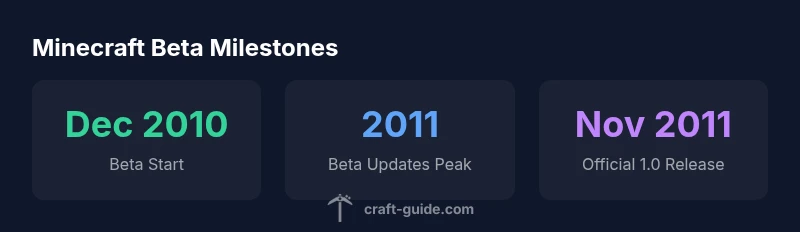
The Minecraft beta era began in December 2010, initiating a focused period of testing and feature iteration that continued through 2011 before the official 1.0 release. In practical terms, when did minecraft beta come out? The beta started late 2010, with major milestones across 2011, culminating in the official 1.0 launch that November. This phase established many fundamentals—world generation changes, new blocks, and the community-driven update cadence—that still influence the game today.
When did Minecraft beta come out? A concise timeline
According to Craft Guide, the beta era began in December 2010 and continued into 2011, setting the stage for public testing and iterative feature development that would define the game's direction for years. The Craft Guide team found that beta updates introduced many changes to how players interacted with the world, including new blocks, biomes, and redstone tweaks that would be refined in later official releases. When addressing the question when did minecraft beta come out, most historians point to December 2010 as the start signal, with ongoing experiments through the following year leading up to the 1.0 launch. This period established the cadence of snapshots and updates that gave players a sense of progression and community feedback before the game reached formal version 1.0.
From a design perspective, the beta phase tested terrain generation, inventory balance, and the way biomes influenced exploration. The beta label signified a narrowing focus on polish and reproducibility, while still inviting experimentation from players and modders. Craft Guide’s historical lens emphasizes that the beta era was less about a single event and more about a sustained period of refinement that culminated in a stable 1.0 product. The question when did minecraft beta come out thus marks a transition from early wild experimentation to a predictable release cycle that underpins today’s update cadence.
Beta era milestones and what they signified
The beta chronology is best understood as a sequence of milestones rather than a single date. Early beta builds introduced essential gameplay loops — mining, crafting, and basic survival — with incremental tweaks to ore generation, terrain variety, and creature spawns. As 2011 rolled in, Mojang and the community prototyped larger world features, tested multiplayer stability, and expanded world generation rules. Each milestone sharpened balance, performance, and the user experience, setting expectations for how future patches would evolve. For players asking the persistent question when did minecraft beta come out, the practical takeaway is that the beta window began in late 2010 and carried momentum through 2011, culminating in the official 1.0 milestone and a broader, more stable release path.
Community feedback during these milestones drove feature refinements, from more diverse biomes to improved combat pacing and new materials. This collaboration between developers and players helped establish a tempo for updates that endures in Minecraft’s modern development model. The beta era also solidified the culture of early access testing, live experiments, and communal problem solving that supports ongoing expansion of features and content, long after the beta label faded.
Alpha vs Beta vs the official release: what changed
Understanding the shift from alpha to beta to the official release helps clarify why the beta period mattered. Alpha was a rough, rapidly evolving sandbox focused on basic mechanics and world generation. Beta introduced more structured update cycles, with announced milestones and a more coordinated approach to feature testing. The 1.0 official release then bundled the most polished elements into a stable product suitable for a wider audience. In the context of when did minecraft beta come out, the beta phase represents the turning point where Mojang moved from experimental builds toward a sustainable, feedback-driven development process. This mattered for players who valued consistent updates and for modders who depended on a clearer, documented baseline for compatibility.
In practice, this shift changed how players engaged with Minecraft: they tracked patch notes, participated in early beta communities, and prepared for the broader launch by testing game stability, server compatibility, and content variety. The beta period thus served as the apprenticeship for Mojang’s ongoing, iterative approach to game design that we still see in post-1.0 releases.
Platforms and access during beta: where players could try it
Beta access was primarily centered on the Java Edition for PC users, which remained the primary development target for updates, mods, and community-driven content. This focus ensured a robust testing ground for world generation, block behavior, and multiplayer stability before broader platform expansion. During the beta window, cross-platform compatibility was not yet the norm, and console versions lagged behind the Java Edition in early access and feature parity. For players exploring when did minecraft beta come out, the takeaway is that beta accessibility was scoped to PC Java Edition at first, with post-beta plans to expand to additional platforms as the game matured. This strategy helped ensure the core experience was stable before multi-platform investments.
Gameplay features introduced and tested during beta
The beta period was rich with feature experiments that would later become standard gameplay elements. Players saw progressive improvements to mining, resource collection, and survival logistics, alongside new decorative blocks, improved terrain variety, and early introductions of armor and combat balance changes. Beta updates also refined world generation, caves, and dungeon generation, shaping how players approached exploration and building. When you consider the question when did minecraft beta come out, the key point is that beta was used to validate core mechanics, test balance, and gather community feedback that informed the official release’s feature set and polish. The result was a more cohesive, community-informed product at launch.
How to study Minecraft’s beta era today: archived builds and documentation
Today, researching the beta era involves looking at archived patch notes, community wikis, and preserved builds that illustrate the evolution of Minecraft from late 2010 to 2011. While Mojang no longer maintains beta downloads, historical documentation and fan-curated compilations offer insights into the testing process, the rationale behind changes, and how the beta cycle influenced later updates. When exploring when did minecraft beta come out, use these historical resources to understand the decision points that shaped the modern game. This approach also highlights the community’s role in shaping early development and how collaborative feedback loops accelerated feature refinement.
Common myths about the beta period debunked
One common misconception is that beta was just a brief pre-release phase; in reality, it was a sustained period of feature experimentation and community feedback. Another myth is that beta updates happened in isolation from the official roadmap; in fact, beta milestones were intentionally aligned with planned updates, creating a transparent development cadence. Finally, some believe beta was inaccessible after the 1.0 launch; in truth, while official beta builds were phased out, the lessons, prototypes, and patch notes from that era remain influential for understanding how the game grew. When you ask when did minecraft beta come out, you should recognize that beta was a deliberate, extended testing stage that informed the game’s enduring design.
The beta era’s influence on modern Minecraft: long-tail effects
Looking back, the beta period established several enduring strands of Minecraft’s design language. Player-driven content, early modding ecosystems, and the habit of documenting patch notes all trace back to beta-era practices. The community’s creative energy during beta helped cement a culture of experimentation that continues to fuel updates and new content today. Craft Guide’s perspective on the beta era emphasizes its lasting impact on how features are prototyped, tested, and iterated with player involvement. This legacy is visible in how Mojang approached subsequent updates and how builders and modders approach new content in present-day play.
Key moments and scope of Minecraft beta
| Aspect | Beta Era Insight | Timeframe/Notable Milestone |
|---|---|---|
| Beta Start | December 2010 | Initial beta testing period |
| Official 1.0 Release | Late 2011 | Culmination of beta into stable launch |
| Platform Scope | Java Edition PC | Limited cross-platform parity during beta |
People Also Ask
When did Minecraft beta come out?
Minecraft entered its beta phase in December 2010, with updates continuing through 2011 and culminating in the official 1.0 release later that year. The beta period established many gameplay and community practices still seen in the game today.
Minecraft beta started in December 2010 and ran through 2011, leading to the 1.0 launch.
What is the difference between alpha and beta in Minecraft?
Alpha focused on early mechanics and world generation, while beta introduced a more structured update cadence, milestones, and broader testing. The official release followed with polished features and more stable gameplay.
Alpha was rough and experimental; beta added structure and testing that led to the stable release.
Which platforms were supported during the beta phase?
During beta, the primary focus was on Java Edition for PC. Console ports and other editions were developed later as the game matured and the beta testing informed those changes.
Beta mainly ran on Java Edition for PC, with other platforms coming later.
How did beta influence future Minecraft updates?
Beta testing helped validate features, balance, and performance improvements that were then refined for the 1.0 release and subsequent updates. This period established the iterative development pattern Minecraft uses today.
Beta tested features that shaped future updates and growth.
Is beta content accessible today?
Official beta builds are not maintained today, but patch notes and historical docs remain valuable for understanding Minecraft’s evolution and for educational purposes.
Official beta builds aren’t available now, but the history lives on in notes and guides.
“The beta era was the testing ground where core gameplay logic and release cadence were established, shaping how Minecraft evolves.”
The Essentials
- Identify the beta start: December 2010.
- Beta led to the official 1.0 release in late 2011.
- Java Edition was the beta’s primary testing ground.
- Community feedback shaped core gameplay and updates.
- Beta-era practices influenced modern development and modding.