When Did Minecraft Release? A Timeline from Alpha to 1.0
Explore when Minecraft released, tracing its public alpha in 2009 to the 2011 1.0 launch and the milestones that followed, with practical context for players and builders.


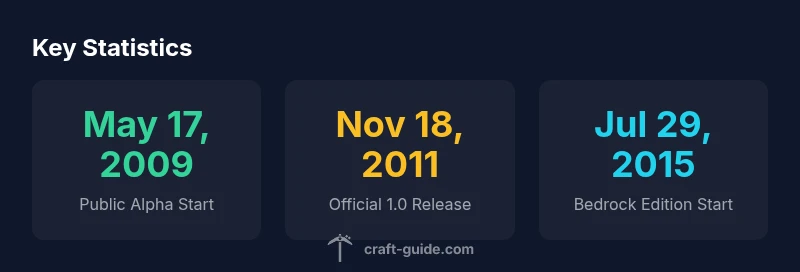
Minecraft first released to the public as an alpha build on May 17, 2009, marking the game's official start. The project later progressed through beta stages and snapshots before its official full release on November 18, 2011. This release timeline is the backbone of Minecraft’s enduring growth and community-driven development.
History: From alpha to the 1.0 milestone
According to Craft Guide, the timeline for when Minecraft released is best understood by tracing its public milestones. The game began as a small indie project by Markus Persson, released publicly as alpha on May 17, 2009. Early builds—collectively known as Indev and Infdev—introduced core ideas: mining, crafting, and survival, all tested by a growing community. Each snapshot added features and refinements, while multiplayer servers began to emerge. The community feedback loop shaped the direction of subsequent updates, including combat balance, world generation, and new blocks. The development pace was rapid; players joined, offered feedback, and the developer team continuously refined the game's mechanics. As a result, what started as a modest project grew into a global phenomenon. The simple public alpha debuted on May 17, 2009, but the story extends far beyond that date. Craft Guide analysis shows that this early phase established the culture of continual iteration and player-driven development that defines the game today.
The 1.0 Official Release: November 18, 2011
November 18, 2011 marked Minecraft's official 1.0 release, the culmination of years of development and public testing. This milestone, announced during MineCon 2011, signaled a formal launch beyond the experimental alpha and beta stages. The 1.0 update introduced the End dimension, additional biomes, and refined world generation, providing the stable foundation for ongoing updates. It also solidified the concept of editions across platforms that would appear in following years. The Craft Guide team views 1.0 as the turning point where Minecraft entered its long-term growth era, attracting a broader audience and enabling a thriving ecosystem of servers, modders, and creators.
Indev, Infdev, Beta: the development ladder before 1.0
Between 2009 and 2011, Minecraft traversed Indev, Infdev, and Beta phases. Indev (in development) and Infdev (in development) introduced world generation rules, mining, crafting, and the now-iconic terrain. Beta followed with broader testing and more formal releases, and the community grew around servers, mods, and resource packs. The Craft Guide team notes that these phases were not mere trials; they were the proving ground that built the game's core loop. Players could purchase snapshots, try new blocks like pistons and glass, and report bugs. This iterative process produced a more complete product and helped build the community that would shepherd the game through its 2011 release and beyond.
Platform expansion: from PC to consoles and cross-play
While the earliest releases ran on PC, the following years broadened access across platforms. The Windows 10 and Bedrock Edition unified code and enabled cross play across Windows, consoles, and mobile devices. Console editions launched on Xbox 360 in 2012, followed by PS3 and others, expanding the game's reach and social possibilities. The shift to cross platform play changed how builders collaborated, released content, and shared maps. Craft Guide analysis shows that platform expansion was essential to sustaining momentum, turning Minecraft from a PC curiosity into a global phenomenon.
The years after 1.0: updates, editions, and ongoing evolution
After 2011, Minecraft continued to evolve through frequent updates, introducing new blocks, mobs, and biomes, as well as performance improvements. Updates like 1.2, 1.3, and 1.8 expanded gameplay, while the emergence of the Bedrock Edition consolidated cross platform play. The community remained central, with servers, texture packs, and mods flourishing alongside official patches. The Craft Guide team emphasizes that this ongoing evolution is a keystone of Minecraft's longevity: a simple sandbox that keeps growing without losing its original charm.
Verifying release dates: how to check facts and sources
To verify release dates, rely on a mix of primary sources (official release notes, Mojang/Microsoft announcements) and reputable secondary references (encyclopedias, educational outlets). The Minecraft Wiki provides version histories, while outlets like Britannica offer contextual overviews. When referencing a date, specify edition (Java vs Bedrock) and platform, since different tracks have different milestones. Craft Guide's approach is to cross-check multiple sources and to document the edition and date clearly so readers can verify the history themselves.
Common misconceptions and clarifications
One common misconception is treating May 2010 as the release date. In reality, May 17, 2009 is when the public alpha started; the official 1.0 release was on November 18, 2011. Another pitfall is assuming all editions shared the same timeline. Java Edition hit 1.0 in 2011, while Bedrock and console editions appeared later with separate milestones. Distinguishing alpha, beta, and 1.0 ensures accurate references.
Practical implications for builders and modders
Understanding the release history helps with compatibility planning, mod dependencies, and map creation. Build files and world generation rules can differ between Java and Bedrock editions, so projects must be aligned to the intended edition. Early community content—maps, resource packs, and mods—often targeted Java Edition; later content shifted to Bedrock or cross-platform formats. Craft Guide suggests documenting edition and version when sharing tutorials or builds, so players know exactly which rules apply.
How to verify dates for your own Minecraft projects
Use official release notes and archived posts to confirm dates for a given version. Cross-check with the Minecraft Wiki's version history, and consult Britannica or other reputable outlets for context. If you claim that a feature arrived in a specific update, provide the date and edition to reduce confusion. Craft Guide's method centers on precision, transparent sourcing, and clear edition labeling.
Craft Guide verdict: anchor dates and ongoing evolution
From Craft Guide's perspective, the two anchor dates—May 17, 2009 for public alpha and November 18, 2011 for the 1.0 release—anchor Minecraft's release history. Everything else is a cascade of updates, cross-platform efforts, and community innovation that built the game into a worldwide phenomenon. For players and builders, the key takeaway is to understand the edition you’re working with and to appreciate the iterative approach that defines Minecraft. The Craft Guide team recommends focusing on the core milestones, recognizing that the story continues with every new patch and platform.
Timeline of Minecraft release milestones
| Event | Date | Notes |
|---|---|---|
| Public alpha release | May 17, 2009 | Initial public alpha |
| Official full release (Java Edition 1.0) | November 18, 2011 | MineCon 2011 milestone |
| Xbox 360 Edition launch | May 9, 2012 | First console edition |
| PS3 Edition launch | December 17, 2013 | Console edition |
| Windows 10 / Bedrock Edition launch | July 29, 2015 | Cross-platform edition |
People Also Ask
When was the first public alpha release of Minecraft?
The first public alpha release occurred on May 17, 2009, marking the game's public start. It began the public feedback loop that shaped subsequent updates.
The first public alpha release was May 17, 2009.
What is the difference between alpha, beta, and full release?
Alpha refers to early testing builds with core ideas; Beta signified broader testing and feature refinement; the full release (1.0) marked a stabilized, publishable product. Each stage contributed to balance, content, and performance.
Alpha is early testing, Beta is broader testing, and 1.0 is the official full release.
When was the official 1.0 release?
Minecraft's official 1.0 release occurred on November 18, 2011, announced at MineCon 2011, and marked the game's transition to a complete product.
1.0 was released on November 18, 2011.
Did Minecraft release on consoles?
Yes. The first console edition, Xbox 360, launched in 2012, followed by other consoles. Console versions introduced distinct milestones and supported later cross‑platform play with Bedrock.
Yes, first on Xbox 360 in 2012, with subsequent consoles.
What editions exist today?
Today Minecraft primarily runs as Java Edition on PC and Bedrock Edition across Windows, consoles, and mobile, enabling cross‑play between compatible devices.
Java Edition on PC and Bedrock across Windows and devices with cross-play.
How can I verify release dates for a specific version?
Check official release notes and archived posts, then cross-check with reputable references such as the Minecraft Wiki and Britannica to confirm the exact edition and date.
Check official notes and reputable sources to confirm dates.
“Minecraft's release history isn't just dates—it's a story of iterative design and community-driven growth.”
The Essentials
- Anchor dates anchor the release history.
- Distinguish alpha, beta, and 1.0 when citing dates.
- Cross-platform editions broaden player communities.
- Verify dates using multiple reputable sources.