What to Buy Minecraft On: Java vs Bedrock (2026)
Explore Java and Bedrock editions to decide what to buy Minecraft on. Compare cross‑play, mods, performance, and platforms in this analytical Craft Guide guide for players of all skill levels.


Java Edition on PC offers deep modding and vast server options, while Bedrock Edition provides true cross‑platform play across Windows, consoles, and mobile. For most players, your choice hinges on whether you prioritize modding and servers (Java) or cross‑device play and performance (Bedrock). Craft Guide's comparison helps you decide what to buy Minecraft on.
What to buy minecraft on: edition fundamentals
When you start thinking about what to buy minecraft on, the most important decision is choosing the edition that matches your device ecosystem and play style. The Java Edition is the original PC version, famed for its expansive modding scene, dedicated servers, and a strong creator community. The Bedrock Edition, on the other hand, is engineered for cross‑platform play, with smoother performance across devices and access to a unified marketplace. According to Craft Guide, this choice often sets the trajectory of your early game experiences, shaping world creation, server interactions, and how you’ll approach updates. The keyword you’re chasing here—what to buy minecraft on—revolves around whether you want a PC‑first, mod‑assisted environment or a broadly compatible, device‑spanning package that plays nicely with friends on consoles and phones.
Edition differences at a glance: core concepts
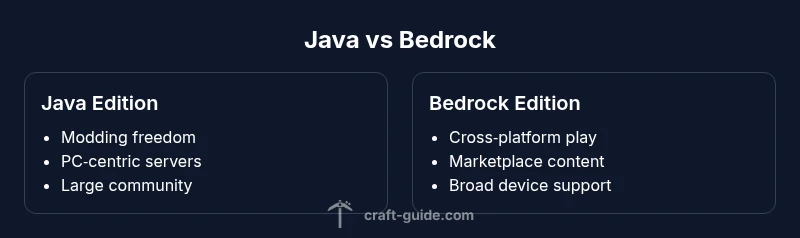
Modern Minecraft fans weighing the two editions should anchor their decision on three pillars: cross‑play potential, modding freedom, and platform availability. Java Edition runs on Windows, macOS, and Linux with a focus on keyboard/mouse control and extensive server options. Bedrock Edition is built for Windows 10/11, Xbox, PlayStation, Nintendo Switch, iOS, and Android, delivering near‑uniform gameplay across devices and tighter integration with the Marketplace. This block explains why the split exists and what that split means for your daily sessions, world design, and multiplayer ambitions. Craft Guide notes that the core tension is between customization liberty (Java) and cross‑device convenience (Bedrock), a theme that permeates every subsequent comparison.
Cross‑play and community dynamics
Cross‑play is a central factor in the Bedrock Edition. It enables friends on a PC, console, and mobile device to join the same world, assuming they’re all on Bedrock. Java Edition offers a vast, dedicated PC community with servers, mods, and plugins that tailor experiences in powerful ways, but it remains isolated from Bedrock players. The result is two distinct communities and two separate upgrade paths. For players who value collaboration across devices, Bedrock provides the smoothest route to inclusive play; for those who crave modding depth and bespoke server cultures, Java remains the gold standard.
Modding and customization ecosystems
Modding is where Java shines brightest. The Java Edition supports a thriving ecosystem of mods, forks, and server software that lets you alter gameplay, graphics, and mechanics far beyond vanilla limits. Bedrock offers add‑ons and a curated Marketplace, but its modding flexibility is intentionally narrower to maintain cross‑platform compatibility. If your goal is to run a private server with heavy customization, Java serves you best; if you want a stable, cross‑device experience with simpler content curation, Bedrock is the more practical path. Craft Guide emphasizes that your comfort with installing third‑party software will influence your choice.
Performance expectations across devices
Performance varies sharply by edition and device. Bedrock is typically optimized for broad hardware ranges, delivering consistent frame rates on mid‑tier machines, tablets, and consoles. Java can demand more CPU power—especially with mods or large world data—and performance hinges on the world size, plugins, and server load. If you’re playing on a high‑end PC, Java can feel incredibly responsive and customizable; on weaker devices, Bedrock’s engine tends to be more forgiving. This nuanced reality underlines why device context matters as much as the edition you select.
Purchasing model, access, and account setup
Buying Minecraft on Java generally means purchasing a license for the Java Edition on PC/Mac, with access through the official launcher. Bedrock purchases cover multiple platforms under a single license framework, with the Windows 10/11 version often bundled with cross‑play features and Marketplace access. Realms and servers behave differently across edits, so double‑checking how you intend to play—solo vs. multiplayer, friends vs. public servers—helps prevent later friction. The decision about what to buy minecraft on ultimately ties to account setup, device ownership, and planned communities.
Marketplace content and content distribution
Java’s ecosystem thrives on user‑generated content: maps, skins, and adventure worlds built by players, hosted across community sites and private servers. Bedrock’s Marketplace offers curated content from official partners, with a focus on compatibility across platforms. If you value a storefront experience with consistent, device‑native purchases, Bedrock’s Marketplace is a clear benefit; if you want unlimited mod packs and community maps, Java’s ecosystem has more to offer. Craft Guide stresses weighing these differences against your preferred content style.
Updates, longevity, and future‑proofing
Both editions receive frequent updates, but the cadence and scope differ. Java players often benefit from early access to certain features and the excitement of community‑driven development cycles. Bedrock users gain quicker cross‑platform feature parity and coordinated updates across devices, which helps long‑term planning for multiplayer sessions. Understanding the update philosophy of each edition can help you forecast how your world and communities will evolve over the next few years.
Practical decision profiles: 7 quick scenarios
- You play mostly on a PC with a strong modding habit: Java Edition is the best fit.
- You want to play with friends on consoles or phones: Bedrock Edition is the clear winner.
- You expect to join large public servers with a thriving plugin ecosystem: Java shines here.
- You value a marketplace for add‑ons and skin packs across devices: Bedrock’s marketplace offers convenience.
- You’re budget‑minded and plan to buy once across devices: Bedrock’s cross‑platform approach may deliver better value.
- You prefer a stable, uniform experience on varied hardware: Bedrock minimizes performance variance.
- You want future cross‑play potential as devices change: Bedrock tends to keep parity across platforms over time.
Authority sources: trust‑but‑verify
Both editions have vibrant communities and official guidance, with in‑depth coverage by major publications and official pages. For further context and independent perspectives, see PC Gamer’s comparison pieces and The Verge’s platform analyses, along with official Minecraft resources for Bedrock and Java editions. Craft Guide urges readers to consult multiple sources when deciding what to buy minecraft on.
How to migrate or switch editions later
Switching between Java and Bedrock is not a simple upgrade path—it's a purchase decision with implications for worlds, servers, and mods. If you anticipate wanting features from both ecosystems, plan upfront for separate purchases and potential world imports where available. Always back up worlds before attempting any cross‑edition actions.
Final practical checklist
- List all devices you currently own and any future purchases planned; prioritize cross‑play if friends are across devices.
- Decide whether modding freedom or curated content matters more for your gameplay style.
- Consider whether you will join public servers or build private worlds; this affects both edition and server choices.
- Review content availability and Realms options on both editions to ensure your long‑term plans align with your budget.
Authority sources: technical appendix
This section consolidates sources for readers who want external validation of the Java vs Bedrock differences, including major gaming publications and official Minecraft documentation. It complements the main analysis by offering third‑party perspectives and platform‑specific nuances.
Comparison
| Feature | Java Edition (PC/Mac) | Bedrock Edition (Windows 10/11, consoles, mobile) |
|---|---|---|
| Cross‑play | No cross‑play with Bedrock; PC‑only multiplayer among Java players | Cross‑platform across Windows, Xbox, PlayStation, Switch, iOS, Android |
| Modding and customization | Extensive mods, plugins, and server software | Limited add‑ons; official marketplace content |
| Performance on hardware | CPU‑intensive; benefits from powerful PCs | Optimized for broad device range; strong on mid‑range hardware |
| Content marketplace | Community‑driven maps, skins, and data packs | Structured marketplace with official partners |
| Purchasing model | Separate Java license; launcher ecosystem | Single license across platforms; cross‑purchase dynamics |
Benefits
- Clear differentiation helps players choose based on play style
- Java edition offers extensive modding and private servers
- Bedrock edition enables cross‑platform multiplayer
- Marketplace and community support across devices
Negatives
- Separate purchases when switching editions
- Modding is limited on Bedrock
- Cross‑edition migration challenges exist
- Platform differences can cause feature gaps (Realms, mods, and servers)
Bedrock edition is the best all‑round choice for players seeking cross‑platform play, while Java edition remains superior for modders and PC‑centric communities
If cross‑play and device variety matter most, pick Bedrock. If you crave extensive mods and robust private servers, choose Java. Craft Guide’s analysis supports this split, with a practical framework to decide what to buy minecraft on.
People Also Ask
Is Minecraft Java Edition available on consoles?
No. Java Edition is PC‑centric and not officially supported on consoles. Bedrock Edition runs on Windows, consoles, and mobile, enabling cross‑play across platforms.
No, Java isn’t available on consoles; Bedrock is the edition designed for cross‑platform play across devices.
Can Bedrock and Java editions play together?
No. Java and Bedrock editions do not support cross‑play with one another. Players must choose one edition to play with their friends unless those friends also use the same edition.
Java and Bedrock can’t play together; pick one edition for your group.
Do I need to buy Java if I already have Bedrock?
Yes. Java and Bedrock are separate editions with distinct licenses. If you want features exclusive to Java, you’ll need a Java purchase even if you own Bedrock.
Yes, you’d need a separate Java purchase if you want Java‑specific features.
Which edition is better for mods?
Java Edition has the most robust modding ecosystem with plugins and community tools. Bedrock supports add‑ons and marketplace content but offers less modding depth.
Java is best for mods; Bedrock offers add‑ons and a marketplace, but mods are limited.
What is Realms, and is it available on both editions?
Realms availability and features vary by edition. Bedrock has Realms with cross‑platform play; Java has its own server and realm options, but compatibility differs. Check current official guidance for specifics.
Realms exist in both editions, but features differ; verify current details before buying.
The Essentials
- Choose Bedrock for cross‑platform play and broad device compatibility
- Opt for Java if modding depth and private servers are essential
- Assess content storefronts: Marketplace vs. community mods
- Plan ahead for potential cross‑edition needs and server access points
- Factor device availability and budget into a single, pragmatic decision