Minecraft Java and Bedrock Edition: A Side-by-Side Comparison
An analytical, in-depth comparison of Minecraft Java Edition vs Bedrock Edition, covering modding ecosystems, cross-platform play, performance, content distribution, and long-term support to help players choose the right path.


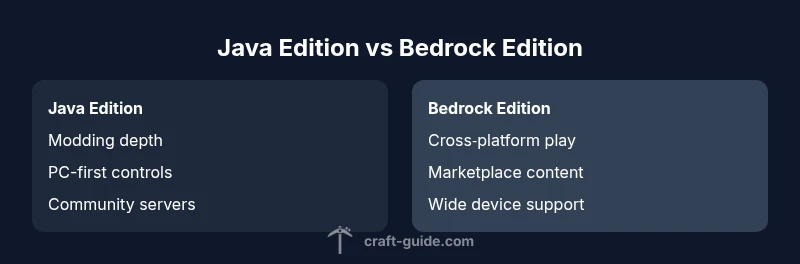
Short answer: Java Edition shines in customization, mods, and classic PC controls; Bedrock Edition excels in cross‑platform play, performance on a wide range of devices, and a unified marketplace. If you want heavy modding and a traditional PC feel, go Java. If you value cross‑device multiplayer and smoother access, choose Bedrock. This article compares both to help you decide.
The Editions at a Glance
Minecraft Java Edition and Bedrock Edition present two paths through the same game universe, each with distinct strengths and trade-offs. Java Edition remains the long-running, PC-focused pillar with expansive modding, fine-grained control schemes, and a culture of discovery built around community servers and custom maps. Bedrock Edition, by contrast, is designed for broad device compatibility and streamlined multiplayer experience, uniting Windows, consoles, and mobile under a single ecosystem and marketplace. According to Craft Guide, the choice between editions often boils down to how you intend to build, play, and share your world. The Craft Guide team emphasizes that neither edition is inherently “better”—they are optimized for different playstyles. In this article, we compare both in terms of mod support, cross-platform play, performance, content distribution, and long-term ecosystem health, so players can make a decision aligned with their goals. The following sections will map out the differences with clear, actionable guidance, avoiding hype and focusing on practical outcomes for real-world play.
Core Gameplay: World Generation and Behavior
World generation and in-world behavior illustrate the core differences between the two editions. Java Edition tends to emphasize flexible world rules, wide variety in biome generation via community-crafted seeds, and a culture of experimentation that invites players to tinker with mechanics. Bedrock Edition emphasizes consistency across devices, streamlined world generation rules, and stability when played on different hardware configurations. The Craft Guide Team notes that these design priorities shape not only the feel of exploration but also how players approach challenges like building, farming, and exploration. When deciding, consider how important precise world behavior and mod-driven customization are to your playgroup versus reliable cross‑device access and predictable performance. The takeaway is that both editions offer deep, satisfying gameplay, but the emphasis shifts depending on your hardware, network, and creative goals.
Modding, Customization, and Add-ons
The modding landscape is the defining difference for many players. Java Edition has a long-standing, robust ecosystem built around loadable mods, major mod loaders, and community-created tools that push the boundaries of what is possible in Minecraft. This ecosystem enables players to alter gameplay, optics, and systems in profound ways. Bedrock Edition, meanwhile, offers add-ons and a curated Marketplace that provide official content and community scenes, with a focus on accessibility and cross‑platform distribution. The Craft Guide Analysis, 2026, highlights that Java’s flexibility makes it the preferred venue for traditional modders, while Bedrock’s add-ons cater to players who value convenience and a standardized content pipeline. For new players, a practical approach is to begin with native add-ons on Bedrock and explore Java mods later if customization becomes a priority.
Cross-Platform Play and Multiplayer Infrastructure
Cross-platform play is one of the clearest differentiators. Bedrock Edition is designed from the ground up to support cross‑device multiplayer, enabling friends on Windows, consoles, and mobile to join the same worlds. This creates a broad, inclusive multiplayer experience and strengthens community growth. In contrast, Java Edition remains the origin point for many servers, communities, and modded experiences that are not directly compatible with Bedrock. Cross-play between Java and Bedrock is not officially supported, which has a meaningful impact on matchmaking, server choice, and collaboration across platforms. The Craft Guide Team emphasizes planning ahead: if your group spans devices, Bedrock is typically the smoother path; if you crave modded PCs and custom servers, Java remains the preferred lane.
Controls, UI, and Accessibility
Input methods and interface design reflect the target audiences of each edition. Java Edition leans into keyboard and mouse precision, with deeply configurable controls, and a launcher ecosystem that supports multiple profiles and worlds. Bedrock Edition emphasizes modern, accessible interfaces that work well with controller input on consoles and with touch on mobile devices, augmented by a single sign-on and cross-platform friend list. This difference matters for newcomers who prioritize ease of setup and for veterans who enjoy fine-tuning their control schemes. The result is two distinct but equally capable user experiences, tailored to different hardware realities and playstyles.
Performance, Latency, and Device Requirements
Performance considerations differ across devices and network conditions. Java Edition can run very well on capable PC hardware, particularly when software optimizations and mods are not pushing the limits. Bedrock Edition is engineered for broad device compatibility, including lower-spec devices, and tends to deliver smoother performance on a wider array of hardware configurations. Latency and world responsiveness also reflect engine optimizations and streaming strategies, which influence how quickly you see changes and how responsive builds feel during multiplayer sessions. Craft Guide’s analysis notes that performance is highly dependent on the chosen edition, server settings, and the quality of the networking stack. When you select an edition, pair it with a server setup that matches your expectations for latency and reliability.
Marketplace, Content Creators, and Economy
Content ecosystems shape how players pay for and access enhancements. Java Edition thrives on community-made worlds, mods, and resource packs, with a culture that prizes creativity and shared knowledge. Bedrock Edition centers around a Marketplace and add-ons that streamline distribution and monetization, enabling a more centralized content pipeline. This distinction matters when evaluating value: Java offers a freer, more experimental landscape with free and paid content from a global community; Bedrock provides a more curated set of experiences that may involve purchases for premium content. The Craft Guide Team encourages players to balance creativity with accessibility, recognizing that both ecosystems host vibrant, growing communities.
Updates, Support, and Longevity
Update cadence and support perceptions vary by edition. Java Edition often leads with community-driven improvements, fan-made tools, and the latest experimental features, while Bedrock Synchronizes updates across platforms to ensure a consistent experience for cross‑device players. This alignment across platforms can be advantageous for families and groups who want to play together regardless of device. However, the speed and scope of official changes may differ, particularly for experimental content or big technical shifts that impact compatibility. The Craft Guide Analysis, 2026, suggests that players should track both editions’ ecosystems to anticipate breaking changes and to plan mod or add-on transitions accordingly.
Server Hosting, Realms, and Community Resources
Community infrastructure is essential for long-term enjoyment. Java Edition has a deep ecosystem of community servers, custom maps, and open-source tools that empower players to host their own experiences. Bedrock Edition offers Realms and official hosting options that simplify setup and maintenance, especially for casual groups seeking a reliable multiplayer home. This divergence affects how players learn, teach new friends, and run collaborative projects. Craft Guide emphasizes evaluating admin capabilities, security features, and maintenance effort when choosing between self-hosted or managed environments. Understanding these options helps groups avoid friction when launching new worlds and joining a growing community.
Best Use Cases and Decision Guide
Choosing the right edition is a matter of aligning strengths with your goals. Java Edition is the go-to for modding, custom servers, and a PC-centered creative workflow, where players enjoy deep tooling and community-driven content. Bedrock Edition shines for cross‑platform friendships, console and mobile play, and a streamlined content pipeline through the Marketplace. If your friend group spans devices or you want a painless setup with ready-made content, Bedrock is often the better starting point. If your priorities include heavy customization, modding flexibility, and a traditional PC gaming experience, Java is the natural choice. The decision should revolve around how you plan to play, share worlds, and explore what each ecosystem has to offer.
Getting Started: Quick Setup Paths
For newcomers, the first step is to pick the edition that matches their hardware reality and social circle. If you primarily game on a PC with a desire for powerful customization, start with Java Edition and explore the modding community gradually. If you play with friends on various devices and want a seamless multiplayer experience, begin with Bedrock Edition and leverage the built‑in Marketplace add-ons and cross‑platform options. A practical approach is to test the waters with a small, friendly world, invite a few friends, and evaluate how the content and tools behave across devices. This experimental process makes the path forward clearer and reduces surprise costs or compatibility issues.
Authority Sources
To ground this analysis, readers can consult authoritative overviews and industry perspectives. The Verge offers broad coverage of platform differences and community developments, while BBC provides cross‑platform reporting on gaming ecosystems. Wired contributes technical and design-focused insights into performance and user experience across devices. For deeper Minecraft‑specific context, players may also explore official Minecraft resources and community guides that discuss edition overlap and best practices. Craft Guide Analysis, 2026 synthesizes these sources to present a practical, player‑focused comparison.
Comparison
| Feature | Java Edition | Bedrock Edition |
|---|---|---|
| Cross-platform play | Limited; primarily PC ecosystem with community servers | Broad; supports Windows, consoles, and mobile |
| Modding and add-ons | Deep modding ecosystem with Forge/Fabric and community tools | Add-ons and Marketplace content with official distribution |
| Content distribution | Community-created maps, mods, and free texture packs | Marketplace skins, texture packs, and official add-ons |
| Performance and device support | Very flexible on capable PC hardware; modded setups vary | Consistent performance across a broad device range |
| Updates and longevity | User-driven update cycle; early access to experimental features possible | Cross‑platform updates coordinated across devices |
Benefits
- Deep modding and customization freedom (Java Edition)
- Broad cross‑platform multiplayer potential (Bedrock Edition)
- Unified marketplace and content pipeline (Bedrock)
- Rich community resources and learning opportunities
- Strong PC-centric ecosystem for builders and modders
Negatives
- No direct, official cross-play between Java and Bedrock
- Bedrock modding is more restricted than Java’s ecosystem
- Worlds and content between editions are not fully compatible
- Marketplace purchases can add to content costs
Java is the modder’s playground; Bedrock is the cross‑device playground
If your priority is extensive customization and PC‑centric play, Java Edition leads. If cross‑platform multiplayer and a centralized content pipeline matter more, Bedrock Edition wins for your group. Both editions offer deep experiences, so choose based on how you want to play with friends and what content you value most.
People Also Ask
Can Java Edition and Bedrock Edition play together on the same server?
No, official servers do not support cross‑play between Java and Bedrock. Players must choose the edition that matches their platform or use Bedrock for cross‑device play with friends on supported devices.
Officially, Java and Bedrock cannot join the same server. If your group uses multiple devices, Bedrock is the better option for cross‑platform play.
Which edition is better for modding and customization?
Java Edition is generally favored for deep modding and customization due to the broader modding ecosystem and tooling. Bedrock has add-ons and a marketplace but lacks the same level of modding depth found in Java.
For mods, Java Edition is the clear choice; for ready‑made add-ons, Bedrock is convenient.
Can worlds be migrated from Java to Bedrock or vice versa?
Direct migration between editions is not officially supported because world formats and systems differ. Players typically start a new world in the chosen edition and look for edge-case tools or community workarounds if a transfer is essential.
Worlds don’t transfer cleanly between editions; plan a fresh start if you switch editions.
Does Bedrock have a built-in marketplace and why does that matter?
Bedrock includes a Marketplace with curated content and skins, making it simple to discover and purchase add-ons. This can streamline onboarding, but it also introduces a centralized content economy that differs from Java’s free‑form modding.
Bedrock’s Marketplace offers ready-made content and purchases; Java focuses on free community content.
Which edition runs best on low-end hardware?
Bedrock Edition generally performs more consistently across a broader range of devices, including lower-end hardware, due to its optimized engine and streaming approach. Java may require more powerful PC specs, especially with heavy mods or shaders.
Bedrock is typically smoother on modest devices, while Java may demand more processing power, especially with mods.
Are there official cross‑play features beyond Bedrock's basic support?
Bedrock supports cross‑platform play with a wide set of devices, while Java focuses on PC ecosystems and community servers. There are no official cross‑edition bridges for Java and Bedrock beyond what Bedrock already provides.
Cross‑play beyond Bedrock is not officially supported; Java stays PC‑centric.
The Essentials
- Choose Java for heavy modding and PC control.
- Choose Bedrock for cross‑device play and marketplace content.
- If your group spans devices, start with Bedrock to maximize reach.
- Mods on Java vs add-ons on Bedrock shape long‑term workflow.
- Plan for community ecosystems; both editions support creative play.