Is Minecraft harder than Terraria? A Comprehensive Comparison
A detailed, analyst-focused comparison of Minecraft vs Terraria, examining mechanics, progression, combat, and world design to gauge difficulty.


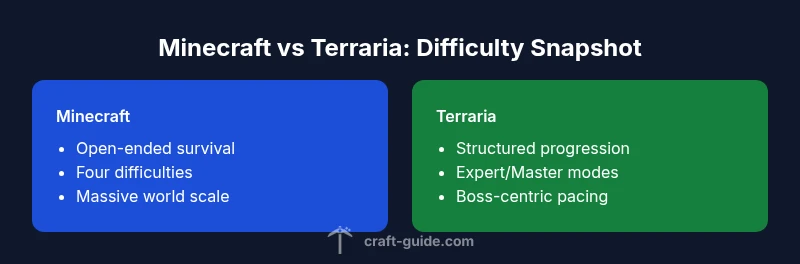
Is Minecraft harder than Terraria? The short answer is: it depends on your goals. Minecraft emphasizes large-scale survival, exploration, and resource management, often feeling harder when you aim to live off the land in hostile environments. Terraria concentrates on structured progression, boss encounters, and dungeon challenges, which can be punishing at higher difficulties. Craft Guide notes that difficulty scales with mode and playstyle.
Is Minecraft harder than Terraria? Defining difficulty and scope
The question is framed as "is minecraft harder than terraria" but the answer depends heavily on what players are chasing in each title. Minecraft presents a vast, open-ended world where survival hinges on resource gathering, shelter building, and adapting to unpredictable threats across generations of biomes. In contrast, Terraria channels difficulty through structured progression, a fixed sequence of bosses, and increasingly aggressive waves as you advance. According to Craft Guide, this difference between open sandbox and guided progression makes direct comparisons tricky until you specify mode and playstyle. Both games can be brutal, but they test different skills: strategic planning and long-term risk in Minecraft, versus precise combat pacing and boss knowledge in Terraria. The result is a nuanced verdict rather than a simple winner or loser.
Core gameplay differences that affect difficulty
At a high level, the core mechanics in Minecraft and Terraria push you to develop different mindsets. Minecraft favors expansive planning, authentic resource management, and habitat design, because threats can arise anywhere, anytime, and across the world’s vast terrain. Terraria, on the other hand, concentrates danger into compact spaces with guided boss encounters and biome-specific threats. The interplay of weather-like environments in Minecraft and tiered enemy spawns in Terraria shapes what counts as 'hard' for a given player. In practice, a player who favors exploration and base-building will experience difficulty as you scale biomes and nether-like hazards, while a player who loves combat pacing will feel the squeeze of boss cycles, loot tiers, and adaptive enemies in Terraria. The Craft Guide team notes that perception is heavily influenced by whether you emphasize sandbox freedom or structured milestones.
Survival systems: managing threats and long-term goals
Survival is the heart of both games but approaches it differently. In Minecraft, danger is persistent: a single night can threaten your sinew, and the world’s scale means you rarely have a perfect plan from day one. You must gather wood, stone, and metals, then improvise shelter, lighting, and farming to weather endless night cycles. In Terraria, the threat is tighter and guided. You prepare for specific bosses, build nests of traps, and farm for specialized drops to reach next stages. The contrast matters: Minecraft rewards patient, long-term survival management, while Terraria rewards quick adaptation to escalating boss patterns and loot-driven power spikes. Across modes, Craft Guide analysis shows that difficulty intensifies with harsher settings and with increasingly dangerous mobs, yet players can soften the curve by choosing friendlier settings or by focusing on co-op play.
Progression and rewards: structured vs open-ended
Progression in Minecraft is fluid and player-driven. You can roam, collect resources, and upgrade your base indefinitely; the 'end' is not a hard barrier but a late-stage milestone if you choose to tackle the End and the dragon, or you can keep expanding your world to keep the challenge alive. Terraria offers a very different rhythm: a guided path with tiered weapons, armor, and tools tied to boss defeats and dungeon exploration. The progression curve is steep but predictable, giving players clear milestones. The contrast creates two different kinds of 'hard'—one that grows with you as you define your goals, and one that forces you to adapt to escalating equipment and enemy power. In both games, the player’s willingness to push into harder content dramatically changes perceived difficulty.
Combat design and risk management
Combat systems define immediate risk. Minecraft’s combat blends melee, ranged, and environmental hazards, but success often depends on preparation, equipment parity, and escape routes. In Minecraft, health and hunger mechanics add pressure, but the randomness of mob spawns can create moments of surprise that feel disproportionately difficult. Terraria prioritizes combat pacing and boss design: patterns, telegraphs, and arena mechanics demand on-the-fly decision-making and precise timing. A successful Terraria run usually hinges on mastering boss patterns and knowing when to retreat, refresh gear, or reposition during a fight. Both games reward tactical thinking and skill growth, but Terraria tends to reward frequent, high-skill fights, whereas Minecraft builds resilience over time in a broader sandbox.
World generation, building constraints, and creative modes
World generation is a key weight in perceived difficulty. Minecraft’s landscapes are vast, procedurally generated across millions of blocks with biomes, caves, and oceans that can surprise even experienced players. The sheer scale invites slow-burn challenges: resource scarcities, hostile mobs, and environmental hazards compound over miles of terrain. Terraria’s worlds are smaller but densely packed with biomes, dungeons, and pre-set boss areas that guide exploration. Building in Terraria is intense but often more linear than Minecraft’s freeform construction, which affects how players experience mastery and frustration. Creative modes in both games remove most risk, but the contrast remains: Minecraft’s sandbox remains the ultimate proving ground for architectural prowess, while Terraria’s compact, design-rich worlds foreground combat efficiency and planning.
Modding, community content, and how that shifts difficulty
Community content reshapes difficulty in measurable ways. Minecraft’s modding ecosystem is vast, offering new dimensions, items, and mechanics that can stretch or soften difficulty. Players who install hostile mods may experience steeper curves, while quality-of-life and automation mods can reduce the day-to-day grind. Terraria also benefits from a devoted modding scene, but the ecosystem is smaller and more focused on content packs and hard-mode tweaks. In both cases, the community offers pacing options that alter how challenging the game feels with the same base rules. Craft Guide notes that modded play can either heighten tension or smooth the path depending on the mods chosen, so players should align mods with their preferred difficulty profile.
Which game is harder for different players? Best-for scenarios
If you crave endless exploration and world-building without explicit end-points, Minecraft tends to feel harder because your goals stretch far into the horizon and impossible to complete in a single session. If you prefer a well-defined progression arc with boss-driven milestones, Terraria often feels harder because you must master increasingly difficult fights and avoid punitive dungeons within shrinking windows of opportunity. For players who value cooperative play, both games offer viable routes, but Minecraft’s scale can be overwhelming in solo sessions while Terraria rewards team coordination in boss arenas. Craft Guide’s framework suggests choosing based on how you want to learn: open-ended experimentation or structured mastery.
Synthesis: measuring difficulty with personal goals
Ultimately, the difficulty of Minecraft vs Terraria is a function of your goals and your tolerance for risk. If your aim is to build, explore, and survive across a world that seems to stretch to infinity, you will encounter a different kind of challenge than if your aim is to conquer a curated sequence of bosses and unlock increasingly powerful gear. The best way to evaluate which is harder for you is to define your preferred playstyle, set a couple of concrete milestones, and test both titles in your chosen mode. The Craft Guide team consistently finds that the perceived difficulty shift hinges on mode selection, cooperation, and whether you value breadth over depth, or vice versa. This is the core takeaway for players and builders alike.
Authority Sources
- Minecraft official site: https://www.mojang.com/
- Terraria official site: https://terraria.org/
- Polygon coverage of boss fights and hard-mode encounters: https://www.polygon.com
Closing note on sources
This section is intended to anchor the comparison in widely accessible materials while keeping the core content focused on player experience and playstyle. For the purposes of this article, the emphasis remains on practical assessment rather than promotional detail.
Comparison
| Feature | Minecraft | Terraria |
|---|---|---|
| Difficulty scope | Four standard difficulties (Peaceful/Easy/Normal/Hard) | Normal, Expert, Master |
| Progression focus | Open-ended survival and exploration | Structured progression with bosses |
| Combat emphasis | Less mandatory combat; combat optional and emergent | Combat-driven progression and boss fights |
| World generation | Expansive, procedurally generated with vast scale | Smaller, densely packed worlds with predefined dungeons |
| Resource management | Unbounded, player-directed goals; resources vary by biome | Tiered resources with boss drops and set loot paths |
| Learning curve | High variance; depends on playstyle and goals | Tighter feedback loops and progression pacing |
| Endgame content | Open-ended endgame through multiple milestones | Boss-centric endgame with escalating difficulty |
| Modding and community content | Very high mod support; long-tail communities | Growing but smaller mod ecosystem with hard-mode tweaks |
| Accessibility and platforms | Broad platform support; strong creative mode presence | Cross-platform with a compact, mobile-friendly base |
Benefits
- Minecraft offers unparalleled creative freedom and open-ended challenge
- Terraria provides focused progression and intense boss encounters
- Both games reward experimentation and learning by doing
- Modding and community content extend lifespan, especially for Minecraft
- Co-op play can reduce perceived difficulty in both games
Negatives
- Open-ended play in Minecraft can feel overwhelming for newcomers
- Terraria's Expert/Master difficulties can be punishing quickly
- Modded play can introduce balance issues or instability
- No single metric captures difficulty across both titles
Minecraft edges Terraria in long-term endurance; Terraria excels in focused, boss-driven challenge
Choose Minecraft if you want vast, open-world survival and creative freedom. Choose Terraria if you prefer structured progression, precise combat, and short-term mastery of tough content.
People Also Ask
Which game is harder for beginners?
Terraria can feel more approachable at Normal mode due to guided progression, while Minecraft Survival may overwhelm new players with its vast, open world. Start with Creative to learn mechanics in both games before attempting survival runs.
Terraria tends to be a bit more beginner-friendly at baseline, but both games reward patience and gradual learning.
Does playing in Creative mode affect long-term difficulty?
Yes. Creative mode removes most survival pressure, letting players explore mechanics and build without risk. This lowers perceived difficulty, but you miss the planning, resource management, and combat learning that define the core experience.
Creative is great for learning layout and design without risk, but it isn’t a substitute for real survival practice.
How does difficulty change with modes in Terraria?
Terraria’s Expert and Master modes increase enemy health and damage, and alter boss behavior, which significantly raises the challenge. This creates sharper spikes in difficulty compared to the standard Normal mode.
Expert and Master modes make fights much tougher and require more precise strategy.
Can mods tilt the difficulty in Minecraft or Terraria?
Mods can both raise and lower difficulty. Some mods introduce harsher survival challenges, while others add automation or quality-of-life features that make survival easier. Always align mods with your preferred playstyle.
Mods let you tailor the challenge—use them to either intensify or simplify the game.
Does multiplayer change the perceived difficulty?
Co-op play can distribute the survival burden and boost efficiency in both games. However, coordination becomes a new skill, and failures can feel more impactful in team settings.
Playing with others often reduces personal pressure but increases the need for teamwork.
The Essentials
- Define your goal to assess difficulty accurately
- Minecraft’s openness creates sprawling challenges over time
- Terraria emphasizes tight progression and combat
- Mods and co-op can shift perceived difficulty