Fortnite vs Minecraft: Which Is Harder to Master Overall?
A rigorous, balanced comparison of Fortnite and Minecraft, analyzing core mechanics, learning curves, multiplayer dynamics, and modding to answer whether is fortnite harder than minecraft.


The short, evidence-based answer is that hardness depends on how you define it. For quick, reflex-driven play, Fortnite tests speed and precision, which can feel harder in the moment. Minecraft demands long-term mastery—crafting, survival planning, and world-building—creating a deeper, ongoing challenge. If you seek rapid, high-skill play, Fortnite can be harder; if you crave enduring mastery, Minecraft typically presents the deeper difficulty.
is fortnite harder than minecraft
In practice, hardness in video games blends reaction time, strategic depth, and the breadth of knowledge you must acquire. When players ask is fortnite harder than minecraft, they are really weighing two distinct kinds of difficulty: immediate, moment-to-moment skill versus sustained, systemic mastery. According to Craft Guide, the perception of difficulty shifts with your goals and playstyle. Fortnite emphasizes rapid decision-making, precise aim, and fast-paced building under pressure, while Minecraft centers on long-term planning, resource management, and the iterative process of crafting and exploration. The contrast is not simply one game being harder overall; it’s about which facets of the experience you value most and where you are willing to invest time to improve.
Core Gameplay Focus
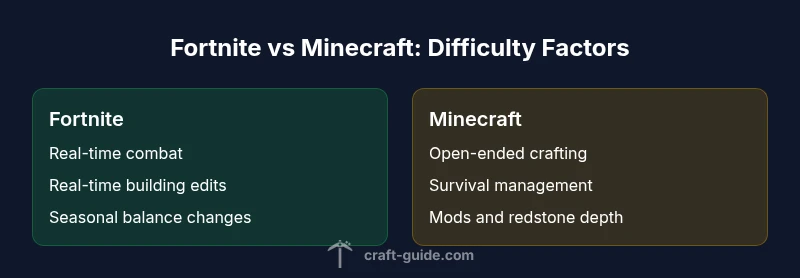
Fortnite centers on competitive combat within a shrinking play area, with real-time building as a defensive and offensive tool. Mastery demands fast hand-eye coordination, rapid sequencing of edits, and a keen sense of spatial awareness. Minecraft, by contrast, relies on a open-ended loop of gathering, crafting, and building, with optional combat and exploration. The difficulty here emerges from planning long-term projects, managing resources across biomes, and solving environmental challenges. The divergence in core loops means players often feel different kinds of pressure: split-second reflexes in Fortnite versus extended experimentation and iteration in Minecraft.
Learning Curve for Beginners
New players typically find Fortnite approachable for a first session because matches are short and the goal is immediate: survive a few minutes, achieve a victory, or land a few strategic shots. The initial barrier is learning to move and shoot while concurrently placing structures. Minecraft offers a gentler onboarding for those drawn to exploration and creativity; however, the survival mode introduces a slowly escalating challenge: hunger, hostile mobs, and resource scarcity. Craft Guide notes that beginners may spend more time understanding crafting recipes and basic redstone logic, but the early payoff—having a secure shelter or a useful tool—appears earlier in Minecraft compared with Fortnite’s longer-term meta.
Mastery and Skill Ceiling
Fortnite’s skill ceiling is driven by micro-mkill improvements, which compound as you master editing, sequencing, and game sense. Each season shifts weapons and balance, requiring players to relearn certain tactics and adapt quickly. Minecraft’s mastery constructs a deeper ceiling: advanced crafting, redstone engineering, complex mob farming, and intricate automatic systems. The modding ecosystem further expands possibilities, enabling players to design custom challenges and environments. Craft Guide’s analysis shows that the long-tail commitment in Minecraft tends to build a cumulative expertise that can outpace the pace of Fortnite mastery for many players.
Online Play and Community Dynamics
Online play in Fortnite centers on competitive matches, squads, and seasonal events that emphasize social coordination under time pressure. The learning curve here is amplified by the presence of skilled teammates and the evolving meta. Minecraft’s multiplayer shines in collaborative builds, survival servers, and community challenges, where social dynamics can either smooth learning or introduce new kinds of pressure (griefing, coordination, or resource sharing). The difference matters: Fortnite rewards individual and small-team coordination under a ticking clock, while Minecraft stresses sustained collaboration and problem-solving in a persistent world.
Controls, Accessibility, and Platform Differences
Input methods shape perceived difficulty. Fortnite’s control schema blends aiming with building, which can be challenging on controllers or keyboards, especially under duress. Minecraft supports a broader range of platforms and input devices, with craft-and-build workflows that are intuitive on PC but can feel unfamiliar on consoles. Accessibility features—like aim-assist, modifiers, and UI options—vary by platform and game mode, affecting how hard the game feels to new players. Craft Guide highlights that the accessibility of core mechanics often determines initial engagement, while depth emerges as players master the nuanced controls and commands across modes.
Content Variety and Modding vs Updates
Minecraft’s modding ecosystem introduces new layers of difficulty by expanding the range of mechanics and systems players can encounter, from tech mods to adventure maps. This variety can lengthen the path to mastery but also offers more entry points depending on your interests. Fortnite’s content cadence relies on official updates, seasonal events, and new weapons that reshape the competitive landscape. While this keeps the game fresh, it can complicate ongoing learning as players must adapt to new gear and balance changes.
Game Modes and Their Impact on Difficulty
Minecraft’s Survival mode emphasizes resource management, exploration, and combat with durability and hunger mechanics that create a persistent challenge. Creative mode removes survival constraints, focusing on design and experimentation. Fortnite offers Battle Royale, Creative, and Team modes; each mode has distinct skill demands: battlefield awareness and snappy edits in Battle Royale, while Creative emphasizes design and rapid iteration without the same competitive pressure. This mode diversity means one player might experience high difficulty in one mode and relative ease in another, depending on what skills they value most.
Practical Scenarios: When Each Game Feels Harder
In short sessions, Fortnite may feel harder due to the high tempo of combat and the immediate need to respond to opponents’ tactics. In longer play sessions, Minecraft can feel harder because sustained planning, complex crafting chains, and consistent resource management become daily habits. Players who enjoy a fixed set of tasks, predictable outcomes, and clear progress may find Minecraft’s structured goals easier to track, while those who crave unpredictable, fast-paced competition may find Fortnite more challenging in the moment. Craft Guide’s framework emphasizes aligning difficulty with your personal play goals and preferred pace of growth.
How to Approach Learning Each Title Efficiently
A practical approach to learning each game is to set targeted goals: a 15-minute Fortnite session focused on improving a specific build sequence and a Minecraft session devoted to mastering one crafting chain or survival tactic. Use practice worlds, template maps, or training modes to decouple mechanics from pressure. Track progress with simple metrics—time-to-build, accuracy, or resource collection efficiency—instead of chasing rapid wins alone. With deliberate practice, players can reduce the perceived hardness over time by building consistent routines and reinforcing effective decision-making.
Comparison
| Feature | Fortnite | Minecraft |
|---|---|---|
| Core Gameplay Focus | Battle royale with real-time building and editing | Open-ended survival, crafting, and exploration |
| Input Complexity | High (aiming and fast edits) many players use a controller or keyboard/mocus | Moderate-to-high (crafting commands, inventory management) with mods and redstone complexity |
| Learning Curve for Beginners | Quick entry, short matches; skill grows with practice | Longer onboarding; survival mechanics and crafting recipes take time |
| Modifiability & Content Diversity | Limited official mods; seasonal balance shifts | Extensive modding; vast variety of worlds and mechanics |
| Online Play & Community | Competitive, team-based play; meta shifts with seasons | Cooperative and competitive multiplayer; large collaborative communities |
| Content Longevity & Updates | Frequent updates; evolving weapons and balance | Endless world generation and user-created content |
| Cost & Access Model | Free-to-play with in-game purchases | One-time purchase plus optional DLC/skins |
Benefits
- Fortnite offers rapid onboarding and high replayability in short sessions
- Minecraft provides deep, enduring creativity and world-building opportunities
- Both games reward practice routines and deliberate progression
- Multiplayer experiences scale with skill, offering meaningful social play
- Open-ended design in Minecraft supports diverse playstyles and communities
Negatives
- Fortnite’s meta and balance changes can frustrate long-term strategists
- Minecraft’s complexity can be intimidating to newcomers without guidance
- Seasonal updates in Fortnite may force players to relearn mechanics
- Modding in Minecraft can introduce compatibility and stability challenges
Minecraft generally presents the deeper long-term difficulty; Fortnite tests high-skill, moment-to-moment play
If you’re chasing enduring mastery, Minecraft’s crafting, building, and modding pathways create a steeper, ongoing challenge. Fortnite emphasizes rapid decision-making and tight mechanical execution, which can feel harder in the moment. The best choice depends on whether you value depth and persistence or speed and competitive reflexes, and Craft Guide recommends aligning your pick with your preferred pace and goals.
People Also Ask
Is Fortnite harder to learn than Minecraft?
Fortnite and Minecraft present different learning curves. Fortnite is quick to pick up but mastering edits, aim, and situational awareness takes time. Minecraft has a gentler onboarding for crafting and exploration, yet long-term survival and redstone can become complex. The overall difficulty depends on which mechanics you prioritize.
Fortnite is easier to start, Minecraft can get deeper with time.
Which game has a higher skill ceiling?
Minecraft generally offers a higher ceiling in terms of long-term systems (crafting, building, redstone, and mods). Fortnite’s ceiling is driven by micro-skills in combat and editing under pressure; both can be punishing for different reasons.
Minecraft tends to demand broader, deeper mastery over time.
Do mods affect Minecraft’s difficulty?
Yes. Mods can increase complexity or tailor experiences, making a game feel harder or easier depending on which mods are installed. Vanilla Minecraft remains the more straightforward starting point for beginners.
Mods can add new layers of challenge or simplify tasks.
How do updates affect difficulty in Fortnite?
Seasonal updates in Fortnite often change weapon balance and map dynamics, which can quickly shift the difficulty landscape. Players must adapt to new metas, which can temporarily raise the learning curve.
New seasons mean you adapt to new rules.
Are some modes easier or harder than others?
Yes. Fortnite’s Battle Royale emphasizes fast-paced competition, while Creative mode can be easier as it removes combat pressure. Minecraft Survival is harder than Creative due to resource management and threats, while Mods add varied challenges.
Mode choice really changes the difficulty feel.
The Essentials
- Define what 'hard' means for you (short-term challenge vs long-term mastery)
- Minecraft rewards sustained practice, planning, and modular upgrades
- Fortnite emphasizes fast-paced combat, edits, and adaptive strategy
- Try both modes to discover where your strengths and preferences lie
- Use deliberate practice and small goals to reduce perceived difficulty