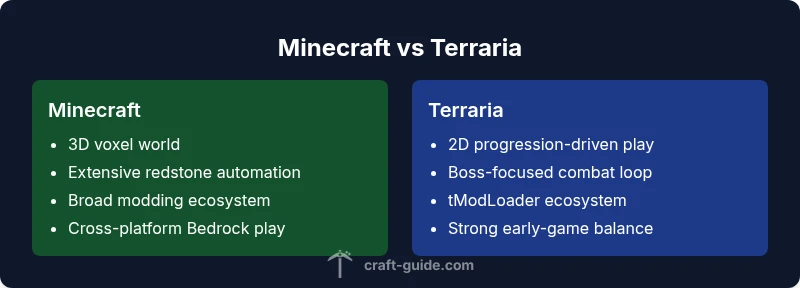
Minecraft vs Terraria: In-Depth Side-by-Side Comparison
A thorough, balanced comparison of Minecraft and Terraria, covering world design, building, progression, modding, and community to help you pick the best sandbox for your playstyle.


Minecraft vs Terraria is not about which is universally better, but which fits your playstyle. If you crave massive, endless building and deep automation, Minecraft is the stronger sandbox; if you prefer compact, progression-driven exploration with challenging bosses, Terraria shines. Both have active communities and ongoing updates, and the choice hinges on 3D openness vs 2D focus.
Core Gameplay Philosophies
minecraft vs terraria are both sandbox games, but they teach players to approach play differently. Minecraft embraces an expansive, open-ended playground where almost any project is possible given time, resources, and creativity. Terrain, structures, and even game rules can be shaped by the player, creating enormous, self-authored worlds. Terraria, by contrast, emphasizes a curated, progression-driven loop: the world is open, but there is a clear sequence of bosses, biomes, and gear upgrades that guide you forward.
According to Craft Guide, the most salient distinction in minecraft vs terraria is how players balance freedom with progression. In Minecraft, freedom is the selling point: you can mine, build, automate, or explore dimensions at your own pace. The challenge lies in mastering systems like redstone, enchanting, and potioncraft, which can be intimidating for newcomers. Terraria offers a gentler onboarding with a tighter world and a steady escalation of power. While you still craft, fight bosses, and explore, the milestones are more tangible early on. This difference shapes how players experiment, how communities organize servers, and how long a given world remains engaging. If your priority is colossal, ongoing construction and automation, Minecraft tends to win; if you prefer focused adventures with defined goals, Terraria often fits best.
Comparison
| Feature | Minecraft | Terraria |
|---|---|---|
| Gameplay Perspective | 3D voxel world with open-ended sandbox | 2D side-scrolling sandbox with structured progression |
| World Design | Infinite procedurally generated worlds with biomes and dimensions | Procedurally generated map with layered biomes, dungeons, and caverns |
| Building and Crafting | Extensive building system with redstone automation | Compact crafting with gear-based progression and modular upgrades |
| Progression and End Goals | End-game content includes Nether, End, and large-scale projects | Boss-driven progression with hardmode and milestone rewards |
| Modding and Customization | Large mod ecosystem (Forge/Fabric) with thousands of mods | Active but smaller mod scene via tModLoader |
| Art Style and Atmosphere | 3D blocky aesthetic; vast landscapes | 2D pixel-art style with tight, stylized worlds |
| Platform Availability | PC, consoles, mobile; Bedrock cross-platform | PC, consoles, mobile; cross-platform within the same edition |
| Performance and Hardware Needs | Can be demanding with large builds and complex redstone | Generally lighter on hardware; stable performance on older machines |
| Content Updates Cadence | Frequent major updates across editions | Substantial updates less frequently but meaningful |
| Community and End-User Content | Huge servers, maps, and modpacks; expansive ecosystem | Strong community with seeds, maps, and curated mods |
Benefits
- Minecraft offers vast creativity and deep automation potential
- Terraria delivers tight, progression-driven gameplay with quick rewards
- Both games have active communities and extensive user-generated content
- Bedrock edition enables broad cross-platform play for friends and groups
Negatives
- Minecraft can be resource-intensive on large builds and mod packs
- Terraria’s scale is smaller in scope, which may feel limiting to some players
- Mod compatibility in Minecraft can be volatile across versions
- Terraria's mod scene, while dedicated, is smaller and less varied than Minecraft's
Minecraft wins for scale and automation; Terraria wins for focused progression and quicker, bite-sized adventures
Choose Minecraft when you want to design sprawling worlds and automated systems. Choose Terraria when you prefer a tight, progression-driven experience that delivers frequent goals and faster combat-paced play.
People Also Ask
Which game is easier for beginners?
Terraria often presents a gentler onboarding with a quicker sense of progression. Minecraft has deeper systems (redstone, enchantments) that can be overwhelming at first but unlocks near-limitless creative potential.
Terraria is generally more approachable for newcomers due to its clear early goals and simpler combat, while Minecraft’s depth rewards persistence.
Can you play both games on the same device?
Yes. Both games are available on PC, consoles, and mobile. Choose the edition that matches your platform and save preferences, then enjoy separate ecosystems.
Yes, you can play both on most major devices; just pick the edition that fits your platform.
Which game receives more content updates?
Minecraft tends to release frequent, major updates across editions, while Terraria updates are substantial but less frequent, focusing on new bosses and gear.
Minecraft usually has more frequent, larger updates; Terraria updates are powerful but come less often.
How does modding compare between the two?
Minecraft has an expansive modding scene via Forge and Fabric, enabling vast changes. Terraria relies on tModLoader for a strong but smaller set of mods that integrate with its progression.
Minecraft mods are broad and varied; Terraria mods are focused and cohesive with the game’s progression.
Which is better for solo play?
Both support solo play well. Terraria offers quicker goals and frequent combat, while Minecraft rewards long-term projects and world-building at your own pace.
Both are great solo; Terraria for quick hits, Minecraft for ongoing projects.
Is there cross-platform play between the two games?
Cross-platform play exists within each game's Bedrock ecosystem (and within Terraria across its supported platforms). Cross-edition crossplay between Minecraft and Terraria versions is not supported.
Cross-play works inside Minecraft Bedrock or Terraria editions, but not across the two games.
The Essentials
- Identify your preferred playstyle: vast building vs structured progression
- Factor hardware and platform availability into your decision
- Expect divergent modding ecosystems: breadth vs cohesion
- Consider long-term engagement: ongoing updates vs periodic milestones
- Both games foster active communities and long-term replay value