Is Minecraft Harder Than Roblox? A Practical Comparison
An analytical, side-by-side comparison of Minecraft and Roblox difficulty, covering learning curves, creation tools, and long-term mastery for players of all levels.


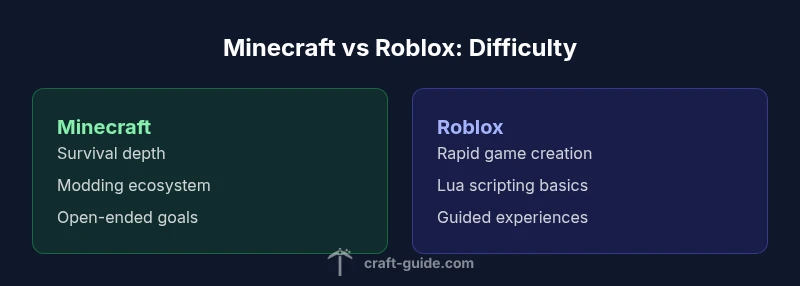
Minecraft generally presents a higher difficulty ceiling than Roblox, especially for survival-oriented play, redstone engineering, and modding. Roblox tends to offer quicker on-ramp experiences through guided games and built-in development tools. For most players seeking a true mastery challenge, Minecraft is the harder platform, while Roblox rewards rapid experimentation and approachable creation.
Is Difficulty Subjective? Framing the Question
When we compare how hard Minecraft is relative to Roblox, the answer depends on what you value: survival realism, coding, building scope, or how quickly you can publish a game. If you ask 'is minecraft harder than roblox', the answer depends on your goals and learning style. For a novice, Roblox’s guided experiences and user-friendly scripting with Roblox Studio can feel approachable, while Minecraft demands navigation of resource scarcity, health, hunger, and tool durability. The Craft Guide Team has found that player perception of difficulty often aligns with goals: builders face different obstacles than explorers, and coders encounter entirely separate challenges.
In Minecraft, even a new world can become overwhelming as you decide whether to focus on exploration, farming, or building a fortress. You’ll learn to prioritize mining routes, manage inventory, and master combat systems. In Roblox, the hardest part for many players is not the Lua-like logic of a game, but choosing a project, learning Lua syntax, and understanding how to publish a playable title. However, Roblox benefits from a vast library of templates, tutorials, and starter scripts that reduce the initial mountain of unknowns. The key is to map your personal objectives to the skill set you want to develop: survival instincts and creative engineering in Minecraft versus rapid game-design fluency in Roblox.
According to Craft Guide, the most important metric isn’t raw time spent, but growth in targeted competencies: strategic planning, problem solving, and system-thinking. By reframing difficulty in terms of skills gained, players can pick the path that matches their preferences and time investment.
Core Mechanics That Drive Challenge
Minecraft and Roblox reward different kinds of gameplay, and understanding the core mechanics helps explain why players perceive difficulty differently. Minecraft centers on resource gathering, crafting cycles, health management, and combat with hostile mobs. The game also introduces Redstone, a digital logic system that can replicate simple machines. Mastery grows through efficient mining routes, enchanting gear, and the ability to sustain a base while exploring hazardous biomes. The complexity is layered: you must balance risk and reward, manage hunger, and keep your tools in working order during long expeditions. Multiplied by mods and datapacks, the horizon expands even further, turning small caves into elaborate engineering projects.
Roblox, by contrast, is an ecosystem of countless games rather than a single title. The difficulty for a player often depends on the specific game you choose: some obbies emphasize reflexes and obstacle navigation, others are strategy sims or role-playing experiences requiring social coordination. For developers, Roblox Studio introduces a pipeline of asset creation, scripting with Lua, testing, and publishing. The challenge shifts from surviving a hostile world to designing engaging experiences that work across devices. The platform’s strength is that many games are built to lower the barrier to entry, so a curious beginner can quickly publish a playable demo. The trade-off is that quality and challenge vary widely between titles, making the overall difficulty feel uneven.
Learning Curve: From Starter World to Mastery
From the moment you start, the path from zero to expertise diverges sharply. In Minecraft, you typically begin by gathering basic resources, learning to craft, and understanding hunger mechanics. As you advance, you encounter more complex systems: compound farms, enchantments, and, for many players, Redstone circuitry that resembles electrical engineering. Each tier adds a layer of problem solving and patience. The learning curve grows with exploration, where dangerous biomes, cliffs, and mobs force you to plan ahead and adapt.
Roblox offers a different route. Beginners can jump into a simple game and produce a runnable prototype within hours, especially if they choose starter templates. The bottlenecks often involve scripting logic, debugging a multiplayer interaction, or aligning assets with performance targets across devices. For developers, there’s a multi-step process: design, script, test, and publish. The cadence is fast, and iteration cycles are short, which can make Roblox feel less daunting initially. Yet the deeper you dive into scripting and game mechanics, the steeper the climb becomes, mirroring the experience in any professional-grade engine.
Tools, Mods, and Customization
Minecraft shines with a vast ecosystem of tools that expand what you can do in-game. Mods, datapacks, texture packs, and server plugins let you reimagine the entire world. The nerdy delight of Redstone circuits adds a layer of engineering practice, from simple doors to complex automation. The tradeoff is that compatibility and installation can be fiddly, and some mods require additional software or knowledge. For players who want a deeply personalized sandbox, Minecraft offers almost limitless customization.
Roblox centers on an integrated development environment with Roblox Studio. The platform emphasizes accessibility first, offering a robust set of assets, a scripting language (Lua), and real-time testing across devices. You can publish complete games and monetize through the platform’s economy. The downside is that tools are tightly coupled with Roblox’ ecosystem, which means you’re often learning within their constraints rather than a universal standard. Still, the ability to prototype ideas quickly makes Roblox a compelling choice for those who value speed and collaboration.
Community, Content Creation, and Longevity
Minecraft benefits from a long-running, global community. There are countless tutorials, seed showcases, and mod packs that keep games fresh for years. The social aspect extends to cooperative builds, large-scale servers, and adventure maps that showcase extreme creativity. The modding community provides additional layers of complexity, occasionally introducing compatibility issues but delivering enormous creative power. Longevity comes from the balance between survival storytelling and community-run realms that evolve over time.
Roblox thrives on a vibrant, creator-driven economy. The platform continuously churns out new experiences, often designed by small teams or solo developers. The social dynamics are strong: group projects, live events, and collaboration across continents are common. The ease of publishing and monetization attracts newcomers, but the quality spectrum is wide. This rapid cycle of content creation makes Roblox feel more accessible yet requires ongoing learning to stay current with platform updates and scripting changes.
Practical Scenarios: Which Is Harder for You?
If your priority is enduring, self-directed survival with customizable worlds, Minecraft is likely the harder choice. The learning curve compounds as you design intricate farms, enchantments, and automated systems. If your objective is to produce a playable game quickly and see results, Roblox offers a gentler, faster path to published projects and monetization. For players who want a blended experience—creative building plus quick game prototyping—both platforms present meaningful challenges, but in different flavors.
For teachers and learners, the decision often hinges on the type of skill you wish to develop. If you want system thinking, resource management, and engineering concepts, Minecraft provides the richer sandbox. If you want rapid prototyping, scripting fundamentals, and collaboration, Roblox offers a more approachable starting point. Craft Guide’s analysis suggests choosing the platform that aligns with your goals and the type of mastery you want to build over time.
Getting Started: Quick Wins to Make Both Easier
- Define your goal for the first week: build a small shelter in Minecraft or publish a simple Roblox game.
- Pick a guided tutorial or starter template to reduce overwhelm and gain momentum quickly.
- Schedule short, consistent practice sessions focused on one core mechanic at a time (mining, crafting, scripting basics).
- Join a beginner-friendly community to get feedback and resources, then gradually expand your scope.
- Use in-game or in-editor checklists to track progress and prevent scope creep.
- Tackle a small, concrete project in each platform to build confidence before attempting more ambitious builds or games.
Common Mistakes That Increase Difficulty
- Jumping into high complexity projects before learning the basics.
- Ignoring foundational tutorials or reference guides for core concepts.
- Underestimating the time needed for testing and iteration.
- Trying to master both platforms at once without a clear plan.
- Overlooking platform constraints that limit what you can ship quickly.
Additional Resources and Next Steps
- Official Minecraft resources and community wikis for survival tips, Redstone basics, and modding.
- Roblox Developer Hub and scripting tutorials to accelerate prototype development.
- Practice plans, seed lists, and starter projects to maintain consistent progress across both platforms.
Comparison
| Feature | Minecraft | Roblox |
|---|---|---|
| Learning Curve | High; survival, crafting, and Redstone complexity | Medium; guided experiences and scripting basics |
| Creation Tools | Extensive modding and datapacks; large tool ecosystem | Roblox Studio with Lua; rapid prototyping |
| Content Scope | Open-ended sandbox with infinite world potential | Diverse catalog of user-created games |
| Typical Session Length | Long-form survival sessions | Short-to-medium play sessions depending on game |
| Accessibility for Beginners | Moderate-to-high initial barrier | Lower barrier; guided onboarding |
| Community & Longevity | Massive modding community and long-tail content | Vibrant creator ecosystem with frequent new games and events |
Benefits
- Minecraft offers deep learning opportunities through survival, farming, and redstone
- Roblox enables rapid onboarding and accessible game development
- Both platforms reward experimentation and creative collaboration
- Modding and Studio tooling allow long-term project growth on each platform
Negatives
- Minecraft's complexity can deter absolute beginners
- Roblox's quality and difficulty vary across games
- Modding Minecraft can require extra tools and setup
- Roblox Studio has a learning curve for scripting and publishing
Minecraft generally offers higher long-term mastery challenges; Roblox is easier to start but still rewarding.
Choose Minecraft if you want deep sandbox mastery and modding complexity; choose Roblox for faster entry and simpler game development, with room to grow.
People Also Ask
Is Minecraft harder to learn than Roblox?
For most players, yes. Minecraft blends survival, crafting, and complex systems like Redstone, which raises the entry barrier. Roblox emphasizes accessible game creation, so beginners can publish simpler games sooner. The overall experience depends on your goals.
Most players find Minecraft harder to learn due to survival and Redstone complexity, while Roblox offers a gentler start with faster publishing. Your goals determine how you perceive difficulty.
What aspects make Minecraft harder?
Key factors include resource management, hunger mechanics, combat with mobs, and the depth of Redstone engineering. The modding ecosystem adds another layer of complexity that can extend the learning curve for serious builders.
Survival challenges, combat, and Redstone engineering are the core reasons Minecraft tends to be harder.
What makes Roblox easier to start?
Roblox provides guided experiences, templates, and Lua scripting basics that allow newcomers to create and publish playable games quickly. The platform emphasizes iteration and collaboration, reducing the initial momentum barrier.
Roblox helps beginners get a project up and running fast with templates and simple scripting.
Can a beginner enjoy both platforms?
Absolutely. Start with Roblox to learn fundamentals of game design and scripting, then explore Minecraft to dive into deeper survival mechanics and large-scale building. A staged approach reduces overwhelm and builds transferable skills.
Yes—start with Roblox for quick wins, then experiment with Minecraft for deeper building and survival mastery.
Which platform has better learning resources?
Both have strong communities, tutorials, and official docs. Minecraft’s community tends toward mods and survival guides, while Roblox emphasizes Studio tutorials and scripting references. Your preference for hands-on tinkering or coding will guide which is more useful.
Minecraft leans on mods and survival guides; Roblox leans on Studio tutorials and coding references.
Is modding allowed in Roblox?
Roblox uses Roblox Studio for game development with Lua scripting rather than traditional 'modding' as in Minecraft. You publish experiences, monetize, and iterate, but you operate within Roblox’ ecosystem and tooling.
Roblox uses a built-in Studio for development rather than external mods; it's more about building games within Roblox.
The Essentials
- Define your goals before choosing a platform
- Expect Minecraft to demand more time for mastery
- Roblox offers quicker results and easier scripting
- Both platforms reward steady practice and community learning