Minecraft Java Edition vs Bedrock Edition: A Comprehensive Comparison
Explore the key differences between Minecraft Java Edition and Bedrock Edition, from cross-play and updates to modding and marketplaces. Learn which edition fits your play style so is minecraft and minecraft bedrock the same is clarified in practical terms.


Minecraft Java Edition and Bedrock Edition are not identical; they share core gameplay but differ in platforms, cross play, world generation, modding, and official features. This quick comparison highlights the main distinctions to help you choose the edition that fits your play style.
Is Minecraft and Minecraft Bedrock the Same?
Is minecraft and minecraft bedrock the same in every respect? No — while both editions share the same core game, they diverge in where you play, how content is delivered, how communities form, and the tools available to customize your world. Craft Guide analyzes the practical differences for builders, explorers, and players who value either modding flexibility or cross platform play. In practice, the same survival instincts apply, but your choices about platforms, controls, and content will shape your experience. This guide uses concrete distinctions to help you navigate the two editions without hype.
Core Differences in Platform and Ecosystem
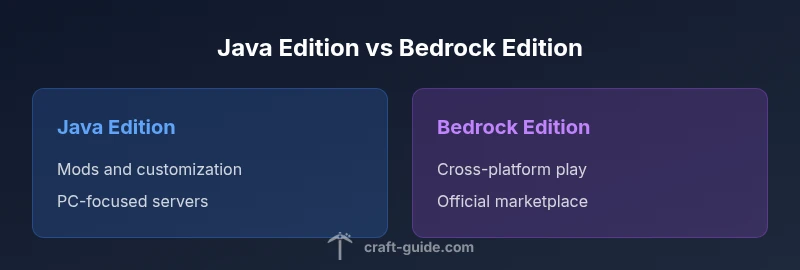
Minecraft Java Edition runs on Windows, macOS, and Linux on a PC. Bedrock Edition, by contrast, spans Windows, Xbox, PlayStation, Nintendo Switch, iOS, and Android, creating a broad ecosystem. These platform choices influence file structure, performance, and community ecosystems. Java is known for its open modding scene and extensive server networks, while Bedrock emphasizes cross platform play, official support for add ons via the marketplace, and more consistent performance across devices. If you are building large worlds with complex mods, Java favors customization; if you want to play with friends on consoles or mobile, Bedrock offers the broadest reach. In this context, the key to a good choice is pairing your hardware, friends, and play style with the edition that aligns with those constraints.
Cross-Play, Updates, and Parity
Cross play is a defining difference: Bedrock enables multiplayer across Windows PC, consoles, and mobile devices, letting friends on different devices play together. Java does not support Bedrock cross play and relies on PC only servers. Update parity is nuanced: Java often receives content updates in a way that differs from Bedrock, and some features arrive on one edition before the other. In many cases both editions reach similar functionality over time, but exact parity depends on the feature and the update cadence. For players who value a unified multiplayer pool, Bedrock is typically superior; for those who want PC centric modding and servers, Java remains more flexible.
Modding, Marketplace, and Add-ons
Java Edition has a long, vibrant modding community with thousands of mods, pack creators, and custom servers. Modding on Java is primarily community driven and file based, offering exceptional customization but sometimes requiring more technical setup. Bedrock Edition provides a formal marketplace with add-ons, skins, and paid content curated by Mojang and partner studios. This structure makes it easier to find content on Bedrock but is more restrictive for deep, system level customization. If your goal is pure modding freedom, Java excels; if you want a curated ecosystem with easy access, Bedrock wins.
World Generation, Seeds, and Biomes
World generation behavior differs between Java and Bedrock. While seeds are numeric inputs that should, in theory, define a starting landscape, the exact biome distribution and underground features can diverge between editions. As a result, a seed that generates a striking desert canyon in Java may produce a different outcome in Bedrock. Builders should be aware of these differences when planning large projects or sharing seed-based challenges. The practical takeaway is that seeds are not universally portable across editions; plan for the edition you are playing.
Performance, Hardware Requirements, and Optimization
Bedrock is generally optimized for cross platform performance and tends to run smoothly on lower spec machines and consoles. Java is more RAM hungry because of the JVM and the broader customization options; players who run Java on a high end PC can push very high frame rates with careful tuning. If you want a fast and stable experience on a modest device, Bedrock is often the better choice; if you have a capable PC and enjoy texture packs, shaders, or heavy mods, Java can deliver outstanding visuals and control flexibility.
Controls, UI, and Accessibility
The user interface and control schemes reflect the edition design. Bedrock emphasizes a consistent, cross platform control language that works across a keyboard, mouse, and gamepad, making console and mobile play more approachable. Java offers keyboard and mouse precision that PC players often prefer, along with a more configurable UI and menu system for mods and servers. Accessibility improvements have been a focus in both editions, but the hardware footprint and input methods will steer you toward one edition depending on how you play.
Realms, Servers, and Multiplayer Nuances
Realms and external servers behave differently between editions. Bedrock Realms provide a straightforward, cross platform multiplayer option with cross device friends, while Java Realms and Java servers emphasize larger mod friendly communities. Server performance, plugins, and world editing tools vary notably between editions, so if you rely on community servers, check the server type and edition compatibility before joining. Understanding these nuances helps you avoid frustration when joining friends or hosting communities.
Achievements, Advancements, and Progression Systems
Advancements and achievements are implemented differently in the two editions. Bedrock tracks progress across platforms via a Microsoft account for cross device progression, whereas Java maintains its own progression system tied to the Java edition profile. This distinction matters for players who want a single, cross platform progression history or who value the independence of the PC ladder. Understanding these systems helps you set realistic goals and share progress with your friends.
Choosing Between Java and Bedrock: Scenarios
If you primarily game on PC with heavy emphasis on mods and custom servers, Java Edition is likely the best fit. If you value cross platform play with friends on consoles or mobile and prefer a curated marketplace experience, Bedrock is the better option. Consider your device availability, whether you want to join mod heavy communities, and whether you want to participate in cross platform play when making your decision. This practical guidance helps you pick the edition that aligns with your goals.
The Path Forward: What to Expect in 2026 and Beyond
Looking ahead, both editions stand to evolve with continued updates, feature parity efforts, and improvements to performance and accessibility. Bedrock may expand cross platform features and content delivery, while Java continues to push modding and server innovations. This ongoing evolution means that the best edition today may shift as new features land and communities grow. Craft Guide suggests staying informed about update notes, modding communities, and official announcements to plan your Minecraft journey for 2026 and beyond.
Authority Sources
For authoritative context, consult major publications and official sources that discuss Minecraft editions and cross platform play. Britannica provides a concise overview of Minecraft, while The Verge and CNET offer practical comparisons of Java versus Bedrock features and limitations. These sources help validate the practical differences described in this guide.
Comparison
| Feature | Minecraft Java Edition | Minecraft Bedrock Edition |
|---|---|---|
| Platform availability | PC (Windows, macOS, Linux) | Windows, Xbox, PlayStation, Nintendo Switch, iOS, Android |
| Cross-play | Java edition: no cross-play with Bedrock; Java-only multiplayer | Bedrock edition: cross-play across Windows, consoles, and mobile |
| Updates and parity | Java often leads on feature timing; parity varies | Bedrock aims for cross-platform parity; updates are coordinated where possible |
| Marketplace and mods | No official marketplace; rich modding via CurseForge and community servers | Official Marketplace; official add-ons and paid content |
| World generation and seeds | Different seed logic; biome distribution differs | Same seeds can yield different worlds; editions diverge in biome and generation rules |
| Performance | RAM-heavy on PC; performance depends on JVM tuning | Optimized for cross-platform play; generally smoother on lower-end devices |
| Modding support | Vast modding ecosystem; open file access | Limited mods; official add-ons via marketplace |
| Achievements/Advancements | Java: traditional in-game advancements | Bedrock: cross-platform progression tied to Microsoft account |
| Best for | Modders, servers, and PC builders | Cross-platform play and console/mobile players |
Benefits
- Clear edition differentiation helps players pick the right version
- Cross-play on Bedrock expands multiplayer options
- Java Edition’s modding ecosystem remains unmatched for customization
- Both editions share core gameplay, lowering the learning curve
Negatives
- Feature parity is imperfect, leading to confusion across editions
- Mixed-group play can be challenging due to edition restrictions
- Bedrock’s official marketplace can feel restrictive for modders
Bedrock is best for cross-platform play and accessibility; Java is best for modding and PC-centric play
Choose Bedrock if you want to play across devices with friends; choose Java if you want a vast modding scene and classic PC Minecraft.
People Also Ask
Are Minecraft Java Edition and Bedrock Edition the same game?
Not exactly. They share core gameplay but differ in platform support, content delivery, and modding ecosystems. This guide clarifies the main differences and helps you choose.
Java and Bedrock share the core game, but are distinct editions with different platforms and features.
Can Bedrock players play with Java players?
No, Bedrock and Java editions do not support cross edition multiplayer. Bedrock supports cross platform play within its own ecosystem, while Java remains PC only for multiplayer.
Bedrock and Java cannot play together directly.
Which edition is better for modding?
Java Edition has the larger modding ecosystem with extensive customization options, while Bedrock focuses on official add-ons and marketplace content with less flexibility.
If you want mods, Java Edition is the better choice.
What about updates and feature parity?
Updates arrive on both editions, but parity is not guaranteed at all times. Some features appear earlier on Java, others land on Bedrock first or in parallel.
Updates differ by edition, parity varies by feature.
Is there any cross buy or marketplace difference?
Bedrock has an official Marketplace with add-ons and paid content. Java has no official marketplace, relying on community-created mods and packs.
Bedrock uses a marketplace; Java relies on mods from communities.
Who should read this guide?
This guide helps new players decide which edition to start with and helps current players understand the implications of their choice for future multiplayer and modding.
If you want a clear path to pick your edition, this guide helps.
The Essentials
- Choose Bedrock for cross-platform play and performance on varied devices
- Choose Java for mods, servers, and traditional PC gameplay
- Expect ongoing differences in features and content between editions