Mastering computer gaming minecraft: a practical getting started guide
Learn to set up Minecraft on PC, choose editions, optimize performance, and build or survive with actionable, step-by-step instructions tailored for computer gaming minecraft.


In the realm of computer gaming minecraft, getting started on PC is the first big step toward a limitless world of creativity and challenge. This guide walks you through choosing editions, installing the game, and optimizing performance for smooth gameplay. According to Craft Guide, PC players can customize visuals, controls, and mods to suit your personal style and hardware. By following these steps, you’ll unlock reliable performance and a satisfying start to your minecraft journeys on a computer.
Introduction to computer gaming minecraft and why it matters
For many players, the phrase "computer gaming minecraft" signals a blend of strategy, exploration, and creative building. This title has become a cornerstone of PC play, offering deep systems like redstone machinery and immersive exploration that reward careful planning. The Craft Guide team has observed that novices and veterans alike benefit from a measured approach to setup, performance tuning, and incremental skill-building. In this section we outline what makes minecraft on a PC appealing, how your hardware influences experience, and what you can expect as you begin to explore the landscape of biomes, mobs, and redstone contraptions. By framing your goals early, you’ll navigate both the creative and survival modes with confidence and clarity.
Key idea: your computer and your choices in settings shape your early adventures, so start with a clear plan and steadily expand from there. This foundational approach is essential for anyone entering the world of computer gaming minecraft on a PC.
- Start with a concrete goal (creative build, survival challenge, or redstone project).
- Ensure your PC meets or exceeds the recommended requirements for a smooth experience.
- Use quality peripherals to improve precision and comfort during long sessions.
Craft Guide’s perspective: a careful, incremental setup leads to better long-term enjoyment and fewer performance hiccups.
Getting Started: System Requirements and Setup
A successful minecraft session on a PC begins with solid foundations. For computer gaming minecraft, you’ll want to verify your system meets the minimum and ideally the recommended specs before you install. The general rule is to prioritize a dependable CPU, sufficient RAM, and a capable GPU to render terrain, textures, and lighting without stutter. In addition to hardware, network stability matters for multiplayer worlds or servers. This section breaks down the typical PC requirements, OS considerations, and a practical setup routine so you can jump into your first world quickly. Craft Guide’s analysis highlights that players who optimize memory allocation and update drivers consistently enjoy fewer crashes and crisper visuals.
- Minimum specs usually include a modern multi-core CPU, 4 GB RAM as a bare minimum, and a mid-range GPU. For comfortable performance with higher texture packs and shaders, aim higher.
- Choose your platform variant (Java Edition vs Bedrock Edition) based on your goals, mods, and cross-play needs.
- Prepare your storage: Minecraft and its add-ons can add up, so ensure ample free space and a dedicated game folder for clean management.
Setup routine:
- Install your chosen edition from the official source.
- Update graphics and audio drivers to the latest version.
- Allocate memory to Minecraft through the launcher settings.
- Test a basic world to confirm stability before expanding to mods or resource packs.
Craft Guide recommends performing a clean install on a fresh drive if you’ve had issues in the past to avoid legacy files interfering with performance.
Editions and Modding Paths: Java vs Bedrock, Vanilla vs Mods
Choosing the right edition is one of the most important decisions for computer gaming minecraft. The Java Edition offers extensive modding support, a broad community, and flexibility for custom maps and servers. Bedrock Edition provides smoother cross‑play across platforms, a more streamlined marketplace, and optimizations for lower-end hardware. If you plan to tinker with mods, Forge or Fabric are popular modding frameworks to explore within the Java ecosystem, while Bedrock relies on in‑game add-ons and official content.
Understanding the tradeoffs helps you align your goals with your setup. For players who want absolute customization and large mod catalogs, Java Edition is often the best path. For those who value performance on diverse hardware and cross‑play with friends on different devices, Bedrock is typically preferable. In both cases, the core experience remains centered on exploration, building, and problem solving, all framed by your decisions about difficulty, world type, and server access.
When you start modding or joining multiplayer worlds, remember that some communities enforce rules or require specific versions. Always back up worlds before installing mods and test in a separate environment to prevent data loss. Craft Guide notes that a thoughtful approach to mods and servers yields a richer, more stable minecraft journey on PC.
Performance Tuning: Visuals, Audio, and Latency
Performance in computer gaming minecraft hinges on a careful balance of visuals and responsiveness. This section covers practical tweaks to keep your frame rate steady while preserving the look and feel of your worlds. Start with core settings: render distance, graphics quality, and smooth lighting. Reducing unnecessary draw calls can noticeably improve FPS on mid-range rigs, which is a common concern for players aiming to maximize performance without sacrificing too much visual fidelity. In addition, prioritizing high-quality audio cues enhances immersion and helps you detect important in-game events.
- Graphics: Choose balanced settings first (Medium to High) and gradually enable features like fancy shadows if your hardware supports them. Consider shader packs only after you’re comfortable with baseline performance.
- RAM allocation: Allocate enough memory to Minecraft so it isn’t starved by other processes, but avoid over-allocating which can cause stability issues.
- Latency: For multiplayer, a wired connection is preferable to reduce jitter. If you must use Wi‑Fi, place the PC close to the router and select a low-latency server when possible.
- Audio: High-quality sound can enhance reactions to in-game events and mobs, but ensure it won’t push CPU usage unexpectedly.
Craft Guide emphasizes that small, deliberate changes to settings often produce the most noticeable improvements for computer gaming minecraft on PC.
Creative Building vs Survival Play: Practical Approaches
Many players discover that the most satisfying aspect of computer gaming minecraft is the ability to switch between creative building and survival challenges. In creative mode you can experiment freely, test redstone circuitry, and prototype large-scale builds without resource constraints. Survival mode, by contrast, emphasizes resource gathering, exploration, and combat strategy. A practical approach is to alternate between modes in the same world, or maintain separate worlds for each play style. This helps you grow your skills gradually while keeping your goals clear.
- Creative practice: set a project brief (a castle, a village, a redstone device) and time-block sessions to iterate.
- Survival progression: establish a safe base, collect essential resources, and plan routes to distant biomes to maintain motivation.
- Hybrid play: create a hub that organizes your builds and a separate survival zone for resource gathering and exploration.
The phrase computer gaming minecraft often appears in discussions about how these modes complement each other, reinforcing the idea that balanced play leads to deeper mastery.
Troubleshooting Common Issues the PC Player Faces
Even with careful setup, a few recurring problems can hinder your computer gaming minecraft experience. This section covers common issues and practical fixes. Crashes or launcher errors are often caused by corrupt files, outdated Java versions (for Java Edition), or conflicting mods. Lag can stem from insufficient RAM, high render distances, or network problems in multiplayer worlds. By systematically diagnosing the root cause—starting from the simplest checks like updates and connectivity—you’ll regain stability more quickly.
- Issue: Crashes on startup — verify game files, reinstall, and ensure drivers are current.
- Issue: Stuttering during gameplay — reduce render distance, disable resource packs, and confirm enough RAM is allocated.
- Issue: Multiplayer connection problems — test a wired connection, check server status, and confirm firewall settings.
Craft Guide notes that keeping backups and applying incremental fixes prevents data loss and helps you learn from each troubleshooting step rather than being forced to restart from scratch.
Advanced Topics: Redstone, Commands, and Multiplayer Servers
For players seeking deeper mastery in computer gaming minecraft, delving into redstone mechanics, command blocks, and server administration offers a substantial challenge. Redstone systems can automate farms, doors, gates, and complex machinery. Commands let you customize game rules, teleport, or spawn items for testing. Running a private server opens avenues for collaborative builds, competitive minigames, and a thriving community. Start with small redstone projects, learn to read circuit timing, and gradually expand to larger contraptions.
- Redstone basics: understand power sources, repeaters, and pistons to build functional machines.
- Commands: practice in a test world before applying them to your main world to avoid unintended changes.
- Servers: pick a trusted host, set up player permissions, and establish clear rules to foster a friendly community.
In all cases, plan your design, test often, and document your builds so future you can replicate or scale your systems. This approach fits well with computer gaming minecraft on PC, where experimentation is a core part of the experience.
Learning Resources, Community, and Next Steps
Continual learning is essential for mastery in computer gaming minecraft. The community hosts countless tutorials, texture packs, and map seeds that inspire new ideas and expand your technical repertoire. Start with official guides, then move to community-driven wiki pages, forums, and video walkthroughs. Practice regularly, save progress, and reflect on what you’ve learned after each session. Craft Guide recommends keeping a short journal of setups, tweaks, and outcomes to track your improvement over time.
- Official resources: game manuals and support pages from Mojang.
- Community tutorials: player-created videos and step-by-step guides on topics like redstone and server setup.
- Practice and review: set weekly goals, experiment with different editions, and compare results to refine your approach.
As you grow, consider joining a friend’s server to apply what you’ve learned in a cooperative environment. The ongoing practice will deepen your understanding of computer gaming minecraft and help you build a durable skill set for future updates and releases.
Tools & Materials
- PC with reliable internet connection(Quad-core or better, 8 GB RAM minimum for smooth modern gameplay)
- Minecraft edition (Java or Bedrock)(Choose based on goals; Java for mods, Bedrock for cross‑play)
- Mouse and keyboard with comfortable grip(Ergonomic setup for long sessions)
- Monitor with decent refresh rate(144 Hz is ideal for smooth visuals)
- Speaker or headphones(Quality audio enhances immersion but not essential)
- Backup storage or external drive(Useful for world backups and mods)
Steps
Estimated time: 1-2 hours for initial setup and familiarization; ongoing practice plus new features over weeks
- 1
Install the chosen edition
Download the official installer from the publisher, run the installer, and follow on-screen prompts to complete installation. Ensure you select the correct edition (Java or Bedrock) to match your goals in computer gaming minecraft.
Tip: Check your system meets the minimum requirements before installing to avoid performance issues. - 2
Update drivers and software
Update your graphics, audio, and chipset drivers to the latest versions. This reduces compatibility issues and improves stability when you run Minecraft on PC.
Tip: A clean reboot after updates helps ensure all components initialize correctly. - 3
Allocate RAM in the launcher
Open the Minecraft launcher settings and allocate a reasonable amount of RAM based on your available memory. Too little RAM can cause stuttering; too much can degrade system performance.
Tip: A good starting point is 4-6 GB for 8-16 GB total RAM, adjust as needed. - 4
Choose edition tweaks and settings
Set your preferred graphics, render distance, and particle settings. For multiplayer servers, adjust settings to balance visuals with performance.
Tip: Disable resource packs until you confirm stable performance. - 5
Create or join a world
Set difficulty, game mode, and world seed as you begin. For a first world, keep it simple to reduce overwhelm while you learn basics.
Tip: Take quick survival notes (food, shelter, safety) to establish routine early. - 6
Explore basics of building
Practice basic structures in Creative mode to get comfortable with controls, then switch to Survival to apply those skills with resources.
Tip: Start with a small project, then scale up once you’re comfortable. - 7
Experiment with redstone
Practice simple circuits (pressure plates, doors) to understand timing and power flow. Gradually add complexity as you gain confidence.
Tip: Document your circuits with notes to replicate later. - 8
Join a community or server
Find a friendly community or private server to play with others. Share builds, learn from others, and get feedback.
Tip: Always back up worlds before sharing or joining new servers.
People Also Ask
What edition should a new player start with on PC?
For beginners, Bedrock Edition offers smoother cross‑play and simpler performance, while Java Edition provides more modding options and a larger community. Choose based on whether you value cross‑platform play or customization. Craft Guide recommends starting with Bedrock if you want quick access and easier setup.
For beginners on PC, start with Bedrock Edition for smoother cross‑play and simple setup; choose Java later if you want more mods.
How can I improve Minecraft performance on a mid-range PC?
Lower render distance, reduce fancy graphics, and limit particle effects. Allocate a reasonable amount of RAM and update drivers. Use a lightweight resource pack or none at all while you tune performance, then optionally add shaders when ready.
Drop render distance, update drivers, and allocate RAM; you can add shaders later if performance allows.
Are mods safe for Minecraft on PC?
Mods can enhance gameplay but may introduce instability or malware if sourced from untrusted sites. Always download from reputable modding platforms, back up worlds, and keep mods compatible with your Edition and version.
Mods can be great, but download from trusted sources and back up your worlds.
What’s a good first project in Creative mode?
Try building a small house with a defined layout and a basic 3‑story structure. It teaches block placement, plan drawing, and resource management in a low‑risk Creative environment.
Start with a simple house to learn layout and block placement.
How do I join a multiplayer server safely?
Choose reputable servers, read rules, and use basic security practices. Start with a friend’s server to learn norms before joining larger communities.
Join small, trusted servers first and follow their rules.
What basic redstone project should I start with?
A simple door or trap mechanism teaches power flow, timing, and circuit logic without overwhelming complexity. Build on this foundation to create larger systems.
Begin with a basic redstone door to learn wiring and timing.
Watch Video
The Essentials
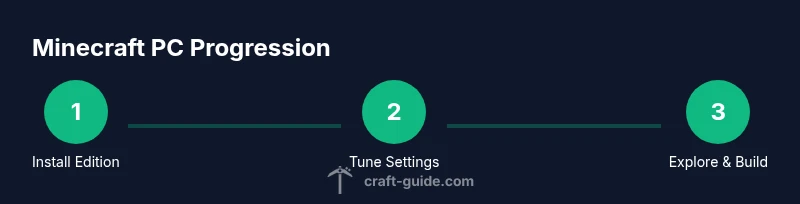
- Install the edition that fits your goals.
- Tune settings to balance visuals and performance.
- Back up worlds before mods or server changes.
- Practice in both Creative and Survival modes to build skills.
- Join communities to accelerate learning and stay motivated.