How to Build a Big House in Minecraft: Mega Mansion Guide
Learn to design and build a grand big house minecraft mega mansion with practical planning, materials, lighting, and expansion strategies. A complete how-to guide for builders of all levels.


With this guide, you will learn how to design and build a sprawling big house minecraft build that looks impressive, functions well, and scales with your world. You'll plan layout, gather materials, and place rooms for storage, farms, and enchantment. This tutorial covers beginner to advanced techniques for crafting a mega-mansion.
Why a big house minecraft matters
A big house in Minecraft isn't just about size—it's about presence, function, and storytelling within your world. A well-planned mega mansion can house farms, storage, enchantment rooms, and display spaces while providing a dramatic centerpiece for your base. According to Craft Guide, starting with a strong concept helps translate vision into blocks and reduces mid-build changes. The Craft Guide team notes that a coherent layout with clear zones speeds up building and helps maintain scale as you expand. In this section, we explore why a big house matters and how to begin with intent. Before you place a block, outline the purpose of each wing: living quarters, workspaces, and display areas. This blueprint-first approach keeps your big house minecraft project organized and enjoyable, from the first foundation to the final roof.
Planning your mega mansion: layout and style
Before laying blocks, sketch the footprint. Decide whether you want a symmetrical manor or a more dynamic, asymmetrical layout. A big house minecraft project benefits from a central hall with wings for living areas, storage, and workshops. According to Craft Guide, set a theme early—medieval stone, modern glass and concrete, or rustic timber—so every room reads as part of a single story. Consider verticality: towers, cantilevered balconies, and high ceilings can create scale without expanding the footprint excessively. Map out core zones: entry, living spaces, work areas, and display galleries. Use a grid system to keep walls aligned across floors, which reduces misalignment during later expansion. As you plan, think about future growth: will you add a second wing, a dungeon, an attic, or a basement? A thoughtful plan saves time during build and makes the final big house minecraft feel cohesive.
Materials and palettes for a grand build
Material choice defines tone as much as form. For a grand mansion, use a layered approach: base blocks (stone bricks or quartz) for structure, warmer woods for interior accents, and glass to invite light. Keep a consistent palette with two primary blocks and one or two accents to avoid a busy facade. For example, stone bricks with dark oak and white concrete accents create a modern, stately look; cobblestone with spruce and oak can give a medieval feel. Craft Guide suggests keeping a reserve of test blocks to experiment with proportion before committing to full walls. Plan transitions between textures at key points—corners, doorways, and window intervals—to maintain cohesion. Also plan functional spaces like a grand entry hall, a library, and a dining area for flow between floors.
Laying the foundation: base, footprint, framing
Begin with the footprint by marking the outer walls and core corners to prevent drift as you build higher. Create a simple, wide base to support later wings without causing tilt or instability in your design. Use a basic skeleton frame (floor slabs, stairs, and support blocks) to test sightlines and symmetry. Craft Guide emphasizes checking sightlines from important vantage points—entry, balcony, and main stairwell—to ensure the mansion reads correctly from multiple angles. Once the footprint is sound, fill the interior with a rough division of rooms: living spaces, storage, workshop, and leisure areas. This keeps the build manageable and reduces later rework. Never skip scaffolding during high sections; it saves time and prevents misplacement when you raise walls.
Inside design: rooms and flow
With walls in place, plan room sizes that feel generous but practical. Allocate a large central hall or staircase that guides the eye toward a focal point—an grand fireplace, statue, or centerpiece art wall. Place storage rooms, farms, and crafting stations on adjacent wings to minimize walking distance. Consider multi-functional spaces: a workshop that doubles as a display gallery, or an upstairs library connected to a study. Use consistent door and window spacing to maintain rhythm and balance. Remember to leave space for future expansion—attics, basements, or additional wings—so the mansion grows without external upheaval. Craft Guide notes that clear zoned layouts help teammates collaborate efficiently in multiplayer worlds.
Exterior details: walls, roofs, windows, and landscaping
Facade decisions define the building's character. Combine vertical columns, overhangs, and varied materials to create depth and interest. A grand mansion benefits from large windows paired with shutters or awnings to articulate mass without reducing light. Roof design matters as much as walls—gambrel, gable, or flat-roof variations can alter the silhouette dramatically. Plan a landscaping approach that frames the house—terraces, staircases to gardens, and a courtyard can elevate curb appeal. The goal is coherence: repeat key block types at intervals, but mix textures enough to avoid monotony. Include accessible exterior features like a front porch, side balconies, and a back patio for a livable feel in survival mode.
Lighting, safety, and mob-proofing large builds
Lighting is crucial in a big house minecraft to prevent mob spawns and preserve ambience. Use a combination of ceiling lights, wall sconces, and outdoor lanterns to create layers of glow without harsh shadows. Place torches strategically for aesthetic, but favor glow lichen or lanterns for modern builds where appropriate. Mob-proof edges by sealing basements and attics, employing flush doors, and using glass or iron bars where players might accidentally reach from outside. Consider hidden lighting behind staircases or under floors to minimize visible sources while keeping the space bright. Craft Guide recommends balancing practical illumination with artistic lighting to maintain mood and performance in larger maps.
Performance tips and world management
Large builds can strain performance, especially on lower-end hardware or multiplayer servers. Use chunk loading wisely by avoiding unnecessary redstone networks that run continuously. When expanding, keep external architecture aligned with the main build to reduce redraw costs. In practice, reserve sections for future expansion and avoid chaining too many new blocks in one update. Craft Guide analysis shows that modular sections with shared textures improve rendering efficiency and reduce lag during gameplay. If you enable opti-fine or shader packs, test them on a smaller section before applying to the entire mansion to maintain a stable frame rate.
Finishing touches and expansion ideas
Fine-tuning is where a big house truly shines. Add decorative interiors like art walls, period furniture, and plants to bring character to each room. For expansion, plan wing additions that mirror or reverse the initial layout. Consider auxiliary buildings—stables, a courtyard pavilion, or a greenhouse—that complement the mansion and extend its scope without overwhelming it. The Craft Guide team recommends keeping a design journal or blueprint file to track changes, compare proportions, and map future additions. With a solid plan, you can grow your big house minecraft into a sprawling base that remains cohesive and enjoyable.
Tools & Materials
- Stone bricks(Core structural blocks for durability and realism)
- Quartz or sandstone(Accent blocks for color and style)
- Wood planks (oak/dark oak)(Warm interior walls and floors)
- Glass panes(Windows and light distribution)
- Doors (wooden or iron)(Access and security)
- Stairs and slabs(Multilevel access and transitions)
- Lanterns or glowstone(Ambient lighting options)
- Torches (temporary)(Scaffolding and initial visibility)
- Scaffolding (if available)(Safe elevation during construction)
- Torches/reds tone blocks for lighting strategy(Seasoning for aesthetics)
Steps
Estimated time: 5-9 hours
- 1
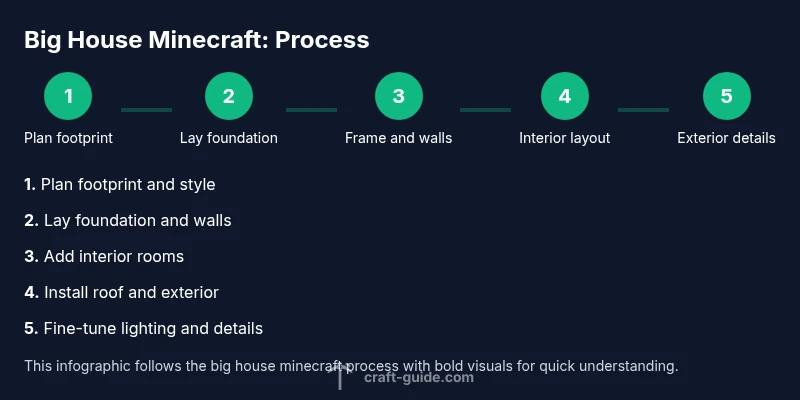
Plan footprint and style
Decide on the mansion’s base footprint and overall architectural style. Sketch a rough layout with zones for living spaces, storage, and work areas. Ensure the plan scales with future expansions.
Tip: Pro tip: start with a simple rectangle, and add wings later to keep symmetry manageable. - 2
Prepare base materials and storage plan
Gather a core set of blocks (stone bricks, wood, glass) and set a temporary storage area for quick access. Organize by block type to speed up building. Prepare a small supply of scaffolding for high sections.
Tip: Pro tip: label chests or use color-coded blocks for quick identification. - 3
Lay foundation and exterior walls
Mark the outer perimeter and raise the base walls. Check sightlines from key viewpoints (entry, stairs, main hall) to ensure the mansion reads correctly from multiple angles.
Tip: Pro tip: place a central spine to guide future wings and corridors. - 4
Add interior walls and room layout
Divide the interior into living quarters, storage, and work zones. Create a central hall or staircase to unify spaces across floors.
Tip: Pro tip: use consistent wall thickness to maintain a cohesive look. - 5
Install floors, stairs, and roof structure
Lay floors on each level and install stairs or ladders for vertical movement. Build the roof frame first to establish mass and silhouette.
Tip: Pro tip: test roof pitch with small models before committing to full-scale sections. - 6
Exterior detailing and windows
Add windows with appropriate framing and apply façade details such as ledges and arches. Balance window size with wall mass for visual harmony.
Tip: Pro tip: stagger window heights across floors to avoid a flat façade. - 7
Lighting plan and safety checks
Implement layered lighting to minimize dark corners and spawn points. Check for mob spawn areas and seal hidden spaces.
Tip: Pro tip: place light sources behind decorative blocks to keep aesthetics clean. - 8
Landscaping and exterior ground work
Create pathways, a courtyard, and garden areas. Extend the landscape to frame the mansion and guide visitors toward the entrance.
Tip: Pro tip: add lighting along paths for safety and atmosphere. - 9
Review, refine, and plan expansions
Walk through the mansion in different light conditions, adjust proportions, and plan future wings or districts. Keep a change log for expansions.
Tip: Pro tip: keep modular sections ready to copy or adapt in future builds.
People Also Ask
How big should a mega mansion be to feel impressive without becoming impractical?
Impressive scales vary by world size and goal. Start with a 3–4 wing layout around a central hall, then expand as needed. Test in creative to adjust proportions before committing in survival.
Aim for a central hall with three to four wings. Expand gradually and test proportions in creative first.
Which materials provide durability and a timeless look for large builds?
Stone bricks or quartz offer durability and a refined look, paired with oak or dark oak for warmth. Add glass accents to keep interiors bright and open.
Stone bricks with wood accents and glass for light balance durability and style.
How can I prevent performance issues on large builds?
Limit redstone complexity, use modular sections, and test lighting in chunks. Consider turning off fancy shadows for smoother gameplay in big worlds.
Keep redstone simple, test in chunks, and use modular sections to stay smooth.
How should I organize storage and farms inside a big house?
Create nearby dedicated zones: a bulk storage hub, a farming wing, and a crafting floor. Label chests and group items by workflow to minimize walking distance.
Group storage by function and label chests to keep things efficient.
Is it better to build in creative or survival for a large mansion?
Creative speeds planning and testing, while survival adds realism and resource management. A practical approach is to prototype in creative, then rebuild in survival with shared seeds and world settings.
Prototype in creative, then recreate in survival for authenticity.
Can I replicate a real-world mansion in Minecraft?
Yes, but plan scale and permissions. Use reference photos and a modular approach to replicate details without overloading the build.
Absolutely, plan carefully, use modular chunks, and verify proportions as you go.
Watch Video
The Essentials
- Plan first, build later to save time.
- Use a cohesive palette to unify the mansion.
- Design with expansion in mind for future growth.
- Balance aesthetics with performance considerations.