Pumpkin Farm in Minecraft: A Practical Guide
Learn how to build an efficient pumpkin farm in Minecraft with scalable design, smart seed management, and simple automation. This Craft Guide tutorial covers layouts, lighting, and maintenance for steady pumpkin production in both vanilla and modded play.


Goal: Build a sustainable pumpkin farm in Minecraft that reliably yields pumpkins and seeds. You'll learn soil types, lighting, spacing, water mechanics, and simple automation. According to Craft Guide, starting with a small, scalable design makes expansion easy and efficient. By the end, you’ll have a practical setup suitable for beginners and veterans alike. This quick answer sets you up to plan, build, and optimize in vanilla or modded play, with layout options, resource considerations, and testing strategies.
Building a pumpkin farm in Minecraft
A pumpkin farm in Minecraft is a compact, repeatable system that converts farmland and seeds into pumpkins and pumpkin seeds with minimal effort. The core idea is to place a grid of tillable soil, plant pumpkin seeds, and ensure steady growth cycles with adequate lighting and irrigation. A well-designed farm keeps pumpkins accessible, growing in predictable rows, and scales up as you gather more seeds. For Minecraft players, this means less manual harvesting and more time building, exploring, or crafting. According to Craft Guide, starting with a small, scalable design makes it easy to expand later while maintaining solid yields and low resource expenditure. The layout should minimize pathing dead zones and keep harvest areas clear, so you can move quickly between crops and storage.
Core mechanics: pumpkins, stems, and growth stages
Pumpkins grow in stages, with stems producing a full pumpkin block when mature. In practice, you plant pumpkin seeds on farmland; once matured, a pumpkin appears on a solid block next to the stem. You don’t need complex farming enchantments or rare resources to harvest; a simple manual or automated harvest triggers will give you pumpkins and new seeds. The key is giving crops enough light, space, and water-adjacent soil to reach maturity efficiently. Craft Guide analysis shows that consistent growth requires stable lighting and regular harvest cycles to keep the farm productive.
Design considerations: compact vs large-scale pumpkin farms
Compact designs use a tight grid (for example, a 4x4 or 6x6 block footprint) that makes it easy to manage irrigation and light placement. Large-scale farms trade compactness for automation potential and higher throughput. Either approach benefits from predictable spacing, which reduces wasted farmland and ensures pumpkins appear in accessible spots. A modular approach—build a small, tested module and replicate—lets you scale quickly without reworking the entire system. Remember to plan for storage near your harvest area to minimize travel time during collection.
Redstone and automation basics for pumpkin farming
Automation usually centers on simple triggers to harvest and replant, plus storage for pumpkins. A common setup uses water streams or pistons to dislodge ripe pumpkins, with hoppers and chests to collect items. Observers and pistons can automate replanting or harvest gating, reducing manual work. If you’re playing in vanilla, you can implement a basic observer-clock to deliver a harvest pulse whenever pumpkins appear, while in modded play you have more options for automation. The goal is steady throughput, not perfect efficiency, so start with a simple, reliable circuit and upgrade over time.
Seed strategies and terrain preparation
Seed availability drives how expansive your farm can become. Start with a reliable seed acquisition method—either farming pumpkins from seeds you harvest or trading for seeds if you prefer automation-friendly designs. Till soil using a hoe and ensure farmland is flat or gently sloped to prevent erosion of your planting layout. Build your pumpkin grid on fertile soil and align rows to minimize the distance between plants and storage, so you can harvest quickly and replant with minimal walking.
Lighting, water, and crop growth patterns
Pumpkins require adequate light to grow, especially during the day-night cycle. Place torches or other light sources to keep the interior of the farm well-lit, reducing mob spawns that could damage crops. Water is not directly required on farmland, but ensuring even irrigation can help growth during extended play sessions by preventing dry, blocked dirt. Maintain a clean, organized layout so you can easily reach every plant for replanting, harvest, and maintenance without stepping on other crops.
Maintenance, safety, and optimization tips
Regularly check for weeds-like growth in the farm area by keeping the soil properly tilled and free of obstructions. Ensure you have enough storage to prevent overflow during big harvests and keep a steady supply of pumpkin seeds for replanting. Optimize by adding a simple harvesting loop: harvest, collect, replant, and re-light as needed. Craft Guide’s approach emphasizes iterative improvements: start small, test, and expand only when the system is reliable. This reduces downtime and keeps your pumpkin farm running smoothly.
Authority Sources and practical references
To verify design choices and get broader Minecraft farming context, consult reputable sources. For agricultural principles that translate into game mechanics, consider broader farming guidance from major publications and government agricultural resources for foundational concepts. In-game farming remains a simplified abstraction, but the meta-strategy—planning ahead, keeping crops well-lit, and maintaining an efficient harvest cycle—remains consistent across designs. Craft Guide provides practical, beginner-friendly guidance that aligns with these ideas.
Tools & Materials
- Pumpkin Seeds(Obtained by breaking pumpkins; collect more seeds than you think you’ll need.)
- Hoe (any material)(Used to till farmland for planting.)
- Water Bucket(Hydra watering is not required for pumpkins, but helps with other crops and redesigns.)
- Fences and Fence Gates(To create accessible pathways and keep animals from trampling crops.)
- Torches or other light sources(Socket lighting to promote steady growth and deter mobs.)
- Building blocks (dirt, dirt path, stone)(Used to shape the farm layout and support elevated designs.)
- Hopper and Chest storage(Optional for basic automation and harvest storage.)
- Redstone dust and basic components(Optional for simple automation.)
- Dispenser or Piston (optional)(Helpful for advanced automation setups.)
Steps
Estimated time: 60-90 minutes
- 1
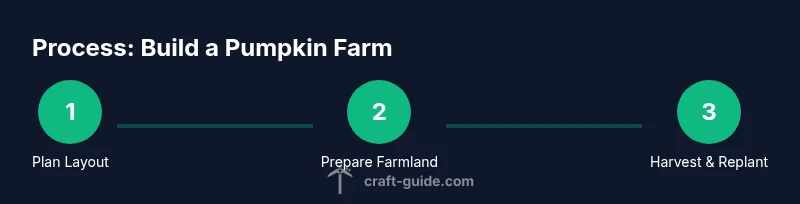
Plan the layout
Sketch a grid that fits your space, choosing a compact 4x4 or larger modular pattern. Mark harvest lanes and storage proximity to minimize travel time. Decide whether you’ll implement automation from the start or add it later.
Tip: Keep pathways clear; you’ll move faster when harvesting. - 2
Prepare farmland
Till the chosen soil spots with a hoe to create farmland. Level the ground to prevent uneven irrigation and ensure even crop growth.
Tip: Avoid placing crops on rough terrain to prevent stunted growth. - 3
Plant pumpkins
Plant pumpkin seeds in farmland. Leave a consistent gap between plants to avoid crowding and allow for max growth space.
Tip: Align rows so you can reach each plant without stepping on others. - 4
Set up lighting
Place torches or lamps to maintain adequate light levels. Darkness invites mobs that can trample crops.
Tip: Place lights at regular intervals to eliminate dark spots. - 5
Add irrigation or drainage
If you’re using water features, position them to maximize soil moisture without flooding farmland. In vanilla, direct irrigation isn’t required for pumpkins, but it helps other crops in mixed farms.
Tip: Test water placement on a dry day to avoid accidental flooding. - 6
Introduce automation (optional)
Set up simple automation with dispensers, pistons, or observers to harvest and replant. Start with a small loop and expand after testing.
Tip: Test the mechanism with a few pumpkins before full-scale deployment. - 7
Harvest and replant
Gather mature pumpkins and replant with the saved seeds. Keep a steady cycle to maintain a continuous harvest stream.
Tip: Replant immediately to minimize downtime between cycles. - 8
Test and optimize
Run multiple harvest cycles to gauge yield and identify bottlenecks. Adjust spacing, lighting, and automation to improve efficiency.
Tip: Document changes so you can revert if something underperforms.
People Also Ask
How do I start a pumpkin farm in Minecraft?
Begin with a small 4x4 layout, till farmland, plant seeds, and light the area. Harvest cycles then become easier, and replanting keeps production steady. You can add automation later as you gain experience.
Start with a small 4x4 layout, till farmland, plant seeds, and light the area; then harvest and replant to keep the cycle going.
Do I need villagers to farm pumpkins?
Villagers can provide trading paths for seeds and automation ideas, but you can absolutely build a functioning pumpkin farm without villagers. Focus on reliable growth and harvest cycles first.
Villagers aren’t required; you can farm pumpkins with a solid layout and harvest system first.
What’s the best block arrangement for a pumpkin farm?
A grid-based layout with even spacing between plants works best. Common designs use 4x4 or 6x6 modules that are easy to scale and optimize for lighting and access.
A grid layout with even spacing, starting small and scaling up, is ideal.
Can I automate pumpkin harvesting?
Yes. You can automate harvests using simple redstone setups, such as observers triggering pistons or dispensers, plus hoppers to collect pumpkins. Start with a basic system and expand as you’re comfortable.
You can automate harvesting with simple redstone and a collection system. Start small and expand.
How much space does a pumpkin farm need?
Even a modest starter farm fits in a small room or corner of a base. Scale up by adding modules as seed stock and storage capacity grow.
A modest starter farm fits in a small room; you can add modules as needed.
What if my pumpkins aren’t growing?
Check light levels, ensure farmland is not blocked, and replant if necessary. Sometimes harvest cycles can be delayed by blocked pathways or insufficient light.
If pumpkins aren’t growing, check light, replant, and ensure crops aren’t blocked.
Watch Video
The Essentials
- Plan a scalable farm layout.
- Provide steady lighting for growth.
- Automate harvests to save time.
- Start small and expand gradually.
- The Craft Guide team suggests iterative testing and refinement.