Farm in Minecraft: Step-by-Step Farming Guide
Learn to build efficient farms in Minecraft with practical layouts, crops, and animal setups. This Craft Guide guide covers planning, building, automation, and maintenance to maximize yields for a sustainable farm in minecraft.


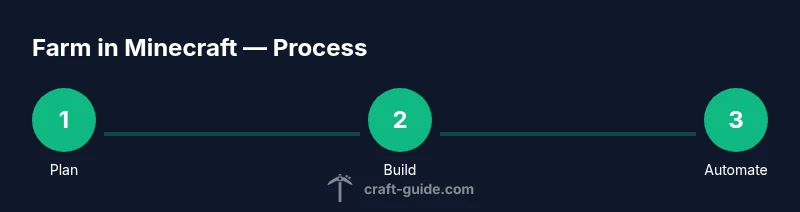
Goal: learn how to create an efficient farm in Minecraft. This quick answer outlines the core steps and essentials: decide your farm type (crop, animal, or hybrid), gather basic materials, choose a suitable location, build a compact, scalable setup, and automate harvesting and collection where possible. You’ll maximize yields while keeping costs and risks in check.
Planning your farm in Minecraft
Planning your farm in Minecraft begins with clear intention. When you plan, you decide what you want to produce, how much space you need, and how the layout will support growth over time. For many players, the first choice is between crop farms, animal farms, or a hybrid system that combines both. A solid plan reduces wasted space, minimizes travel distance, and makes automation feasible later on. In Craft Guide analyses, players who sketch a rough layout before digging report faster builds and fewer rebuilds. The core principle is balance: a farm that fits your world size, play style, and upkeep tolerance stays efficient across seasons and updates. A well-considered design will also leave room for experimenting with new crops or mobs, and can adapt to changes in game versions. This approach is especially important for a farm in minecraft, where small choices early on compound over time.
Next, consider your game biome and resources. Some crops grow best in certain climates, and animal farms can benefit from nearby water or shelter. Position your farm near a shared storage area to streamline collection, and leave room for expansion as you gather more seeds and animals. Finally, decide how you’ll defend your farm from mobs and weather, since protection affects uptime and yields.
Choosing a farm type: crops, animals, or hybrids
Choosing the right farm type is the foundation of efficiency. Crop farms focus on renewable yields from seeds such as wheat, carrots, potatoes, and beetroot. Animal farms maximize steady supplies of meat, leather, eggs, or wool, depending on the animals you keep. A hybrid approach combines both crop and animal systems in a shared footprint, enabling cross-use of space and resources. A farm in minecraft designed with crops near animals can leverage shared irrigation, shelter, and storage, which reduces travel time during harvests. Consider your play style: if you enjoy farming every day, a crop-centric layout with compact enclosures may be perfect; if you want steady resources with occasional trading, add animal pens adjacent to your plots. Craft Guide analysis shows that when players diversify, they experience fewer downtime periods and better long-term yields as game progression unlocks new farming techniques.
Layout and zoning for efficiency
Efficient layouts minimize walking, maximize accessibility, and support smooth automation. Start with a modular core: core crops in the center, irrigated by water channels within four blocks of any plot. Surround the core with livestock pens, using fencing to define zones and prevent wandering. Create clear paths that connect to a shared storage area and a central feeder or hopper system if you plan automation. Zoning also means thinking about future expansions: leave blank modules that are easy to clone or repurpose as you add more crops or animals. Lighting is not just for mobs—it helps crops reach mature stages predictably in time-based farming cycles, especially when you play into nights or longer sessions. A well-zoned farm in minecraft grows with you, shrinking travel time and reducing waste.
Automation and redstone basics
Automation saves time and reduces repetitive work. Start simple: use water channels to auto-harvest crops that reach maturity, and utilize chests and hoppers to transport items to a central storage area. You don’t need heavy redstone to begin; initial farms can rely on gravity and manual labor while you test layouts. As you gain confidence, add collection systems with hopper lines and a basic timer or comparator-based pulse to coordinate repeated harvest cycles. For animal farming, automatic breeders or simple livestock pens with gated access can streamline feeding and growth. The key is to keep automation modular and expandable, so you can add more farms without redesigning the entire layout. This approach preserves performance and keeps your farm in minecraft manageable.
Common mistakes and how to avoid them
Many players start too large or too complex, creating maintenance bottlenecks and storage chaos. A frequent error is neglecting water logistics, which leads to dry farmland or uneven harvests. Another pitfall is underestimating space; cramped layouts reduce accessibility and slow down collection. Lighting and mob protection are often overlooked, resulting in lost crops or animal losses. Finally, ignore storage planning at your peril: if you can’t find items, your farm becomes a bottleneck rather than a productivity engine. Avoid these by testing small modules first, measure yield pace, and scale up gradually with well-planned storage and clear fencing.
Scaling your farm over time
Scale happens in layers. Start with a compact, efficient core that you can reproduce to new plots. Add more crop rows or additional animal pens as you gather seeds and livestock. Integrate automation gradually: a single hopper line that routes items to a chest can be a turning point toward full automation. Maintain modularity by using consistent block choices, storage layouts, and irrigation rules. Periodically review your yields and adjust spacing to minimize crowding or wasted water. A scalable farm in minecraft grows with your world, making room for future updates and new farming techniques.
Tools & Materials
- Seeds (wheat, carrot, potato, beetroot)(Choose one type to start; diversify later for variety.)
- Water source(Irrigate crops; keep within four blocks of farmland.)
- Hoe(Till soil to farmland for crop planting.)
- Building blocks (wood/planks, dirt, stone)(Form terraces, borders, and shelter.)
- Fencing(Defines animal pens and garden boundaries.)
- Chest(s) and storage(Store seeds, crops, and animal products.)
- Hopper(s) and basic redstone(Facilitates automated item transport; add later as needed.)
- Buckets of water(Water sources for irrigation and animal care.)
Steps
Estimated time: 2-4 hours
- 1
Select location and boundary
Choose a flat area near a storage chest cluster. Mark clear boundaries for crops and pens, ensuring water can reach all plots within four blocks. This setup reduces distance traveled and simplifies future expansion.
Tip: Keep your core under 9x9 blocks to maximize efficiency and keep early growth predictable. - 2
Choose farm type and prepare soil
Decide between crops, animals, or a hybrid. Use a hoe to till soil where you’ll plant crops, or build sheltered pens for livestock. Prepare enough seed stock to seed a full row without pauses.
Tip: Starting with a small crop bed of 3x3 or 5x5 helps you master irrigation before scaling. - 3
Create irrigation and layout channels
Arrange water channels so every plot is within four blocks of water. This keeps farmland hydrated and productive. For animals, ensure shelter remains accessible and feed lines are easy to navigate.
Tip: Test water reach with sprinting to verify coverage in all corners. - 4
Plant seeds and monitor growth
Plant your seeds and set a routine to check growth stages. Keep a log or use a simple storage system to track what’s planted and what’s harvested. Rotate crops periodically to maintain soil health and yields.
Tip: Bone meal can accelerate growth in the early game; use sparingly to conserve resources. - 5
Set up harvesting and collection
Install chests and, if desired, hopper lines to transport harvests to a central storage. Manual harvesting works well initially; automation can be layered in once basics are stable.
Tip: Keep a dedicated harvest path so you don’t block future expansion. - 6
Add animal pens and breeding (optional)
Place pens close to crops for convenience and set up gates for easy access. Regularly feed animals and breed when possible to steady resource flow.
Tip: Separate breeding areas from crop plots to minimize path overlap. - 7
Introduce basic automation
Add a simple hopper-to-chest system for crops or animal products. Keep the design modular so you can upgrade without reworking the whole farm.
Tip: Test automation on a small module before scaling up across the entire farm. - 8
Evaluate and iterate
Run a few mining days to observe yields and travel time. Iterate layout and storage to improve throughput and reduce downtime.
Tip: Document changes; small improvements compound into big gains over time.
People Also Ask
What is the easiest farm to start with in Minecraft?
The easiest starting point is a small crop farm using a single crop type like wheat. It requires minimal space, seeds, and basic irrigation. As you grow more confident, you can add animals or multiple crops for variety.
Start with a small crop farm, like wheat, to learn the basics before expanding.
Do I need redstone to automate a farm?
No, initial automation can be achieved with simple hopper and chest layouts or gravity-based collection. Redstone becomes more useful as you scale, but you can start with non-redstone approaches and upgrade later.
You can start without redstone and add automation later.
How big should my first farm be?
Begin with a compact 5x5 or 7x7 crop bed and a couple of animal pens. This size is manageable, allows quick iterations, and scales cleanly when you’re ready to expand.
Begin with a small, manageable farm and grow as you gain experience.
Can I combine crop and animal farming efficiently?
Yes. A paired layout keeps resources close and reduces travel time. Separate zones with a shared storage area helps you optimize collection and processing.
Yes, you can combine them with a simple, efficient layout.
What blocks are best for building a farm?
Use accessible, easy-to-build blocks like wood, dirt, or stone for borders and shelters. Farmland is created by tilling dirt with a hoe, then planting seeds.
Choose practical blocks and remember farmland is tilled dirt.
How do I protect my farm from mobs?
Provide good lighting, secure fencing, and cover exposed areas to deter mobs. A roof and enclosed walls help maintain a safe farming environment.
Keep the area lit and enclosed to reduce mob spawns.
Watch Video
The Essentials
- Plan layout before digging to maximize efficiency
- Choose crop, animal, or hybrid farms based on playstyle
- Keep water within four blocks of farmland for steady yields
- Start with simple automation and expand gradually
- Modular designs scale smoothly and reduce maintenance