Banner Design for Minecraft: A Practical How-To Guide
Learn to craft banner design for minecraft with thoughtful color palettes, pattern layering, and loom techniques. This comprehensive guide covers materials, step-by-step workflow, display ideas, and expert tips for both Java and Bedrock editions.


You’ll learn banner design for minecraft: how to choose a base color, plan patterns, and apply them with dyes and a loom. This quick guide outlines a repeatable workflow to create readable, thematically consistent banners that fit any build, whether you play in Java or Bedrock. By the end you’ll craft banners that communicate your theme at a glance.
Understanding banner design for minecraft: basics and benefits
Banner design for minecraft isn't just decorations; banners act as visual signals that help identify your base, team, or build theme. They integrate color theory and symbolic patterns into a compact, in-world asset. According to Craft Guide, banner design for minecraft blends color theory with in-game crafting to produce distinctive banners that work at various scales, from a doorway to a sprawling fort. In this section, we cover the core concepts: base color, pattern layering, and readability. Start by selecting a base color that contrasts with the surrounding blocks so the banner reads from a distance. Then map patterns that convey meaning—crest, symbol, or motif—without overwhelming the banner's silhouette. We'll also discuss how to adapt designs for Java Edition and Bedrock Edition, and how to balance aesthetics with legibility in different lighting conditions. By understanding these fundamentals, you can design banners that complement your redstone setups, gardens, or castles. We’ll outline a practical workflow you can follow in your next Minecraft session, including a simple template you can reuse for future builds.
Color theory and palette strategies for minecraft banners
Color is the backbone of banner legibility. A strong palette uses high-contrast base and foreground elements to stand out against the block textures around your build. Use a primary base color that is bright enough to be seen from a distance, then layer patterns with one or two additional colors for emphasis. Craft Guide analysis shows that successful banner designs balance contrast, harmony, and readability: avoid too many colors that muddy the symbol, and keep the number of colors to three or fewer for clarity. Use complementary or analogous color schemes to create cohesion with your environment. For example, a white base with black and red patterns reads well on stone or dark wood, while a blue base with white pattern accents suits water features. Also consider seasonality or biome context; a desert banner might favor warm yellows and oranges, while a forest theme may use greens. This section includes practical palette examples and a quick framework for selecting hues based on the environment and build style.
Materials and crafting basics for banners
To begin banner design, gather a base banner (crafted from six wool blocks and one stick) and dyes of your chosen colors. The base banner color determines the default field for patterns. You'll also need a loom to apply patterns and a few basic blocks from your inventory to compare how banners look in different lighting and against different backgrounds. Dyes come in many colors; you can mix primary dyes to create tertiary shades. If you're new, start with a blank banner and a loom; you can craft or place the loom in your base to experiment with patterns quickly. We'll walk through a safe, repeatable setup that works in both Java and Bedrock editions and keeps your materials organized for faster iteration.
Design workflow: concept to final banner
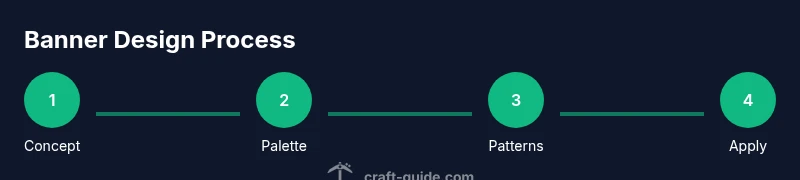
Begin with a concept—what message should the banner convey? Create a small plan that lists the base color, the number of patterns (up to six), and the general motifs you want to include. Sketch with in-game tests or reference images; in Minecraft, you can ephemeral test by applying patterns on a temporary white banner and adjusting colors for contrast. After you finalize the palette and motifs, craft your base banner and set up your loom. Apply patterns one by one, paying attention to how each layer interacts with the next. Save your progress by duplicating banners in your inventory or using a structure in creative mode to reproduce designs quickly in survival worlds. This workflow emphasizes iteration and readability; the goal is a banner that communicates its motif at a glance.
Using looms and banner patterns in practice
Lighting changes, block textures, and distance all affect how a banner reads. The Loom interface lets you mix base color and separate pattern colors to achieve layered designs. Start with the base banner, then select a pattern and dye combination; patterns stack in order—from bottom to top—and produce a final composition. For complex designs, prepare a set of banner Pattern items in your inventory and choose a few to maintain legibility. Note that some patterns require multiple steps or dyes to achieve; plan ahead to avoid wasted dyes. If patterns look muddy, simplify by reducing the color count or increasing base color contrast. Practice on a trial banner before applying to your main build to prevent mistakes.
Display ideas: banners in builds and bases
Place banners at key waypoints, gatehouses, or above doorways to signal rooms or zones inside your base. Consider using banners on armor stands near entrances for decorative effect. In larger builds, banners work well as accents on banner stands or near staircases. Align banners with the architectural rhythm of your build: the spacing between banners should reflect the rhythm of windows and doors. On servers, banners can mark team territories or event statuses. Evaluate lighting, background textures, and the nearby color palette to ensure readability. The Craft Guide team notes that banners add personality to your Minecraft world when integrated with other decorative elements without overwhelming the space.
Troubleshooting and design polish
If a banner's patterns blend into the background, tweak the base color or pattern colors for higher contrast. If you can't replicate a design, simplify or break it into two banners with complementary motifs. Patterns sometimes appear differently under lighting; test your banner in daylight and at night using nearby torches or lanterns. Ensure you have enough dye stock in your inventory and consider saving a few templates for quick reuse. Also, remember that banners are versatile in both Java and Bedrock; minor UI differences may affect how you apply patterns, but the visual result remains similar. The Craft Guide team stresses that the most durable designs are those you can reproduce quickly and adapt to different builds.
Tools & Materials
- Banner base (unpatterned)(Craft from six wool blocks and one stick)
- Wool blocks (6)(Any colors forming base)
- Stick(Used to craft the base banner)
- Dyes (assorted colors)(Plan palette and pattern colors)
- Loom(Optional but highly recommended for patterns)
- Banner Pattern items (optional)(For producing specific motifs)
Steps
Estimated time: 30-60 minutes
- 1
Gather materials
Collect six wool blocks, one stick, and a full set of dyes in your inventory. Organize colors to match your planned palette before crafting.
Tip: Lay out colors on a surface to visualize the palette before you start. - 2
Craft the base banner
Use the crafting table to combine six wool blocks and one stick into a plain banner. This base color defines the background for all future patterns.
Tip: Choose a base color with strong contrast to the nearby blocks. - 3
Set up a loom
Place a loom nearby to apply patterns; if you don’t have one, prepare to use alternative methods for patterning, though looms are the easiest and most reliable.
Tip: A loom speeds up pattern iteration and keeps colors consistent. - 4
Plan pattern order
Decide the sequence of patterns and dyes so they layer cleanly. Remember: patterns stack from bottom to top, affecting readability.
Tip: Draft a quick pattern map on paper or in-game noteboard. - 5
Apply patterns
In the loom, place the base banner, choose a pattern, and pick a dye color. Repeat for each desired layer, testing readability after each addition.
Tip: Keep the color count low (ideally three or fewer) to preserve clarity. - 6
Test and adjust
View the banner from different angles and lighting, adjust colors if necessary, and compare with nearby decor to ensure cohesion.
Tip: Always test in daylight and at night to ensure legibility in all conditions.
People Also Ask
What materials do I need to craft a banner?
To craft a banner, you’ll need six wool blocks, one stick, and dyes in your chosen colors. You’ll also want a loom to apply patterns. This setup works for both Java and Bedrock editions.
You’ll need six wool blocks, one stick, dyes, and a loom to craft and pattern a banner.
How many patterns can a banner have?
A banner can include up to six patterns, stacked bottom to top. Plan the order to ensure each layer remains legible at a glance.
You can apply up to six patterns, stacked from bottom to top.
How do I apply patterns using a loom?
Place the banner in the loom, select a pattern, and choose a dye color. Repeat for additional layers, testing readability after each step.
In a loom, you pick a pattern and dye, then repeat to add more layers.
Are there differences between Java and Bedrock in banner design?
Base materials and the loom workflow are similar across editions, but some pattern shapes and item names may differ. Test each design in both editions if you switch between them.
There are minor differences between editions; test in both if you play both.
What color combos help readability?
High-contrast combos like dark base with light patterns or light base with dark patterns work best. Avoid very similar tones for base and pattern colors.
Choose high-contrast colors to keep the banner readable.
How can I reset a pattern I don’t like?
In the loom, you can remove a pattern by selecting the clear option or reapplying patterns in a different order. Saving templates helps speed re-creation.
You can remove a pattern in the loom or reapply in a new order.
Watch Video
The Essentials
- Plan your color palette before designing.
- Prioritize high contrast for readability.
- Limit to three colors for clarity.
- Test designs in daylight and night.