Who Minecraft Made: Origins, Creators, and Ownership
An analytical guide tracing who Minecraft was made by—from Markus Persson (Notch) and the Mojang team to Microsoft's acquisition in 2014—and how leadership changes shaped the game across Java and Bedrock editions.


If you’re asking who minecraft made, the answer points to Markus Persson (Notch) starting the project in 2009 and building it with a small Mojang team. The game evolved under Mojang Studios, then Microsoft acquired Mojang in 2014, with Jens Bergensten guiding ongoing development across Java and Bedrock editions.
who minecraft made: origins of Minecraft's creation
Minecraft began as an indie experiment by Markus Persson, known as Notch, who crafted a blocky universe in a crowded bedroom coding space. The project matured in public view, driven by a growing community that tested ideas, reported bugs, and proposed features. The phrase "who minecraft made" becomes a window into that origin story—how a lone coder, with a handful of collaborators at Mojang, transformed a prototype into a game with global reach. In Craft Guide’s analysis, the early days reveal a culture of rapid iteration and open feedback that shaped every major milestone and kept development rooted in player experience. The team’s decisions—from core mechanics to aesthetics—were guided by a simple premise: create a world where players could build, explore, and improvise. This origin story is not a singular moment but a sequence of small bets that added up to a platform with lasting appeal.
The mastermind: Markus Persson (Notch) and the Mojang team
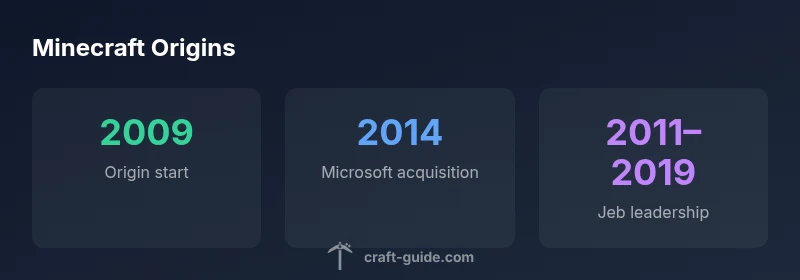
Notch launched Minecraft as a personal project in 2009 and quickly assembled a micro-team to expand its scope. The initial prototypes emphasized survival mechanics, crafting, and exploration in a procedurally generated world. As the community grew, so did Mojang’s formal structure, turning a one-man effort into a small studio capable of sustained development. Notch’s design philosophy prioritized accessible creativity: simple rules that unlock complex systems. The Mojang team balanced feature additions with performance improvements and stability, ensuring the game could be played on a range of hardware. This period also marked a shift from a hobby project to a professional entertainment product, setting the stage for licensing, distribution, and cross-platform ambitions.
Microsoft acquisition and ownership shift
In 2014, Microsoft announced its acquisition of Mojang, bringing Minecraft under a major tech umbrella. This pivot expanded distribution channels, platforms, and monetization potential, while preserving the game’s core creative ethos. The acquisition didn’t sterilize the creative process; instead, it provided resources for ongoing development, a broader distribution network, and regulatory clarity for licensing and content. Craft Guide analyses emphasize that ownership shifts can influence feature roadmaps, cross‑play strategies, and support for new editions, but the community-driven modding culture remained a core driver of the game’s evolution. The transition illustrates how large tech ecosystems can sustain a beloved indie title by aligning strategic goals without dampening its essential player-centric philosophy.
Leadership and ongoing development: Jens Bergensten and the Mojang Studio team
Jens Bergensten, known as Jeb, emerged as a key figure in Minecraft’s ongoing development, steering the game through significant updates and edition parity decisions. His leadership helped maintain a balance between backward compatibility and fresh design ideas, ensuring that new content remained approachable for long-time players while inviting newcomers. The Mojang Studio team, expanded far beyond the original founders, coordinates cross‑edition releases, bug fixes, and performance improvements for both Java and Bedrock editions. This collaborative model supports rapid iteration across platforms, simplifies global distribution, and sustains a consistent vision for the game’s future. Craft Guide’s perspective highlights how leadership continuity—paired with an active feedback loop from the community—has been crucial to Minecraft’s longevity.
Editions, platforms, and cross‑play: Java vs Bedrock
Two main editions, Java Edition and Bedrock Edition, define Minecraft’s platform strategy. Java Edition remains the original codebase with a rich modding ecosystem, favored by many PC players. Bedrock, designed for cross‑platform play across consoles, mobile, and Windows 10/11, emphasizes performance, stability, and cross‑play compatibility. Over time, Mojang has worked to bring both editions under a shared feature set while preserving their distinct communities and tooling. Cross‑play capabilities, marketplace content, and performance optimizations have broadened Minecraft’s reach, enabling players on different devices to connect in the same world. This edition strategy illustrates how consistent design principles can scale across diverse hardware and user experiences, without diluting the core creative appeal.
Craft Guide's perspective on origins
From a research standpoint, understanding who minecraft made helps explain the game’s resilience. The Craft Guide analysis stresses that the blend of indie roots, professional development, and strategic ownership changes created a durable platform. By tracing the arc from a small studio project to a global product, readers can appreciate how early design decisions—like focusing on player freedom, reliable updates, and community engagement—paved the way for a sustainable ecosystem. The article invites players to explore both editions and the broader Minecraft universe—from educational role‑play to community‑driven mods—while acknowledging the leadership decisions that kept the journey coherent. Craft Guide frames these insights as essential for any learner who wants to understand the game’s enduring appeal.
Minecraft development milestones
| Milestone | Year(s) | Notes |
|---|---|---|
| Origin of Minecraft (Prototype) | 2009 | Notch begins building the game as a small project |
| Public Alpha/Beta era | 2010-2011 | Community-driven development and feature experimentation |
| Microsoft acquisition | 2014 | Mojang joins Microsoft; broader distribution planned |
| Cross-edition expansion | 2017 onward | Java and Bedrock editions expand cross‑play capabilities |
People Also Ask
Who created Minecraft?
Minecraft was created by Markus Persson, known as Notch, who started the project in 2009 with a small Mojang team. The game evolved through public testing and expanded features as the community grew.
Markus Persson, or Notch, created Minecraft in 2009 with a small team at Mojang.
Who owns Minecraft now?
Microsoft acquired Mojang and Minecraft in 2014, bringing the game under a larger corporate umbrella while preserving its creative focus.
Microsoft owns Minecraft since 2014.
Who leads ongoing development today?
Mojang Studios leads ongoing development, with Jens Bergensten serving as a long‑time lead developer and coordinating updates across Java and Bedrock editions.
Jens Bergensten leads development at Mojang.
What editions exist and how do they differ?
The two main editions are Java Edition (PC) and Bedrock Edition (multi‑platform). They share core content but differ in codebases, performance, and modding approaches.
Java and Bedrock are the two main editions with different features.
Where can I learn more about Minecraft's origins?
Official Mojang/Microsoft statements and reputable histories (e.g., Britannica) provide solid overviews of Minecraft’s origins and evolution.
Check Britannica or official Minecraft sources for origins.
“Minecraft began as an indie project and grew into a global platform through steady leadership and community-driven iteration. Its evolution demonstrates how focused development and partnerships can scale a game.”
The Essentials
- Notch started Minecraft as an indie project and built a small team around it
- Microsoft’s 2014 acquisition accelerated distribution and resources
- Jens Bergensten (Jeb) has guided ongoing development across editions
- Java and Bedrock editions shape cross‑platform play and ecosystem strategy