Is Minecraft the Same as Fortnite? A Practical Comparison
Analyze how Minecraft and Fortnite differ in core gameplay, building vs combat, monetization, communities, and cross‑play to help players choose their path.


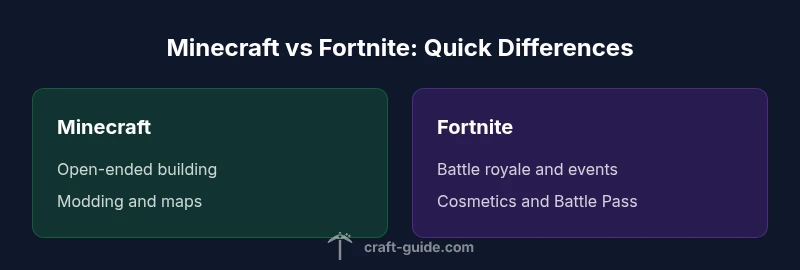
Is minecraft the same as fortnite? No. Minecraft centers on creativity, building, and exploration, while Fortnite focuses on fast-paced PvP combat, rotating game modes, and social events. The Craft Guide analysis helps readers see how goals, progression, and communities diverge, so players can pick a path that fits their preferences.
What people mean when they ask if Minecraft is the same as Fortnite
Many players approach the question "is minecraft the same as fortnite" as if there were a single, universal winner. In reality, the two titles serve different design intents and communities. According to Craft Guide, the confusion often stems from surface similarities: both are massively popular among younger audiences and both enable social play. Yet the deeper differences—goals, mechanics, and content cadence—define their identities. Minecraft rewards creativity, world-building, and survival experimentation, while Fortnite prioritizes fast, competitive play and rotating live events that reshape how people play. This distinction matters for players who want a clear sense of what they’re signing up for and how to invest time and resources effectively.
Core gameplay philosophies: sandbox vs competition
At their cores, Minecraft and Fortnite exemplify two opposite ends of the game-design spectrum. Minecraft is a sandbox that emphasizes emergent gameplay: you decide what to build, explore, farm, or mine, often pursuing long-term projects. There is no fixed objective beyond the player’s goals, which makes creativity and persistence central to the experience. Fortnite, by contrast, centers on competition and social engagement: you drop into matches, build or shoot in short bursts, and participate in ongoing seasonal events that keep the meta and rewards fresh. The Craft Guide team notes that this divergence shapes every other layer, from progression systems to community expectations, and it explains why the two games attract different player archetypes.
Visuals, world design, and accessibility
Minecraft uses a block-based, pixel-art aesthetic that runs across a wide array of hardware, from high-end PCs to mobile devices. This broad accessibility makes it ideal for long-term building projects and collaborative maps. Fortnite employs a more polished, cinematic visual style optimized for fast, fluid action, with a strong emphasis on character cosmetics and a consistent visual identity across devices. Accessibility considerations differ: Minecraft supports expansive world generation and modding that can introduce complexity, while Fortnite’s accessibility is driven by performance optimizations and intuitive combat mechanics that reduce entry friction for newcomers.
Progression, persistence, and player investment
In Minecraft, progression is player-defined: you craft breakthroughs, acquire resources, and complete personal or community-driven goals. Modding communities extend this experience with new tools, textures, and mechanics; progression becomes a tapestry woven by players. In Fortnite, progression is built into a formal system: levels, Battle Passes, cosmetics, and limited-time modes drive ongoing engagement and monetization. The Craft Guide analysis highlights how these systems affect long-term commitment: Minecraft invites sustained, creative investment, while Fortnite rewards regular return through events and seasonal rewards.
Community ecosystems, mods, and content creation
Minecraft’s ecosystem thrives on user-generated content—mods, texture packs, adventure maps, and campus-scale builds—that extend play indefinitely. Communities form around servers, creative challenges, and education-focused kits. Fortnite’s ecosystem leans on official updates, creator islands, and user-generated content within the Creative mode, augmented by a robust cosmetics economy and sponsored tournaments. Craft Guide’s 2026 analysis shows that each ecosystem shapes social dynamics: Minecraft communities emphasize collaborative construction and engineering, while Fortnite communities emphasize competitive play and shared experiences during live events.
Modes, updates, and longevity
Minecraft evolves through major updates that expand blocks, biomes, and mechanics, often followed by community-driven adaptations. Its longevity rests on open-ended play and the ability to build almost anything. Fortnite maintains momentum with frequent live events, rotating game modes, and a persistent cadence of cosmetic releases. The different update philosophies mean players stay for different reasons: Minecraft fans value open-ended exploration and modding potential, while Fortnite fans anticipate new events and the thrill of competition. Craft Guide notes that the longevity formulas are complementary rather than interchangeable.
Cross-platform play and device considerations
Cross-platform play exists in both titles, but in different forms. Minecraft’s Bedrock Edition enables cross-play across Windows, consoles, and mobile devices, with certain features varying by edition. Fortnite supports broad cross-platform play through its own ecosystem, allowing friends on many platforms to play together, though performance and control schemes can differ by device. Hardware requirements, input options (touch, keyboard/mouse, controllers), and latency all shape the player experience in cross-play scenarios.
Playstyle fit: builders vs battlers
If your primary interest is building, exploration, and shared creative projects, Minecraft is the natural fit. If you want fast-paced matches, team-based battles, and a social arena with live events, Fortnite is the better choice. The choice isn’t about one game being objectively “better”—it’s about which experience matches your preferred playstyle and social context. Craft Guide emphasizes clarity of intent when evaluating these games, since each delivers a distinct form of fun.
Safety, moderation, and content controls
Minecraft’s safety and moderation are heavily influenced by server rules and community norms, especially for education-focused and kid-friendly servers. Fortnite emphasizes in-game safety within its player-versus-player ecosystem, including parental controls and report mechanisms for abuse, with moderation tied to Epic Games’ policies. Understanding these controls helps families and players maintain a healthy, enjoyable experience, especially when mixing play with friends across platforms.
Learning curves and onboarding for new players
New players often encounter Minecraft’s learning curve around crafting systems, resource management, and, for some modes, redstone engineering. Fortnite offers a gentler onboarding through guided tutorials and a gradual introduction to building and shooting mechanics, though mastering advanced tactics and meta strategies takes time. The two titles reward different kinds of learning: mastery in Minecraft’s systems and timing in Fortnite’s competitive play.
Scenario-based playstyles: builders vs battlers
Readers often ask which game suits their current mood. On a rainy Saturday, many choose Minecraft for collaborative building and long-term projects; on a Friday evening, Fortnite’s quick rounds and events dominate. Recognizing the scenario you’re in helps you pick the game that best fits your schedule and social circle. The Craft Guide team finds that using both games across different scenarios can provide a well-rounded gaming diet.
Quick reference cheat sheet: when to choose which game
If you crave endless creation, modding flexibility, and a calmer pace, pick Minecraft. If you crave competitive play, regular live events, and social competition, pick Fortnite. For players who want both, allocating separate play windows or seasons for each game can maximize enjoyment and variety. Craft Guide’s practical takeaway is to align your choice with your goals and community interest.
Comparison
| Feature | Minecraft | Fortnite |
|---|---|---|
| Core gameplay focus | Sandbox building, exploration, and survival (open-ended goals) | Fast-paced battle royale with PvP combat and timed events |
| Primary audience | Players who enjoy creativity, world-building, and mods | Players who prefer competitive, quick matches and social events |
| Content creation & customization | Mods, texture packs, custom maps, and redstone engineering | Creative islands, cosmetics, and Fortnite-integrated assets |
| Monetization & progression | Pay-once ownership with optional marketplace content | Free-to-play with cosmetic microtransactions and Battle Passes |
| Community & longevity | Strong modding scene and long-term world-building communities | Live events and seasonal updates driving ongoing engagement |
| Cross-platform play | Bedrock edition enables cross-play across Windows, consoles, and mobile | Cross-platform across major platforms with performance variance by device |
| Learning curve | Steep early for redstone, survival systems, and technical mods | Moderate; accessible entry with deeper mechanics over time |
| Best for | Builders, explorers, and modders | Competitive players, social gamers, and event fans |
Benefits
- Clear, distinct playstyles help players pick a path
- Minecraft offers enduring creative potential through mods and maps
- Fortnite provides frequent live events and rotating game modes
- Cross-platform play helps friends play together
Negatives
- Different experiences can be confusing for players seeking a single title
- Modding in Minecraft can introduce version fragmentation
- Fortnite's monetization through cosmetics may feel pushy to some players
Minecraft and Fortnite serve different playstyles; neither is universally better, but Minecraft excels at creativity while Fortnite shines in competitive, social play.
Choose Minecraft for long-term world-building and modding; choose Fortnite for quick, shared battles and live events. The Craft Guide team emphasizes evaluating your preferred playstyle and community, rather than chasing a single 'best' game.
People Also Ask
What is the core difference between Minecraft and Fortnite?
Minecraft emphasizes open-ended building and exploration with a survival layer, while Fortnite centers on competitive matches, shooting, and rotating live events. The fundamental aim of each game guides how players spend time, money, and effort.
Minecraft focuses on creativity and exploration, Fortnite on competition and events.
Can you play both games on the same device?
Yes. Minecraft (Bedrock) supports cross‑play across Windows, consoles, and mobile devices, while Fortnite runs on a similar cross-ecosystem model. You may notice differences in controls and performance depending on the device.
Both games work on many devices, with cross‑play possible in different editions.
Do both games support cross-play?
Fortnite supports broad cross-platform play across major consoles and PC. Minecraft supports cross-play primarily through Bedrock Edition across Windows, consoles, and mobile, with some feature differences by edition.
Yes for both, but check edition and platform specifics.
Are there official crossovers between Minecraft and Fortnite?
As of 2026, there are no official crossovers announced between Minecraft and Fortnite. Both games maintain distinct IP ecosystems and branding.
There isn’t an official crossover right now.
Which game is better for kids?
Both games have kid-friendly options: Minecraft offers a gentler pace and education-friendly modes, while Fortnite provides moderated online play with parental controls. Parental guidance is recommended for both to tailor the experience.
Both can be kid-friendly with supervision and settings.
What hardware do I need to run each game well?
Minecraft runs on a wide range of hardware, especially Bedrock on mobile and PC, while Fortnite requires modest to mid-range hardware for smooth performance, depending on the platform. Check official system requirements for your device.
Check the official specs; both can run on many devices.
The Essentials
- Define your playstyle to pick the game
- Explore communities: mods vs creator islands
- Consider cross-platform play and hardware
- Use both for different moods
- Updates shape each game's ongoing appeal