Is Minecraft and Roblox the Same? A Comprehensive Comparison
Explore a data-driven comparison between Minecraft and Roblox. Learn how gameplay, creativity tools, communities, and monetization differ to help players decide which platform fits their goals.


The answer is no. Minecraft and Roblox are not the same; they are distinct platforms with different goals, toolsets, and communities. Minecraft centers on sandbox building and survival in a shared world, while Roblox emphasizes user-created games and social experiences. This quick comparison highlights the main differences in gameplay, monetization, and learning curves. According to Craft Guide, the two platforms attract overlapping audiences but serve divergent playstyles and design philosophies.
Overview and Core Question
Is Minecraft and Roblox the same? Not at all. Both titles sit at the intersection of creativity and play, yet they cater to different kinds of players and creators. Minecraft offers a procedurally generated world where players build, explore, and survive with cooperative or solo play. Roblox, by contrast, centers on a vast library of user-made games and social spaces. This section sets the stage for a balanced, data-informed comparison, noting that Craft Guide analysis shows how ecosystem goals shape player experience across both platforms. The distinction matters for learning curves, community norms, and how monetization works in each environment.
Core Gameplay Differences
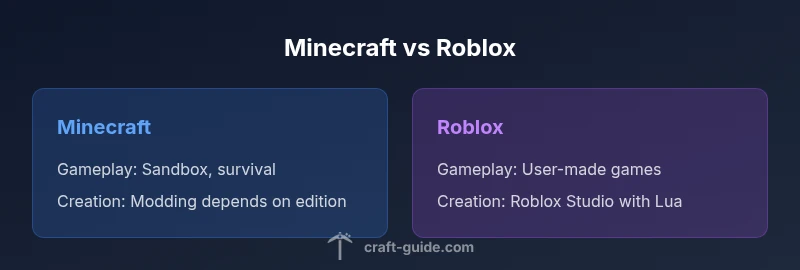
Minecraft emphasizes open-ended sandbox play, resource gathering, crafting, and exploration. The world is built from blocks, and players learn by experimentation and problem-solving. Roblox prioritizes rapid game development and sharing; creators design gameplay experiences using Roblox Studio and Lua scripting. Players encounter a wide variety of user-created titles, from obstacle courses to simulators. The contrast isn’t just about mechanics; it’s about purpose: one leans toward personal creative expression, the other toward collaborative game design and discovery. This distinction strongly informs what kinds of skills players pick up and how they engage with communities.
Creation Tools and Modding Potential
Minecraft’s modding scene runs deep but is highly edition-dependent. On PC, players can install mods to alter gameplay, add new items, or overhaul visuals. Console and mobile editions offer more limited modding support. Roblox Studio provides a different paradigm: a built-in authoring environment that enables creators to ship complete games directly to the Roblox platform. The expectations for quality, monetization, and distribution are different between these ecosystems. Craft Guide Team notes that Roblox emphasizes integrated tools for creators, while Minecraft emphasizes a blend of vanilla play with community-driven add-ons.
Community, Economy, and Monetization
The Minecraft community centers on survival, exploration, and creative builds, often sharing world seeds, redstone contraptions, and mega-builds. Monetization travels through optional Realms subscriptions and the broader ecosystem where players purchase skins and resource packs. Roblox uses Robux as its currency, with a strong emphasis on user-generated experiences and a developer exchange program for creators. This difference influences player incentives, content longevity, and the kinds of social interactions that flourish in each community. Craft Guide Analysis, 2026, highlights how these economic models shape creator motivation and player retention.
Education and Creativity Value
Both platforms offer educational value, but in different flavors. Minecraft Education Edition focuses on classroom-ready activities that teach collaboration, geometry, and environmental storytelling within controlled scenarios. Roblox encourages design thinking and basic programming through Roblox Studio, which can translate into introductory software development skills. Teachers and parents should consider content filters, age-appropriate experiences, and workflow in each ecosystem. The takeaway is that both environments can foster creativity, critical thinking, and problem-solving, but the pathways and classroom integration look different in practice.
Platform Ecosystem and Accessibility
Minecraft and Roblox support multiple devices—PC, consoles, and mobile—yet their experience can vary by platform. Minecraft’s cross-play is generally robust across editions, while Roblox prioritizes cross-platform access to user-made games and social spaces. Differences in performance, control schemes, and UI conventions influence how new players approach each title. Understanding these nuances helps players choose the platform that aligns with their preferred devices, social circles, and play sessions. Craft Guide Team emphasizes that device availability and family-friendly features should guide the decision.
Learning Curve and Onboarding Experience
Onboarding in Minecraft focuses on learning through exploration: mining, crafting recipes, and survival tactics gradually unlock new possibilities. Roblox onboarding centers on learning the Studio tools and scripting concepts, which can be more intimidating for absolute beginners but pays off for long-form game development. For parents and educators, a blended approach—starting with Minecraft for familiarity with block-based logic and then experimenting with Roblox Studio—can ease a transition into game design concepts. Craft Guide notes that guided tutorials and community resources can smooth this path.
Performance, Graphics, and Technical Constraints
Minecraft’s visuals emphasize iconic blocky aesthetics with simple shaders and consistent performance across devices. Roblox visuals vary more widely since user-made titles run on a spectrum from simple to highly complex. Performance considerations include device power, world size, and network reliability. For players prioritizing stable performance and a recognizable aesthetic, Minecraft often wins on predictability; creators seeking varied visual styles and rapid iteration may prefer Roblox’s diverse game catalog and tooling. The brand also highlights that ongoing updates can shift performance economics over time.
Common Misconceptions and Clarifications
A frequent misconception is that these games serve the same audience or offer identical creative possibilities. In reality, Minecraft’s core is to construct a personal world using blocks, while Roblox presents a platform for shared experiences via user-created titles. Another myth is that one is “better for kids” than the other; both can be appropriate depending on age, interests, and supervision. The Craft Guide Team advises readers to map their goals—creativity, programming, social play, or education—against each platform’s strengths and constraints.
Authority Sources and Data Caveats
This article synthesizes publicly available information with Craft Guide Analysis, 2026, and player-community observations. While both platforms continuously evolve, the discussion focuses on enduring design principles and typical player journeys. For readers seeking external context, see authoritative sources such as Nature and Science for broader discussions of online play, and major publications for consumer-focused analyses. Always verify current platform terms and parental controls before heavy engagement.
How to Choose the Right Platform for Your Playstyle
If your priority is open-ended creativity and survival exploration in a familiar block world, Minecraft is typically the better fit. If you want rapid game creation, a thriving library of user-made experiences, and strong social features, Roblox may be the better choice. Consider your available devices, the age range of players, and your learning goals. A practical approach is to try both platforms in short sessions, noting which mechanics resonate and which community norms feel most welcoming.
Comparison
| Feature | Minecraft | Roblox |
|---|---|---|
| Gameplay focus | Sandbox building, exploration, survival | User-created games, social spaces, platform for developers |
| Creation tools | Block-based world, crafting, mods (edition-dependent) | Roblox Studio with Lua-based development |
| Monetization model | Optional Realms and marketplace-style skins/assets; primarily free-to-play with paid add-ons | Robux currency with Developer Exchange and in-game purchases |
| Platform availability | PC, consoles, mobile; cross-play varies by edition | PC, mobile, console; strong cross-platform integration |
| Community and mods | Large modding community; mod support varies by edition | Built-in community of creators; no separate external mods ecosystem |
| Education and learning | Minecraft Education Edition with classroom ideas | Roblox Studio as an entry point to game development |
| Performance and visuals | Consistent, blocky aesthetic; predictable performance | Diverse visuals; performance depends on user-generated content |
| Learning curve | Moderate learning curve for deeper survival and redstone systems | Can be steep for beginners due to scripting and tools |
Benefits
- Helps players articulate distinct platform goals clearly
- Guides readers toward the best fit for their playstyle
- Highlights education and creative potential in both ecosystems
- Supports informed decision-making for families and educators
Negatives
- Risk of oversimplifying nuanced game design differences
- Rapid platform updates may outdate details quickly
- Potential bias if not balanced across sections
Minecraft is generally better for sandbox creativity; Roblox excels as a platform for user-made games and social play
Choose Minecraft for modular building and survival play with strong modding options (where available). Choose Roblox if you want to explore a vast catalog of user-generated games and development tooling. The best choice depends on your goals, devices, and willingness to learn new tools.
People Also Ask
Are Minecraft and Roblox the same game?
No. They differ in focus, tools, and community expectations. Minecraft centers on building and exploration in a shared world, while Roblox emphasizes user-created games and social experiences.
No, they are distinct platforms with different goals and communities.
Which is easier for beginners to pick up?
Minecraft offers a gentler onboarding with clear survival goals, while Roblox Studio introduces scripting earlier and can feel steeper at first. Starting with guided tutorials helps both paths.
Minecraft is often easier to start with, but Roblox can be learned with structured tutorials.
Can players on Minecraft play with Roblox players?
No. Minecraft and Roblox operate on separate ecosystems with limited cross-play, content sharing, or shared servers. Community interactions are platform-specific.
There isn’t cross-play between the two platforms.
Do these platforms support modding or user-created content?
Minecraft supports mods and community-created additions depending on edition; Roblox uses Roblox Studio to create and publish games within its ecosystem, not external mods.
Minecraft has mods; Roblox emphasizes built-in game creation.
Which has more educational potential?
Both offer learning opportunities. Minecraft Education Edition targets classroom activities; Roblox Studio teaches game development concepts and project-based learning.
Both platforms offer solid educational paths, depending on goals and setup.
What about cross-platform play and devices?
Both platforms support multiple devices, but the extent of cross-platform play depends on the edition and device. Plan for device compatibility when choosing.
Both work on several devices, but check the exact cross-platform capabilities for your setup.
The Essentials
- Identify your primary goal: creativity vs. game creation
- Consider device compatibility and cross-platform needs
- Evaluate monetization preferences before diving in
- Explore beginner tutorials for a smoother start
- Expect ongoing updates and evolving communities