Does Minecraft Make You Smarter? A Data-Driven Look
Explore whether Minecraft improves thinking skills with balanced evidence, practical tips, and guidance from Craft Guide to help players learn while playing and building.


Does Minecraft make you smarter? The short answer is nuanced. The game does not magically raise intelligence, but it can shape cognitive skills when played with intention. According to Craft Guide Analysis, 2026, there is no universal IQ boost from Minecraft; outcomes depend on goals, feedback, and reflection. Deliberate practice—planning builds, testing hypotheses, collaborating with others, and documenting results—tends to yield the strongest cognitive benefits. Frame Minecraft as a laboratory for thinking, not a magic wand, and turn play into learning experiments you can carry into real life.
The question: does minecraft make you smarter
Does minecraft make you smarter? The question captures a broader debate about gaming and learning. The game does not instantly increase IQ, but it can shape cognitive skills when played with clear objectives. According to Craft Guide Analysis, 2026, the evidence shows no universal intelligence boost from Minecraft; instead, outcomes hinge on how players engage with the game—goal setting, feedback, and reflective practice. If players simply wander without a learning target, gains are likely modest. When players undertake deliberate practice—planning builds, testing strategies, collaborating with others, and documenting results—the activity can strengthen specific mental networks over time. This nuance matters for players, parents, and educators who want to use Minecraft as a learning tool rather than a substitute for instruction. The Craft Guide team emphasizes framing Minecraft as a thinking lab, which yields the most reliable benefits. In everyday play, convert tasks into learning experiments and extract lessons to carry into other games and real life.
This framing aligns with Craft Guide’s 2026 perspective on game-based learning: you maximize outcomes when you design experiences around thinking, not just entertainment.
Cognitive skills minecraft can sharpen
Minecraft is not a magic spell for intelligence, but it consistently challenges and trains several concrete cognitive skills. Below are the core areas players tend to strengthen when they approach the game with purpose:
- Problem-solving and heuristics: Players test hypotheses, prune ineffective strategies, and refine approaches as they gather more information.
- Spatial reasoning and mental rotation: Navigating biomes, mapping terrain, and planning multi-room builds develop 3D visualization and spatial planning.
- Working memory and attention control: Managing inventories, tracking a sequence of steps, and juggling multiple tasks during a build or redstone project demand focus and mental juggling.
- Planning, sequencing, and project management: Large builds require breaking work into phases, scheduling milestones, and coordinating resources.
- Collaboration and communication: Team play builds collaboration skills, task delegation, and constructive feedback loops.
- Persistence, metacognition, and cognitive flexibility: Setbacks trigger reflection on strategies, enabling adaptive shifts in approach.
The gains in these areas are most robust when players repeatedly practice with clear goals, receive feedback, and reflect on outcomes.
This block emphasizes a practical takeaway: use Minecraft to train specific thinking processes, not to claim broad, general intelligence increases.
Evidence from research and context
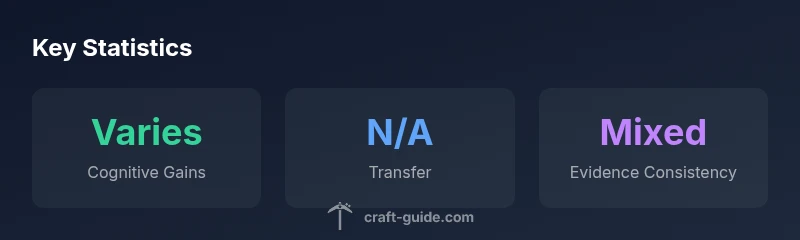
The Craft Guide Analysis, 2026 synthesizes findings from multiple studies and practitioner reports, indicating that cognitive gains from Minecraft are context-dependent and typically domain-specific. In controlled tasks that resemble classroom challenges, players who set explicit goals and received structured feedback showed improvements in problem-solving speed and planning accuracy. In contrast, casual play without deliberate design or reflection yielded limited transfer to non-gaming tasks. A key caveat across game-based learning research is the transfer problem: improvements in game-related tasks do not automatically translate to skills outside the game. For Minecraft, the strongest evidence points to improvements in strategy, collaboration, and adaptive thinking when sessions are goal-driven and followed by reflection. The takeaway is not that Minecraft makes you smarter overall, but that it can cultivate targeted cognitive skills when paired with thoughtful instructions and practice.
These insights suggest educators and players should design sessions that connect in-game challenges to real-world tasks (math, architecture, problem-solving workflows) to maximize transfer and retention.
Practical ways to use minecraft as a learning tool
If you want Minecraft to function as a learning tool, follow a structured approach that blends play with deliberate practice. Start by defining clear learning goals for each session, then design challenges that force you to apply those goals. For example, set a goal to optimize a redstone circuit for reliability or to replicate a real-world architectural feature using geometric reasoning. Use templates or checklists to keep tasks organized, and maintain a simple journal to record what worked, what didn’t, and why. After completing a build, conduct a brief debrief with peers or mentors to surface alternative strategies and lessons learned. Finally, link in-game outcomes to external tasks: measure how planning a village yields improved resource management, or how a complex build maps to project planning in school or work. A structured cycle—plan, perform, reflect—helps translate in-game gains into real-world skills.
Creative vs survival: learning signals differ
Different game modes deliver distinct cognitive signals. In Creative mode, players enjoy open-ended design, rapid iteration, and scale. This fosters design thinking, spatial planning, and aesthetic judgment without the pressure of threats. In Survival mode, players face time constraints, hazards, and resource scarcity that emphasize risk assessment, budgeting, and teamwork under pressure. Both modes contribute to learning, but the cognitive load differs. Creative mode is excellent for practicing architecture and systems thinking, while Survival mode strengthens problem-solving under constraints and collaborative planning. For learners and educators, rotating between modes creates a balanced cognitive workout that sustains motivation and broadens skill development.
Craft Guide advocates pairing modes strategically: start with creative exploration to build understanding, then switch to survival challenges with peers to test application under pressure.
Integrating minecraft into a learning plan
Turning Minecraft into a durable learning habit requires a compact, repeatable plan. Start with a two-week cycle: declare a core project, break it into milestones, and identify the cognitive skills you want to exercise (e.g., spatial reasoning, planning, or collaboration). Each session should begin with a goal and a quick plan for how you’ll test your approach. Use in-game tools and external references (geometry sheets, simple 3D modeling software, or architectural plans) to map real-world concepts. Maintain a reflective log after every session: what was successful, what failed, and what you would do differently next time. Schedule occasional peer reviews where teammates critique designs and propose improvements. Finally, track progress by comparing initial goals to final outcomes, noting improvements in efficiency, accuracy, or collaboration levels. This structured approach helps ensure Minecraft contributes meaningful cognitive development over time.
Limitations and cautions for players and educators
Like any learning tool, Minecraft has limitations and potential drawbacks. Screen time should be balanced with other activities, and play should be structured to avoid repetitive, mindless sessions. For educators, it’s essential to tie in-game tasks to measurable learning objectives, provide feedback, and monitor student well-being. Consider accessibility and inclusion: some learners may need alternative formats or pacing to participate fully. Ensure that play remains purposeful, age-appropriate, and aligned with broader curriculum goals. When used thoughtfully, Minecraft can complement traditional instruction, but it should not replace explicit teaching, practice, or assessment. By acknowledging both the strengths and limits, players and teachers can harness Minecraft’s cognitive benefits while maintaining healthy, balanced gaming habits.
Measuring cognitive benefits in your own play
To understand whether Minecraft is helping your thinking skills, adopt simple measurement practices. Start with a baseline activity that tests a targeted skill (for example, a planning task or a problem-solving challenge). After a set of sessions, re-test with a similar but slightly harder task and compare outcomes. Keep a short journal documenting time to complete tasks, number of iterations, and the quality of final designs. Seek feedback from peers or mentors and record any perceived improvements in decision-making or collaboration. While not every session will show dramatic gains, consistent practice over weeks can reveal meaningful trends in problem-solving speed, planning quality, and teamwork. Remember, the goal is to surface and translate cognitive improvements from Minecraft into real-world contexts, not to claim a universal intelligence boost.
Potential cognitive outcomes from Minecraft play
| Aspect | Potential Benefit | Notes |
|---|---|---|
| Cognitive flexibility | varies | Context-dependent across tasks |
| Problem-solving | varies | Encouraged by goal-oriented play |
| Planning & sequencing | varies | Depends on project scale |
People Also Ask
Can Minecraft actually increase intelligence?
There is no evidence that Minecraft raises IQ. Benefits are more likely to be domain-specific and depend on deliberate practice, feedback, and reflection.
No—Minecraft won’t increase overall intelligence, but with intentional use it can sharpen specific thinking skills.
Which cognitive skills are most affected by Minecraft?
Problem-solving, planning, spatial reasoning, and collaboration are commonly reinforced when players set clear goals and reflect on outcomes.
Problem-solving, planning, and teamwork are the big ones.
How can I maximize learning outcomes while playing?
Define concrete goals, design challenges, document results, seek feedback, and rotate between modes to balance cognitive load.
Set goals, test ideas, and talk about what worked.
Is solo play less effective for learning than group play?
Solo play can build individual skills, but group play amplifies collaboration and feedback, which strengthens learning transfer.
Group play often boosts learning through collaboration.
Are there age considerations or boundaries to keep in mind?
Age-appropriate content and screen-time limits should be observed; align activities with educational goals and supervision as needed.
Make sure it fits the learner’s age and schedule.
“Minecraft is not a magic wand for intelligence, but when used with intent it becomes a powerful sandbox for thinking.”
The Essentials
- Frame Minecraft as a learning tool, not a magic wand
- Set learning goals and reflect after tasks
- Choose play styles (creative vs survival) to align with goals
- Combine Minecraft with deliberate practice for best results