Is Minecraft Good for Your Brain? A Practical Review
Explore whether Minecraft supports cognitive skills, how different play styles affect learning, and practical tips for balanced, brain-friendly gameplay. Insights drawn from Craft Guide Analysis, 2026 to help players use Minecraft as an educational tool.


Is Minecraft good for your brain? The short answer is yes for certain cognitive skills when played with clear goals, intention, and balanced limits. It can support spatial reasoning, planning, and problem-solving, but benefits vary by task, duration, and guidance. Craft Guide Analysis, 2026 highlights that outcomes are context-dependent and optimally realized with structured challenges and reflective play.
Is Minecraft Good for Your Brain? A Practical Framing
The question is often posed by parents and curious players: is minecraft good for your brain? The short answer is: it can support certain cognitive skills when played with intention, clear goals, and balanced limits. From a cognitive science perspective, games like Minecraft provide hands-on problem solving, 3D spatial reasoning, planning, and creative thinking opportunities that can align with learning goals. But benefits are not universal and depend on task design, duration, social context, and guided play. This article, drawing on Craft Guide Analysis, 2026, explores how Minecraft can affect brain function and how to use it as a learning tool rather than a mindless pastime.
Tip: frame play sessions around specific objectives (e.g., “design a sustainable farm” or “build a redstone puzzle”) and cap total screen time to maximize learning outcomes.
How Minecraft Engages Cognitive Domains
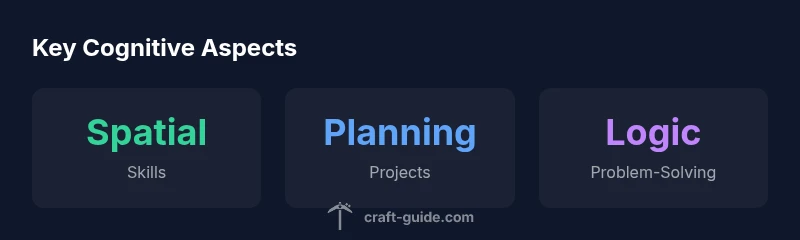
Minecraft’s open-ended sandbox invites players to exercise a range of cognitive processes in a single, cohesive environment. Building structures requires spatial reasoning and mental rotation as you decide where to place blocks to fit a design. Navigating a blocky world sharpens visuospatial skills as you map routes, judge distances, and anticipate how changes to terrain affect your plan. Inventory management and resource gathering challenge working memory and sustained attention, since players track materials and goals across a session. Creative mode emphasizes design and iteration, reducing immediate risk and allowing rapid experimentation, which nurtures divergent thinking. Redstone circuitry—Minecraft’s logic-based system—encourages logical sequencing, debugging, and problem-solving under constraint. The cognitive work is not isolated; it blends planning, memory, and perceptual skills into real-time decision-making.
The Impact of Play Style: Creative vs Survival vs Redstone
Play style largely shapes cognitive engagement. Creative mode shifts emphasis toward planning, aesthetic judgment, and iterative testing without the threat of in-game danger, which can support long-range thinking and sustained concentration. Survival mode introduces risk assessment, resource budgeting, and strategic prioritization, which promote executive function and adaptive planning. Redstone projects are the closest analogue to basic engineering challenges: players test sequences, optimize circuits, and troubleshoot when outputs don’t match expectations. In short, different modes train overlapping but distinct cognitive muscles; the more you mix modes with deliberate goals, the broader the cognitive benefits are likely to be.
Research Realities: What the Evidence Says
Current evidence suggests Minecraft can contribute to cognitive practice, but it does not prove universal brain gains or causation. Studies across the video-game literature highlight associations between certain types of engagement and cognitive skill development, while stressing the importance of context, guidance, and time on task. Craft Guide Analysis, 2026 emphasizes that structure matters: guided challenges, explicit learning goals, and opportunities for reflection tend to correlate with more reliable cognitive practice than unfocused playing alone. Readers should interpret findings as nuanced instead of prescriptive, recognizing that individual differences, age, and prior experience color outcomes.
Practical Guidance for Players and Parents
To maximize brain-friendly benefits from Minecraft, adopt a structured, goal-oriented approach:
- Set clear learning objectives for each session (e.g., “design a compact redstone clock” or “map and label a generated biome”).
- Use guided challenges or educational maps that frame problem-solving tasks and provide feedback.
- Schedule regular, shorter sessions rather than long, sporadic play, with breaks to consolidate learning and prevent fatigue.
- Encourage reflection after builds: note what strategies worked, what didn’t, and how you might improve next time.
- Balance screen time with hands-on activities and real-world problem solving to generalize skills beyond the screen.
Overview of cognitive facets linked to Minecraft play
| Aspect | Play Focus | Potential Cognitive Benefit |
|---|---|---|
| Spatial Skills | Building & exploration | Improved spatial visualization (varies) |
| Planning & Sequencing | Redstone projects, long builds | Enhanced planning and procedural thinking (varies) |
| Memory & Attention | Inventory management, multitasking | Sustained attention and working memory (varies) |
People Also Ask
Does Minecraft improve brain health or IQ?
Current evidence points to improvements in specific cognitive skills under structured play, not a universal IQ boost. Benefits depend on goals, guidance, and time-on-task, and results vary by player.
Minecraft can help with thinking skills when you play with purpose, but it’s not a guaranteed brain booster.
Can Minecraft help kids learn STEM concepts?
Yes, with guided challenges it can illustrate concepts like measurement, geometry, and logic. Teachers and parents can design tasks that connect in-game puzzles to real-world STEM ideas.
Absolutely, especially when paired with lessons or maps that teach math and engineering ideas.
How long should a session last to see benefits?
There isn’t a magic duration. Regular, goal-driven sessions over weeks are more likely to yield cognitive practice than a single long session.
Consistency matters more than a specific time.
Are there risks to brain development from Minecraft?
Excessive screen time and online interactions can have downsides; it’s important to set limits, monitor mood, and ensure a healthy balance with offline activities.
Moderation is key to keeping play brain-friendly.
What practices maximize brain benefits from Minecraft?
Pair play with guided tasks, reflection, and cross-activity learning. Use education-focused mods or maps to reinforce concepts and track progress.
Guided tasks and reflection work best.
“Minecraft isn’t a miracle brain booster, but it provides practical, hands-on challenges that target important cognitive skills when used with clear objectives and reflection.”
The Essentials
- Set learning goals for each session to focus cognitive effort
- Balance play with breaks to prevent cognitive fatigue
- Choose play modes that require planning and troubleshooting
- Pair Minecraft with guided challenges and reflection for clearer benefits
- Monitor time and social context to keep play brain-friendly