Is Minecraft Good for You? An Analytical Review
Explore whether Minecraft benefits learning, creativity, and social well-being. This analytical guide examines cognitive, emotional, and social impacts, with mindful play guidelines and practical recommendations for players of all ages.


Minecraft is a flexible, open-ended sandbox that can be good for you when used with clear goals, mindful play, and balanced schedule. It supports creativity, problem-solving, and collaboration, while risks arise from unstructured time and unsafe online spaces. The game offers learning opportunities when paired with learning objectives and moderation.
Is Minecraft Good for You? A Quick Assessment
Minecraft is a versatile sandbox that can be a positive activity for many players, but its value depends on how you use it. The Craft Guide team notes that the game shines when players set purposeful goals—such as learning basic circuitry with redstone, building a sustainable base, or collaborating on a community project. The key is balance: use Minecraft as a tool for creativity and learning, not as a default filler. When used with clear objectives and safe online practices, Minecraft can contribute to cognitive engagement, social connection, and emotional satisfaction. The Craft Guide analysis, 2026, emphasizes moderation and structured play as essential to maximizing benefits while minimizing downsides. Keeping a routine and aligning game sessions with real-life goals helps ensure that Minecraft remains a constructive activity rather than a time sink.
Cognitive Benefits: Learning and Problem-Solving
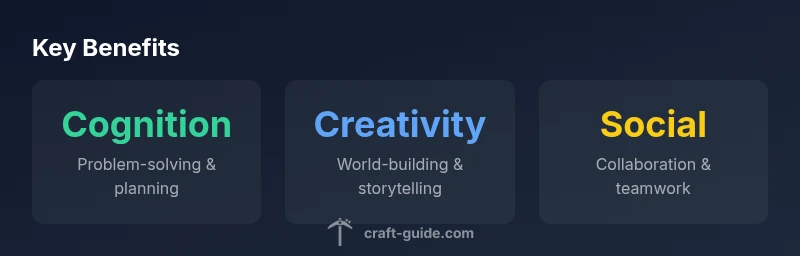
Across many age groups, Minecraft challenges players to think ahead, plan resources, and adapt strategies. Building complex structures, automating tasks with redstone, and managing inventories involve planning, trial-and-error testing, and iterative refinement. For learners, the game can serve as an interactive lab for spatial reasoning, math concepts (like coordinate systems and scaling), and sequence planning. The Craft Guide team highlights that these cognitive tasks translate well to classroom concepts when teachers or mentors frame the activities with clear learning outcomes and assessment rubrics. Players also develop debugging skills as they troubleshoot designs and optimize workflows, which mirrors real-world engineering problem-solving.
Creativity and World-Building: Designing and Planning
Minecraft rewards long-term creative projects, from small decorative builds to sprawling architectural endeavors. Players design floor plans, create themed environments, and craft narratives within their worlds. This creative play strengthens visualization, storytelling, and project management—skills that transfer to art, architecture, and design fields. Implementing a cohesive color palette, texture choices, and functional layouts encourages aesthetic judgment and attention to detail. The collaborative dimension adds another layer: creating shared worlds requires communication, role assignment, and consensus-building. For educators and hobbyists alike, Minecraft becomes a sandbox for practice-based learning and iterative design.
Social Interaction and Teamwork: Collaboration in Play
Multiplayer servers, cooperative builds, and community challenges provide social learning opportunities. Players negotiate building goals, delegate tasks, and coordinate timelines. These interactions foster communication, empathy, and conflict resolution in a low-stakes environment. For younger players, moderated servers and family playtime can model healthy online behavior, while teens and adults can experiment with leadership roles and teamwork dynamics. When combined with clear community guidelines and safety features, Minecraft supports positive social experiences that mirror real-world collaboration.
Moderation and Risk Awareness: Screen Time and Online Safety
While Minecraft offers social and educational benefits, unmoderated play presents risks: excessive screen time, exposure to inappropriate behavior on open servers, and distractions that cut into other responsibilities. Moderation strategies include scheduled playtimes, age-appropriate server selection, parental controls, and explicit safety rules for voice chat and interactions. Teachers and parents can co-create guidelines that balance exploration with rest, ensuring players maintain a healthy rhythm between gaming, school, and offline activities. When risks are managed, the game’s social and cognitive advantages can be realized with reduced downside.
Practical Guidelines for Mindful Play
To maximize positive outcomes, set concrete learning goals before each session (e.g., “build a compact redstone clock” or “design a sustainable farm”). Use in-game eras to segment activities (exploration, construction, education) and track progress with notes or screenshots. Enable time-boxed sessions and include breaks to prevent fatigue. Pair gameplay with real-world objectives (e.g., translating a design into a scale model) to reinforce transfer of skills. For educators, consider Minecraft Education Edition or curated lesson plans aligned with current curricula.
Minecraft vs. Other Activities: When to Choose It
Minecraft shines as a creative, open-ended activity that supports project-based learning and collaboration. It complements reading, coding, and STEM activities by offering practical, hands-on experimentation. Use Minecraft as a bridge between theoretical concepts and tangible outcomes, rather than a replacement for other activities. For example, a lesson on geometry can be enriched by building geometric shapes in-game, while a literature unit can be enhanced by narratively-driven builds. The choice depends on learning goals, available time, and learner interests.
Age and Skill Adaptability: Getting Started for Everyone
The game’s flexible difficulty makes it accessible to a wide age range. Beginners can start with simple exploration and basic crafting, while advanced players tackle redstone circuits and complex farms. Families can tailor server settings and achievement goals to suit younger children or older teens. For educators, starting with guided challenges and gradually increasing complexity helps students internalize concepts and sustain engagement. The key is to match activities to current abilities and gradually raise the challenge level as skills grow.
What the Research Really Says: Methodology and Evidence
Research on Minecraft’s impact blends qualitative observations and small-scale studies. Many educators report improvements in collaboration, problem-solving, and persistence when Minecraft is integrated into structured activities with clear outcomes. Caveats include variability in server quality, instructional design, and participant motivation. This mixed evidence suggests Minecraft is a powerful catalyst for learning when used purposefully and in combination with other tools. While not a universal prescription, it remains a versatile platform for skill development when implemented thoughtfully.
The Role of Mods and Community Content: Extending Learning
Mods, data packs, and community-made maps expand Minecraft’s possibilities, enabling more targeted learning experiences and custom challenges. They can introduce new mechanics, adjust difficulty, or simulate real-world systems for classroom use. The caveat is ensuring mod compatibility and safety, especially for younger players. With careful curation, mods can extend the game’s educational value, allowing students to experiment with engineering concepts, biology simulations, and historical environments within a familiar, engaging framework.
Benefits
- Encourages creativity and long-term planning
- Supports problem-solving and resource management
- Fosters collaboration in multiplayer modes
- Accessible across ages with moderated play
- Educational potential when aligned with learning goals
Negatives
- Potential time sink without boundaries
- Online safety risks if not moderated
- Learning outcomes depend on structure and guidance
- Requires access to compatible hardware or platforms
Mindful Minecraft is a strong educational and creative tool when used with clear goals and safe practices.
Minecraft offers meaningful cognitive, creative, and social benefits for many players. Its value hinges on structure, goals, and moderation. The Craft Guide team recommends integrating it with learning objectives and safe online practices to maximize positive outcomes.
People Also Ask
What are the cognitive benefits of Minecraft?
Minecraft encourages problem-solving, planning, and spatial reasoning through building, exploration, and automation tasks. When guided with learning goals, players transfer these skills to other subjects and real-world situations.
Minecraft helps you plan ahead and solve puzzles, especially when you have clear goals and a learning focus.
Is Minecraft appropriate for kids of all ages?
The game is broadly age-appropriate, especially in moderated settings. Parents and educators can tailor servers and activities to ensure safety and balance with other responsibilities.
Yes, with supervision and safe settings, Minecraft can be a wholesome, creative activity for many kids.
How should I manage playtime?
Set time limits, incorporate breaks, and align sessions with real-world goals. Pair gameplay with other activities to prevent burnout and keep motivation high.
Schedule Minecraft in chunks with breaks and real-world tasks to stay balanced.
Can Minecraft be used for education?
Yes. Minecraft has been used to teach math, science, history, and collaboration skills. When integrated with clear objectives and assessment, it complements traditional teaching.
Absolutely—Minecraft can be a powerful educational tool when used with goals.
What are potential online safety concerns?
Online play can expose players to toxic behavior or inappropriate content. Use moderated servers, privacy settings, and age-appropriate participation to mitigate risks.
Be mindful of who you interact with online and use safe servers.
The Essentials
- Set specific learning goals before sessions
- Balance creativity with structured challenges
- Use moderated servers and safety settings
- Integrate Minecraft activities with real-world tasks
- Monitor time and maintain healthy routines