Is Minecraft Mobile the Same as PC? An Edition-by-Edition Analysis
Explore how Minecraft Mobile (Bedrock) compares to PC (Java). Learn about cross-play, modding, controls, and content differences to decide which edition fits your play style in 2026.


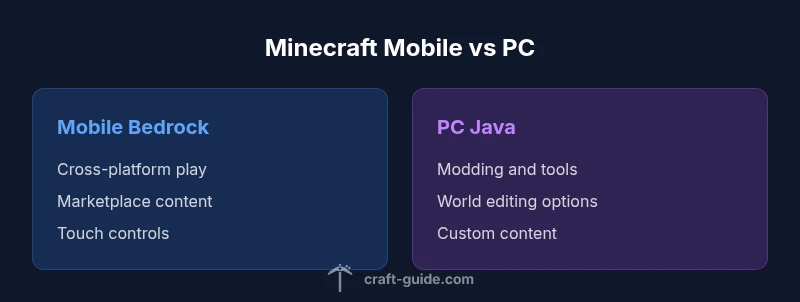
Is Minecraft mobile the same as PC? Not exactly. The two primary editions, Bedrock on mobile and Java on PC, share core gameplay but differ in content, performance, and customization. Bedrock emphasizes cross‑platform play and a curated marketplace, while Java focuses on modding, world editing, and deeper configuration. Craft Guide's analysis shows these distinctions matter when you pick your platform.
Is Minecraft mobile the same as PC? A practical framing
The question is common among players new to the ecosystem: is minecraft mobile the same as pc? The quick answer is that they are different editions designed for distinct audiences and devices. The phrase is frequently asked exactly because the core mechanics—mining, crafting, combat—remain familiar, but the surrounding ecosystem diverges in important ways. In 2026, the distinction is as much about content delivery and community tools as it is about the joystick vs keyboard experience. According to Craft Guide, recognizing this distinction up front saves players from frustration later, especially when thinking about cross‑play and how worlds travel between devices.
In this article, we’ll treat the topic analytically, mapping out the practical differences you’ll feel while playing on mobile versus a PC. Keep in mind that the keyword is is minecraft mobile the same as pc, and we’ll continually clarify where those identities diverge and converge so you can make an informed choice. Craft Guide emphasizes that context matters: your device, your preferred play style, and your tolerance for customization will shape which edition you should invest in.
Bedrock vs Java: Editions at a glance
Bedrock Edition is a cross‑platform framework designed to run on mobile devices, consoles, and Windows 10/11. It emphasizes a unified multiplayer environment and a curated content marketplace. Java Edition, historically the original PC variant, emphasizes open modding, detailed world-building tools, and a robust community of third‑party utilities. While both are “Minecraft,” they operate on different codebases and feature sets. This divergence creates differences in world generation options, content availability, and even the way updates roll out. Craft Guide notes that these are not cosmetic changes; they shape how you play, how you modify the game, and what you can share with friends on different devices.
Cross-play and multiplayer implications
One of the most practical differences is multiplayer reach. Bedrock Edition supports cross‑play across platforms — mobile, Windows, and consoles — under a shared online service. This means a friend on a phone can join a world with someone on PC, provided both players are on Bedrock. Java Edition, by contrast, does not natively cross‑play with Bedrock; it exists as a separate ecosystem with its own servers and IPs. For players who want to host or join servers with both mobile and PC players, Bedrock is the natural choice. Remember that some server features are edition‑specific, so not all servers or worlds will be compatible across editions.
Input methods and UI: Touchscreen vs keyboard/mouse
Controls are a central practical difference. Mobile Bedrock uses touchscreen interfaces, simplified menus, and on‑screen buttons optimized for small screens. PC Java relies on keyboard and mouse precision, with more expansive UI options and configurable keybinds. The input differences affect building speed, combat tactics, and navigation. If you’re a long‑time PC player, you’ll likely miss the precision of a mouse on mobile, while mobile players benefit from portability and one‑handed play. The UI adaptations across editions also influence accessibility and comfort during long play sessions.
Modding, add-ons, and content distribution
Modding on Java Edition is a long‑standing ecosystem featuring third‑party tools, extensive mods, and community wikis. Bedrock’s add‑ons and Marketplace provide curated content, skins, texture packs, and micro‑transactions, but the depth and scope of customization on mobile are more limited by platform policies. If your goal is to experiment with dramatic gameplay changes or custom mechanics, Java offers broader horizons. If you want ready‑to‑use skins, maps, and official add‑ons with straightforward installation, Bedrock on mobile is more beginner‑friendly.
World generation, seeds, and world-building differences
Both editions generate worlds from seeds, but there are subtle differences in biome distribution, ore placement, and feature availability. Java has historically offered more granular control over world generation through seed tweaking and experimental options, while Bedrock focuses on consistency across devices and a smoother out‑of‑the‑box experience. For players who value dream‑like landscapes or precise seed planning, Java may offer deeper control; mobile players often value reliability and consistency across devices when re‑creating a favorite world.
Marketplace, skins, and monetization models
Bedrock’s Marketplace is a centralized shop where you can purchase skins, texture packs, and adventure maps. It creates a stable economy for creators and a straightforward purchase flow for players. Java relies more on community mods and external resources; players typically obtain mods, tools, and textures from independent sites and repositories. If you enjoy curated content and official storefronts, Bedrock on mobile is advantageous. If you prefer free community content and extensive customization, Java on PC remains appealing.
Performance considerations across devices
Mobile devices bring portability but can be constrained by hardware limitations. Battery life, screen size, and thermal throttling can influence long sessions. PC hardware varies widely; a capable desktop or laptop can deliver higher frame rates, better textures, and more consistent performance. In practice, Bedrock on mobile aims for smooth play on a broad range of devices, while Java on PC can push higher fidelity settings and more consistent performance on mid‑to‑high end machines.
Updates, parity, and feature gaps across editions
Major version updates typically arrive for both editions, but parity is not guaranteed. Some features arrive first on Java, while others appear on Bedrock with unique platform adaptations. Craft Guide notes that this divergence means some new blocks, mechanics, or world-building features may be edition‑exclusive for months. Players should plan for edition‑specific content availability and keep an eye on official release notes to understand which features will appear on their platform.
Tools, building, and world editing capabilities
Java Edition benefits from a long history of third‑party world editing tools, servers, and command blocks that offer powerful customization. Bedrock includes built‑in scripts/add‑ons and simpler world customization pathways, but it lacks some of the deep tools available to Java players. Builders prioritizing complex maps, automation, and scripting may find Java’s ecosystem more flexible, while those seeking quick builds, familiar mechanics, and cross‑device access may prefer Bedrock on mobile.
Common myths and mistakes to avoid
A common myth is that “all MC features are the same on mobile and PC.” In reality, there are clear edition-specific differences in content, mod support, and performance. Another mistake is assuming world saves transfer perfectly between editions; cross‑edition compatibility is limited and often requires manual workarounds. Finally, many players underestimate how market content on Bedrock can influence gameplay balance, economics, and available maps.
Practical plan: choosing your edition and getting started
To decide, map your priorities: cross‑play, modding, performance, content availability, and device constraints. If you want to play with friends on different devices, start with Bedrock on mobile. If you crave deep customization and a thriving modding scene, install Java on a PC. If you already own both ecosystems, consider playing different game modes on each edition to maximize your options.
Comparison
| Feature | Mobile Bedrock Edition | PC Java Edition |
|---|---|---|
| Edition scope | Bedrock (mobile/console/Windows) | Java (PC) |
| Cross-Play | Cross‑play with Bedrock family (mobile/PC/console) | No cross‑play with Bedrock; Java‑only multiplayer |
| Controls/UI | Touch controls on mobile | Keyboard/Mouse on PC; larger UI customization |
| Modding & Content | Marketplace, official add‑ons | Extensive mods and external tools |
| World Generation/Seeds | Bedrock generation rules, marketplace seeds | Java seeds with deeper customization |
| Performance | Optimized for mobile hardware; device dependent | Higher FPS potential on capable PCs |
| Updates/Parity | Major updates; edition-specific differences | Same major versions with edition-specific features |
| Content Accessibility | Official storefront, paid add-ons | Community mods and free resources |
| World Editing Tools | Limited built‑in tools, add-ons | Robust third‑party tools (e.g., WorldEdit) |
| Cost & Access | One‑time app purchase; optional marketplace | Base game purchase; no built‑in marketplace |
Benefits
- Cross‑platform play with Bedrock for mixed-device groups
- Official Marketplace content provides curated experiences
- Java Edition offers deep modding and customization
- Clear distinctions help players pick the right ecosystem
Negatives
- Edition fragmentation can confuse new players
- Mobile content is often more restricted than PC for mods
- World transfer between editions is limited
- Some features arrive at different times across editions
Mobile Bedrock and PC Java are not the same ecosystem, but both offer rich Minecraft experiences.
If cross‑play and polished storefronts appeal to you, Bedrock on mobile is compelling. If you want deep mods and advanced world-building tools, Java on PC is the better bet. The Craft Guide Team recommends choosing based on device, desired modding depth, and how you prefer to experience the game.
People Also Ask
Are Minecraft mobile (Bedrock) and PC (Java) the same game?
They are not identical editions. Bedrock on mobile and Java on PC share core gameplay but differ in content, mods, and performance. Understanding these differences helps players pick the edition that matches their goals.
Not exactly—the two editions share core Minecraft but differ in content, mods, and controls.
Can I play with friends across mobile and PC?
Yes, but only if everyone is on Bedrock Edition. Java Edition players cannot cross‑play with Bedrock. Bedrock makes cross‑platform multiplayer possible across mobile, PC, and consoles.
Yes, if everyone uses Bedrock Edition.
Can I use the same world on mobile and PC?
Worlds aren’t automatically transferable between Bedrock and Java. You can replicate a seed or recreate a world, but you can’t simply move a Java world to Bedrock or vice versa without manual conversion tools.
Worlds don’t transfer directly between editions.
Which edition is better for modding?
Java Edition is generally superior for modding due to a long‑standing ecosystem of third‑party tools. Bedrock supports add‑ons and Marketplace content but has more limited modding options.
If mods are your focus, Java is usually the way to go.
How do I switch between editions or update?
Switching editions typically means buying the other edition and installing it separately. Updates arrive on each edition with their own timelines and feature sets, so plan for edition‑specific changes when upgrading.
Switch editions by installing the other edition and following its update path.
The Essentials
- Choose Bedrock for cross‑platform play and accessibility
- Prefer Java for mods and advanced world-building tools
- Be aware of edition‑specific content and transfer limitations
- Expect platform‑dependent performance and UI differences