Minecraft with actions and stuff: practical guide
Learn techniques to add interactive actions in Minecraft using commands, datapacks, and redstone. This guide helps players of all levels craft experiences with triggers, feedback, and quests in a safe, repeatable way.


By the end of this guide you will be able to design and trigger interactive actions in Minecraft using command blocks, datapacks, and redstone. This quick answer outlines a practical, step-by-step path to craft responsive events, quests, and boss fights inside your world. Follow the steps to build repeatable action sequences that players can trigger with switches, pressure plates, or chat commands.
Minecraft with actions and stuff: what this really means
If you’re looking for minecraft with actions and stuff, you’re aiming to create in-game moments that respond to player behavior or environment changes. This section outlines the big idea: use command blocks, redstone wiring, and datapacks to trigger events such as teleporting players, spawning mobs with custom behavior, giving items, or starting timed minigame sequences. The Craft Guide team has observed that well-planned action scripts can turn a flat world into a living experience. The goal is not to flood the player with complex mechanics, but to present clear, repeatable actions that players can understand and enjoy. We’ll cover planning, safe testing environments, and how to keep it accessible for beginners while still offering depth for advanced builders. By thinking in terms of triggers, outcomes, and feedback, you’ll start to see how action-driven design fits into any Minecraft project—from small adventures to large-scale quests.
In practice, these actions hinge on a few core tools: command blocks to execute commands, redstone to drive timing and sequencing, and datapacks to package behaviors. You’ll also encounter scoreboards for tracking progress, and resource packs to customize feedback such as sounds or titles. The aim is to craft responsive moments without relying on heavy mods. This approach scales from simple switches that spawn a loot chest to complex multi-step quests with branching outcomes. As you build, keep a running checklist of outcomes you want players to experience and how you’ll verify each one works as intended.
wordCountRefusalNote? null
Tools & Materials
- Command blocks(Give yourself a command block: /give @p command_block. Place in Creative mode; they do not work with normal inventory blocks.)
- Redstone dust(Power command blocks and create simple clocks or pulse delays for sequencing.)
- Pressure plates / levers(Serve as player or item triggers to start actions.)
- Repeaters / comparators(Use to introduce delays and to shape redstone clocks for timing actions.)
- Datapacks (optional)(Packaging actions into a single bundle makes sharing and enabling easier.)
- Creative-mode testing world(Always test in a safe environment before using in survival or on a public server.)
Steps
Estimated time: 90-120 minutes
- 1
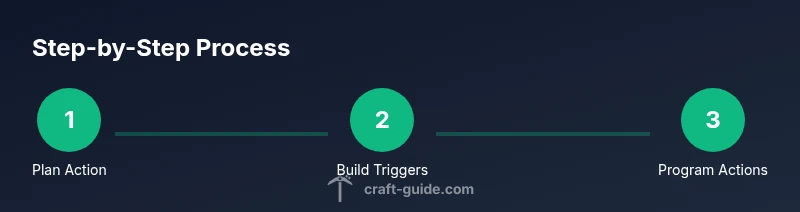
Plan your action sequence
Draft the events you want to trigger, list the outcomes, and map how players will interact with each trigger. Consider multiple branches and fail-safes so the sequence remains robust in edge cases.
Tip: Write your outline in plain language first; it will guide command syntax later. - 2
Choose the right tools
Decide whether to use command blocks alone, Datapacks for more complex logic, or a hybrid approach. For beginners, start with a single trigger and a couple of outcomes before adding more complexity.
Tip: Start with a simple impulse block and a single outcome to validate your concept. - 3
Build the trigger network
Place redstone and triggers (pressure plates or tripwire), then wire them to the initial command block. Add basic timing with repeaters if you need delays between actions.
Tip: Use labeled sections in your world to avoid tangled wiring—document each segment. - 4
Program the commands
Enter the exact commands you need for each action. Test commands individually and then chain them to ensure they execute in the right order. Use /execute for multi-target operations.
Tip: Double-check target selectors and coordinate syntax; a small typo breaks the entire chain. - 5
Test iteratively
Run the sequence in a controlled environment. Look for timing issues, misfires, or unexpected mob spawns. Adjust delays, reorder blocks, or add conditions as needed.
Tip: Test with both single-player and multi-player scenarios to uncover edge cases. - 6
Add feedback for players
Provide immediate feedback with sounds, titles, or chat messages when actions occur. Clear feedback helps players understand outcomes and reduces confusion.
Tip: Use multiple feedback channels (sound, title, chat) to accommodate different play styles. - 7
Document and share your setup
Create a concise document or datapack description that explains what your action sequence does and how to customize it. This improves reusability and collaboration.
Tip: Include a simple flow diagram so others can skim the logic quickly. - 8
Safeguard and backup
Before applying to a live world or server, back up your world. Save a copy with a descriptive name, and keep a changelog as you iterate.
Tip: Automate backups if you’re working on a server; nightly snapshots work well.
People Also Ask
What are command blocks and how do they work in action sequences?
Command blocks are in-game blocks that execute console commands when triggered by a redstone signal. They’re essential for building action sequences because they automate outcomes without requiring players to type commands.
Command blocks run commands automatically when activated by redstone, making it easy to create automated actions.
Can I use these actions in survival mode?
Yes, but you’ll need to enable cheats or use a server with appropriate permissions. In many cases, you’ll perform actions in a controlled area or with a dedicated testing world before deploying on a survival map.
You can in some setups, but plan for permissions and testing first.
Do I need datapacks to build action sequences?
Datapacks are optional but powerful for complex logic. Beginners can start with command blocks and simple redstone clocks, then add datapacks as needed for more structured behavior.
Datapacks aren’t required, but they’re helpful for advanced logic.
What should I do if commands don’t run?
Double-check that you are in Creative mode or cheats-enabled, verify command syntax, ensure the correct selectors, and confirm that redstone is delivering power to the blocks. Start with a simple test command to isolate the issue.
Check mode, syntax, and redstone power; test with a simple command first.
How can I share my action setup with friends?
Package your setup as a datapack or export the world seed and structure. Include clear instructions and optional files so others can reproduce it easily.
Package it as a datapack or share the world with clear instructions.
Are there safety concerns with automated actions?
Automated actions can disrupt gameplay if they’re too powerful or trigger unintended mobs. Start small, include safety checks (like conditional triggers), and provide a way to disable the sequence quickly.
Yes—start small and include safe failsafes.
Watch Video
The Essentials
- Plan action sequences before building.
- Use the right combination of command blocks and datapacks.
- Test thoroughly in a safe environment.
- Provide clear feedback to players.
- Document and back up your work.