Minecraft Gate Redstone: A Practical How-To Guide
Learn to build a reliable redstone gate in Minecraft with practical, beginner-friendly steps. This guide covers materials, wiring, timing, and common pitfalls to help you create a functional entry for your base.


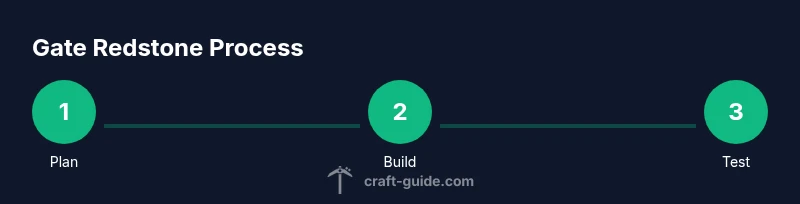
Goal: Build a compact redstone gate that reliably opens and closes using pistons, without leaving your base exposed. You’ll need basic redstone parts, a few building blocks, and a flat testing area. Follow a clear sequence of setup, wiring, and timing checks to validate the gate in practice before integrating it into your build.
What is minecraft and gate redstone
In Minecraft, a gate redstone mechanism is a compact way to control access using pistons and redstone signals. The phrase minecraft and gate redstone captures the idea of combining logic with a physical door in your base. A reliable gate relies on timing, robust block choice, and a clean wiring plan. According to Craft Guide, starting with a simple, repeatable design makes troubleshooting easier and upgrades smoother. In this section we’ll cover the concept, typical gate types, and how to approach your first build. You will learn how gate designs translate into in-game mechanics, and why a solid layout matters for performance and aesthetics. By understanding the core ideas, you can tailor a gate to your base’s rhythm and traffic flow, whether you’re building a simple entrance or a multi-gate security system.
Core components and planning for a gate
Before laying blocks, list the essential components and plan your build. A gate typically relies on a few key elements: pistons (sticky and/or normal), redstone dust, redstone torches, repeaters for timing, and a stable housing block that hides wiring. Decide on the gate type—simple 2x2 door, or a larger, more dramatic entry—based on your space and how you want redstone to interact with other contraptions. Craft Guide analysis shows that starting with a small, modular design makes it easier to scale up later. Sketch a rough footprint on paper or in your world, map where power will originate, and identify a reliable activation method such as a pressure plate, lever, or button. Finally, choose a robust building block for the gate’s frame to avoid misalignment during expansion. This planning stage sets the stage for a smooth wiring phase and reduces troubleshooting later.
Designing your gate layout
Layout planning is the backbone of a clean, durable gate. Create a rectangular footprint that fits your base’s entrance, ensuring it aligns with your tunnel or hallway. Use symmetry to simplify wiring and troubleshooting, and build a protected cavity where redstone components stay safe from player interaction and environment changes. Consider accessibility from both sides of the gate, and decide how you’ll handle power routing to avoid accidental activations. A well-planned layout also makes it easier to upgrade to a larger door or add features like a secondary trap, a deine-like pass-through, or a hideaway storage next to the gate. Craft Guide recommends mapping the wiring path first, then building the gate around it for maximum reliability.
Wiring the gate: pistons, dust, and torches
With the layout set, install the pistons that will physically move the blocks to open and close the gate. Route redstone dust along a clean, hidden channel from the activation point to the pistons and any delay devices. Use redstone torches or repeaters to power the gate reliably while controlling timing. If you’re using a two-piston setup for a 2x2 gate, place the pistons so their faces align with the matching blocks, then connect the wiring so the door opens when power is applied and closes when power is cut. Keep wiring compact and avoid long runs that may pick up unintended signals; modular segments help with future upgrades. Craft Guide notes the importance of keeping signal paths short and well separated from pathways to reduce accidental triggering.
Timing, delays, and reliability
Delays are crucial for a gate to function smoothly, avoiding jitter or misfires as you approach or depart. Introduce controlled pauses using repeaters or carefully placed dust segments to synchronize piston movement with your activation. Test the timing by repeatedly triggering the gate from different angles and distances, adjusting delay settings until the movement is seamless. Reliability improves when you tailor delays to the specific world tick rate you experience in your environment, avoiding overly long or too-short delays. Craft Guide emphasizes iterative testing—tweak one variable at a time and document your settings so you can reproduce the same results in a differently paced world.
Testing, debugging, and common mistakes
Thorough testing catches issues early. Test both manual activation and any automation you add, like pressure plates or switches. Common mistakes include misaligned pistons, inconsistent power delivery, and wiring that intersects with other redstone mechanisms. When problems appear, isolate the gate area, re-check piston faces, and verify that every part of the power rail receives a predictable signal. If the gate stutters or fails to respond, re-evaluate delay timings, check for block updates that might reset the circuit, and ensure the frame remains rigid during operation. The Craft Guide approach is to reproduce the simplest version of the gate first, then layer in complexity only after the core function remains stable.
Integrating the gate into a base and future upgrades
After the gate works reliably in isolation, blend it into your base’s design. Choose materials and textures that match your walls, and consider hiding wiring behind slabs, stairs, or embedded blocks to preserve a clean aesthetic. plan future upgrades such as adding a secondary gate, automating multiple doors with a central control, or linking to a redstone-powered lighting system for a cohesive entrance. Document wiring diagrams and keep spare pistons and dust on hand for quick repairs. The Craft Guide team recommends starting with a modular design you can easily expand, so your base can grow without sacrificing reliability or style.
Tools & Materials
- Redstone dust(Plan for modular wiring segments; keep paths tidy)
- Sticky pistons(Use for 2x2 or larger gates)
- Regular pistons(Optional for older or alternate designs)
- Building blocks (stone, brick, wood)(Frame and door blocks)
- Redstone torches(Power source and fallback control)
- Repeaters(Create deliberate delays and synchronization)
- Levers or buttons(Manual override and testing)
- Scaffolding or ladders(Access for wiring and maintenance)
Steps
Estimated time: 60-90 minutes
- 1
Prepare workspace and materials
Clear a testing area large enough for the gate, gather all required components, and verify spacing to prevent block collisions during operation. This ensures you won’t need to pause mid-build to fetch missing parts.
Tip: Lay out a mock frame on the ground before placing blocks to confirm dimensions. - 2
Plan activation and layout
Decide how you want to trigger the gate (pressure plate, lever, or button) and mark the activation point. Align this with your base’s flow so players approach naturally from both sides.
Tip: Use a temporary block trail to visualize the activation path. - 3
Build the gate housing
Construct the frame using your chosen building blocks, reserving space for pistons to move adjacent blocks. Ensure the frame is square and that the interior cavity is clear of obstructing blocks to allow piston extension.
Tip: Double-check that pistons face the correct direction before wiring. - 4
Install pistons and initial wiring
Place the sticky pistons so their heads align with the gate blocks and connect the initial redstone path from the activation point. Keep wiring within the housing to prevent exposure.
Tip: Test piston extension visually before adding delays. - 5
Add timing with repeaters
Insert repeaters to create deliberate delays that synchronize gate closure with piston movement. Adjust the repeater ticks gradually and test after each small change.
Tip: Document your optimal delay settings for future upgrades. - 6
Connect power path to all components
Finish routing redstone dust from the activation to all pistons and timing devices. Keep paths short and separated from other circuitry to minimize cross-talk.
Tip: Wrap wiring in a clean, shielded channel to prevent accidental damage. - 7
Test basic function
Trigger the gate repeatedly to confirm consistent opening and closing. Observe for any misfires or jams and adjust as needed.
Tip: Use a flat surface to reduce accidental triggering from nearby movement. - 8
Integrate and document
Seal the wiring with decorative blocks and document the wiring diagram for future troubleshooting. Ensure the gate remains accessible for maintenance.
Tip: Keep spare pistons nearby for quick repairs.
People Also Ask
What is the simplest redstone gate I can build?
Start with a basic 2x2 piston gate using sticky pistons and redstone dust. This minimal design demonstrates core principles: movement, signaling, and timing without extra complexity.
A simple 2x2 piston gate is a great starting point to learn the basics of redstone timing and activation.
How do I troubleshoot a gate that won’t open reliably?
Check alignment of pistons, verify signal reach, and test delays one at a time. If signals cross or short unintentionally, re-route wiring and simplify the path.
First, inspect piston alignment, then test your signal timing step by step to find where the failure occurs.
Can I automate multiple gates with a single control?
Yes. Use a central controller that feeds synchronized signals to each gate, ensuring delays are tuned so all gates open and close together. Avoid fan-out that weakens power delivery.
You can chain gates to a common controller, but keep wiring clean and balanced so all gates stay in sync.
What if I want a hidden or aesthetic gate?
Hide the wiring behind walls or use decorative blocks that conceal redstone. Consider a recessed panel with the activation button flush against the wall for a clean look.
Hide wiring behind blocks and use a flush activation button for a tidy, hidden gate.
Do I need advanced components for upgrades?
Basic components are sufficient for most gates. Upgrades like additional pistons or more complex timing can be added later as your build grows.
You can upgrade later; start simple and expand as your base needs evolve.
Watch Video
The Essentials
- Plan the gate footprint before wiring.
- Keep wiring modular and protected.
- Use repeaters to control timing precisely.
- Test incrementally and document results.