Minecraft 3x3 Piston Door: A Practical Build Guide
Learn how to build a compact Minecraft 3x3 piston door with clear steps, materials, and troubleshooting tips. Perfect for redstone fans seeking reliable, space-efficient entryways in survival or creative worlds.


Master a compact minecraft 3x3 piston door using sticky pistons, redstone, and a simple trigger. This guide covers core design principles, essential materials, a step-by-step build, and practical troubleshooting plus variations for different entrances. By the end, the door opens smoothly and closes securely with reliable timing, minimal space, and clean wiring.
What a 3x3 piston door is and why it matters
A 3x3 piston door is a compact redstone mechanism designed to open a three-by-three opening in a wall with a smooth, automated action. The design emphasizes reliability, timing, and space efficiency, making it a popular choice for base entrances in both survival and creative worlds. According to Craft Guide, a well-tuned 3x3 piston door provides a clean aesthetic and dependable operation when built with careful piston alignment and consistent power routing. The core idea is to animate a 3x3 section of blocks so it appears to disappear and reappear, revealing or concealing the doorway without visible hinges or handles. In practice, the door relies on a symmetric layout that minimizes timing lag and misfires, ensuring both halves of the mechanism operate in harmony. Understanding these fundamentals helps you adapt the design to different terrain, lighting, and defensive goals. You’ll learn how to map the footprint, choose trigger methods, and keep wiring organized as you translate theory into a fully functional doorway.
A successful 3x3 piston door balances compactness with reliability. It must tolerate normal player movement, occasional block updates in your world, and potential server lag effects if you play on a multiplayer server. Use solid blocks with minimal texture variation for a clean look, and plan wiring paths that stay tucked behind walls or inside decorative blocks. While the exact construction can vary, the underlying principles stay the same: a symmetric piston array, a dependable trigger, and a redstone network that delivers a clean, repeatable sequence every time. Craft Guide’s practical approach emphasizes testing early and iterating on timing to avoid stubborn misfires or door jams during busy moments.
What you’ll gain by building this door
- A secure, concealed entry that blends with your base design.
- A repeatable, low-lailure mechanism that works in both single-player and multiplayer worlds.
- Flexibility to adapt the size or trigger type without reworking the entire system.
- Hands-on experience with redstone timing, wiring discipline, and systematic troubleshooting.
Tools & Materials
- sticky pistons(Configure an array to form a 3x3 opening when extended; ensure pawl alignment is symmetric.)
- solid building blocks(Any durable block type; consider matching your base aesthetic.)
- redstone dust(Connects pistons to the trigger; plan long runs with minimal crossings.)
- redstone torches or powered blocks(Power source and logic inversion as needed for timing control.)
- repeaters(Use for longer delays or to fine‑tune firing order.)
- pressure plates or buttons(Trigger options; hidden placement improves aesthetics.)
- slime blocks or honey blocks(Optional for alternative move mechanics or smoother transitions.)
- observ ers (optional)(Can provide automatic trigger feedback for creative setups.)
Steps
Estimated time: 60-90 minutes
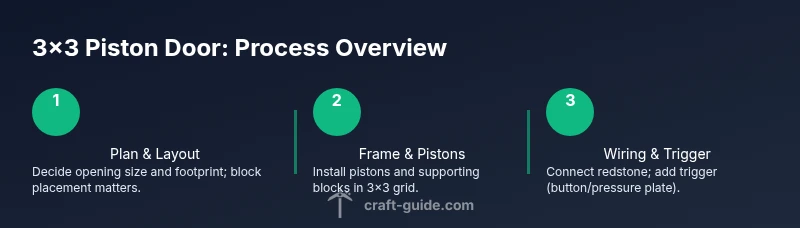
- 1
Plan the footprint
Measure the wall area where the door will live and sketch the 3x3 opening. Decide whether the door will be flush with the wall or set back as a decorative feature. Mark where wires will run and where triggers sit so nothing clashes with your base design.
Tip: Sketching a quick map on paper or in a separate world saves block edits later. - 2
Build the frame
Lay out the 3x3 space using solid blocks to establish the doorway frame. Ensure symmetry so both halves of the mechanism align, and reserve a hidden channel for passing redstone if your world has constraints.
Tip: Keep the frame height consistent to avoid misalignment during piston extension. - 3
Install the pistons
Place sticky pistons to face the doorway opening on both sides of the wall, aligned to push blocks into the 3x3 gap. Double‑check that each piston’s head faces toward the opening when extended and that blocks used for the door are properly supported.
Tip: Test piston travel with no redstone power first to verify smooth motion. - 4
Wire the redstone network
Connect the pistons with redstone dust to a central trigger. Use a clean, parallel routing path to prevent crosstalk. Add repeaters if needed to synchronize the opening and closing action.
Tip: Keep power paths tidy and avoid placing dust on moving blocks to prevent misfires. - 5
Set the trigger and test
Install your trigger (pressure plate or button) and power the system. Observe the door’s open/close sequence in both directions, and test multiple times to ensure consistency across attempts.
Tip: Test with friendly mobs nearby; sometimes entity collision can reveal timing edge cases. - 6
Troubleshoot common issues
If the door stutters or delays, adjust repeater timing or simplify wiring to reduce signal path length. If blocks jam, recheck piston alignment and verify there are no unsupported blocks in the path.
Tip: Keep a spare block or two on hand during adjustment to quickly swap in place. - 7
Finalize aesthetics and protection
Tidy up wiring with concealing blocks, or embed the mechanism behind walls to maintain the base’s look. Add lighting and a secondary, non-triggering entry to prevent accidental entrances.
Tip: Aesthetics matter; a clean look reduces player confusion and showcases your build skill.
People Also Ask
What is a 3x3 piston door?
A 3x3 piston door uses a 3 by 3 block area that is moved by sticky pistons to open or close an entrance. It provides a compact, concealed doorway that remains flush with the surrounding wall.
A compact doorway using sticky pistons that slides a 3x3 block area to open or close.
Do I need slime blocks or honey blocks?
Slime or honey blocks are optional variants that can help create smoother movement in some designs, but a standard 3x3 piston door can work without them with proper timing.
Slime or honey blocks are optional; many builds work fine without them.
Can this door work in survival mode?
Yes. With careful material selection and minimal redstone lead length, a 3x3 piston door can function reliably in survival or on servers. Start in creative to test the layout before switching.
It works in survival; test in creative to ensure it behaves reliably.
What triggers should I use?
Common options include pressure plates for hands-free entry or buttons for deliberate access. Choose triggers that fit your base’s aesthetic and security needs.
Use a pressure plate or button based on how you want players to access the door.
Why does my door misfire at times?
Misfires often occur due to timing drift, misaligned pistons, or dust placed on moving blocks. Re-check the alignment and simplify the wiring to reduce lag.
If it stutters, check alignment and timing, and keep wiring short.
Can I adapt this design to a different opening size?
Yes. The same principles apply to different openings; increase or decrease piston counts and adjust the trigger timing to fit the new dimensions.
Adapting uses the same idea; adjust the number of pistons and timing for the new size.
Watch Video
The Essentials
- Plan the footprint before laying blocks
- Keep wiring neat and parallel for reliability
- Test in both open and closed states repeatedly
- Use repeaters to adjust timing precisely
- Hide machinery to maintain base aesthetics