Are Minecraft and Roblox Rivals? A Comprehensive Comparison
An analytical, side-by-side look at Minecraft and Roblox, examining gameplay, creation tools, monetization, platform reach, and community. Learn how each platform serves different playstyles and creator goals in 2026.


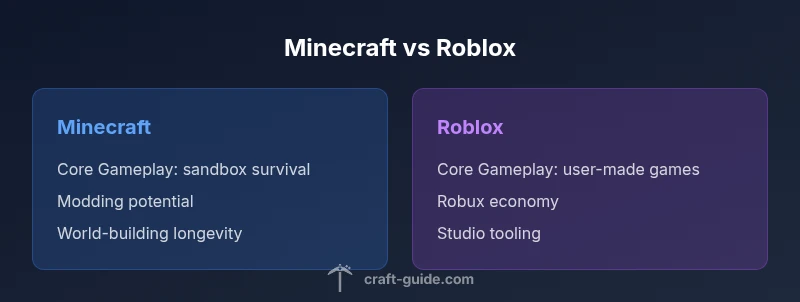
Minecraft and Roblox operate in overlapping sandbox spaces, yet they’re not direct rivals. Minecraft focuses on exploration, long-term world-building, and survival progression, while Roblox centers on user-made games, rapid content creation, and social play. For players, the choice hinges on whether you want enduring creative worlds or a fast, creator-driven library of experiences.
Are Minecraft and Roblox Rivals? Context and Scope
Are minecraft and roblox rivals? The quick reality is nuanced. These two platforms occupy overlapping space in the broader sandbox and community-creation ecosystem, yet they optimize for different experiences. According to Craft Guide, the rivalry is less about direct product competition and more about which player needs each platform best serves. Minecraft centers on procedural world-building, survival mechanics, and a sense of permanence—worlds you shape, mine, and defend over time. Roblox, by contrast, emphasizes user-generated experiences, rapid iteration, social play, and a built-in economy that invites creators to monetize their games. Understanding this distinction helps explain why both platforms remain popular without forcing a single “winner.” For many players, the answer to how they relate is not absolutist but situational: your gaming goals, time horizon, and comfort with community-created content will determine which platform you choose or whether you enjoy both in different seasons.
Core Differences in Gameplay and Goals
The defining differences start with core gameplay loops. Minecraft offers a patient, sandbox progression: gather resources, craft tools, build shelters, and explore a procedurally generated world that rewards creativity with lasting impact. Roblox offers a diverse gallery of user-made experiences—from obstacle courses to simulators—built with Roblox Studio and scripted in Lua, emphasizing quick, iterative releases and social engagement. In terms of goals, Minecraft often rewards exploration and planet-scale projects, while Roblox rewards creative experimentation, scripting challenges, and community feedback across dozens of small to mid-sized games. The result is two distinct frontiers that attract different kinds of players, creators, and families around the world.
Content Creation Ecosystems: Modding vs Studio
Creative empowerment is central to both ecosystems, but the tooling diverges. Minecraft has long supported a modding culture, with community-created mods that alter gameplay, add new mechanics, and expand the world. The modding culture encourages technical tinkering and collaborative testing, though it can require extra setup, launcher tools, and compatibility maintenance. Roblox flips this model: content creation is built into the platform with Roblox Studio, a unified toolkit for building games, programming interactions with Lua, and publishing to the Roblox catalog. This lowers entry barriers for beginners who want to publish quickly, while offering deeper scripting complexity for seasoned creators. For aspiring builders, the choice between external mods and internal tooling shapes not just what you build, but how you learn.
Monetization and Economic Models
Monetization strategies differ sharply. Minecraft generally employs a one-time purchase model, with optional add-ons like skins or texture packs and a cross-platform ecosystem for Bedrock editions. Roblox uses a free-to-play model supported by Robux, an in-platform currency that creators can monetize through game passes, virtual items, and developer exchange programs. The Roblox model fosters a creator economy where small, frequent releases can accumulate meaningful revenue, whereas Minecraft’s model rewards large, sustained projects and community-drawn maps or servers. For players, this matters because it changes perceived value: do you invest in a single, expansive world, or in a pipeline of user-generated games and experiences?
Platform Reach and Accessibility
Both platforms are highly accessible, but their reach differs by device and ecosystem. Minecraft runs on Windows, macOS, Linux, major consoles, and mobile devices, with Bedrock and Java editions offering different cross-play capabilities. Roblox runs on Windows, macOS, iOS, Android, and Xbox, emphasizing broad mobile and console reach with a strong emphasis on cross-platform social play. The accessibility of each platform influences who creates content, how audiences discover it, and how creators can prototype experiments. For educators and parents, these reach patterns also shape considerations around safety features, parental controls, and classroom use.
Community, Safety, and Moderation
Safety and moderation are integral to both ecosystems but operate differently. Minecraft’s community relies on in-game rules, server moderation, and community guidelines to manage behavior in shared worlds and servers. Roblox, with its large catalog of user-generated experiences, emphasizes more proactive content moderation and age-appropriate controls, given the vast variety of experiences created by users. Both platforms provide clear reporting channels and parental controls, but the scale of Roblox’s catalog calls for ongoing attention to content quality, trust-and-safety workflows, and community signals when evaluating potential creators or games to follow. A healthy creator journey on either platform benefits from understanding these safety frameworks early on.
For Builders and Creators: Which Platform Suits Your Goals?
If your primary goal is long-term, architecture-driven building and survival progression, Minecraft offers a robust canvas with deep redstone mechanics and vast modding potential. If you want to publish games quickly, test ideas with real players, and participate in a thriving creator economy, Roblox provides an integrated development environment and immediate audience feedback. The decision often isn’t “one platform versus the other” but “which toolset aligns with your aims today, and could you learn both over time?” Craft Guide recommends starting with the ecosystem that matches your current interests and then exploring complementary tools to expand your skill set. The choice may shift as your projects grow or as platform policies evolve.
The Creator Economy and Longevity
Sustainability is a key consideration for creators. Minecraft’s longevity comes from a dedicated modding scene, community servers, and a steady supply of new world-generation ideas that keep players returning. Roblox’s vitality stems from a continuous cycle of user-generated experiences, a permissive scripting environment, and a revenue-sharing model that can reward prolific creators. Both platforms offer insulation from market fluctuations via passionate communities and recurring events, yet the paths to long-term success diverge. As player interests evolve, many creators choose to diversify across both ecosystems to maximize opportunities and resilience.
Practical Decision Framework for Players
To decide whether you want to pursue a Minecraft-heavy path, a Roblox-driven route, or a hybrid approach, start with a simple framework: identify your primary goal (creative world-building vs rapid game development), assess your comfort with scripting and mods, check platform accessibility on your devices, and evaluate safety preferences for younger players. If you’re a beginner, try a starter project on Roblox Studio to grasp the basics, then experiment with a small Minecraft build or mod to compare the learning curves. By separating goals, tools, and audiences, you can craft a plan that aligns with your interests and time commitments.
Comparison
| Feature | Minecraft | Roblox |
|---|---|---|
| Core Gameplay Focus | Sandbox survival, exploration, world-building | User-generated games, social play, varied genres |
| Content Creation/Modding | Modding culture; external tools; community-driven mods | Roblox Studio; built-in scripting (Lua); no external mods |
| Platform Availability | Windows, macOS, Linux, consoles, mobile (Bedrock/Java variants) | Windows, macOS, iOS, Android, Xbox |
| Monetization Model | One-time base game purchase; optional cosmetics/DLC | Free-to-play with Robux; creator revenue sharing |
| Audience Demographics | Broad age range; longevity of play | Primarily younger audiences; strong teen creator community |
| Graphics/Visual Style | Blocky, voxel visuals; consistent aesthetic | Diverse visuals; games with varying aesthetics |
| Moderation and Safety | Server rules; community guidelines; parental controls | Active moderation; content filtering; age controls |
| Learning Curve | Accessible basics; deep systems for builders (redstone, mods) | Accessible start with Studio; scripting adds complexity |
| Best For | Enduring worlds, long-term projects | Rapid game creation, social experiences |
Benefits
- Long-term engagement through expansive world-building and mods
- Roblox enables rapid content creation and a creator-driven economy
- Cross-platform potential expands player and creator reach
- Vibrant, active communities with abundant learning resources
Negatives
- Roblox content quality varies widely due to user-generated nature
- Minecraft modding can be intimidating for new players
- Monetization dynamics may favor established creators on Roblox
- Safety and moderation challenges require ongoing attention on both platforms
Minecraft remains the stronger long-term platform for world-building; Roblox excels as a fast, creator-driven ecosystem
Choose Minecraft if you value durable, large-scale builds and mod potential. Choose Roblox if you want quick publishing, a thriving creator economy, and a broad social audience. Both platforms have merit depending on your goals.
People Also Ask
Are Minecraft and Roblox rivals in the same sense?
Not exact rivals; they compete for players in the sandbox space but excel in different ways. Minecraft emphasizes enduring builds, while Roblox emphasizes rapid, creator-driven experiences. Craft Guide’s analysis suggests they serve distinct creator and player archetypes.
They aren’t direct rivals; they target different creator and player goals. Minecraft focuses on long-term world-building, Roblox on quick, creator-driven games.
Can I play both games on the same device?
Yes. Both Minecraft and Roblox support cross-platform play on many devices, allowing you to switch between experiences without changing hardware. Your library, saves, and creators will adapt to each ecosystem’s design and controls.
Yes, you can run both on many devices and switch between them as you like.
Which platform has a bigger creator economy?
Roblox tends to showcase a larger, more explicit creator economy due to Robux and revenue sharing. Minecraft supports a modding culture and community servers, which are creator-driven but less centralized in earnings.
Roblox leans toward a bigger creator economy via Robux; Minecraft relies on mods and servers with community influence.
Is there cross-play between Minecraft and Roblox?
There is no direct cross-play between Minecraft and Roblox since they are separate ecosystems with different game engines, communities, and storefronts. Players often engage cross-platform separately and may join community events that feature both communities.
There’s no direct cross-play between the two games; use each platform’s features to engage with its own community.
Which is easier for a beginner to start with?
Roblox Studio offers a gentler entry into game development for many beginners, thanks to its integrated tools and scripting help. Minecraft’s creative mode and guided tutorials are also friendly but may require more time to master mods or complex redstone systems.
Roblox can be easier to start with for game development, while Minecraft is approachable for creative building with a learning curve for deeper systems.
How should a creator think about safety and moderation?
Both platforms emphasize safety, but Roblox has a heavier emphasis on age-appropriate controls and content filtering due to its vast catalog of user-generated experiences. Minecraft relies on server moderation and community guidelines to maintain safe spaces.
Safety matters on both platforms; Roblox emphasizes stronger filters due to user-generated content, Minecraft uses server rules and moderation.
The Essentials
- Clarify your priority: world-building versus quick game creation
- Assess monetization and cross-platform accessibility
- Experiment with both ecosystems if possible
- Prioritize safety features and parental controls from the start