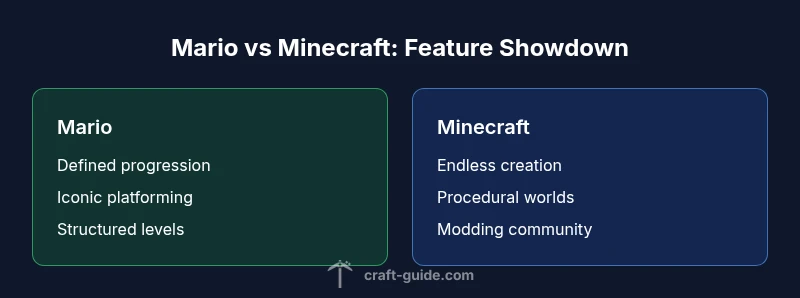
Mario vs Minecraft: A Thorough Side-by-Side Comparison
An analytical side-by-side comparison of Mario and Minecraft, examining gameplay, creativity, multiplayer, and platform factors to help players decide their preferred sandbox or platformer experience.


In short, Minecraft excels at creative freedom and sandbox exploration, while Mario offers narrative-driven platforming with clear progression. The two games target different playstyles—open-ended construction versus structured levels—so the best pick depends on whether you want boundless building or a guided, rule-based arcade experience. This page breaks down the core differences for players.
Context: Mario vs Minecraft in the Gaming Landscape
mario vs minecraft sits at the crossroads of two long-running gaming philosophies: tight, level-driven platforming and expansive, player-driven creation. According to Craft Guide, these franchises appeal to different audiences and sensibilities, yet they often surface in conversations about game design, accessibility, and community participation. For newcomers, the contrast can be distilled to a simple question: do you want a curated adventure that guides you through levels, or do you crave a vast canvas where rules are flexible and goals are self-set? Both games have endured because they align with enduring player desires—challenge and control on one side, imagination and collaboration on the other. This article maintains an analytical, reader-first approach to help you weigh your preferences and choose your path with confidence.
Core Gameplay: Goals, Mechanics, and Player Agency
Mario games pin players to precise, repeatable sequences: jump timing, enemy rhythms, and level-specific puzzles build a predictable arc of difficulty. Each title introduces new power-ups, but the progression remains linear and tightly scripted, rewarding mastery of skill and memory. Minecraft, by contrast, treats the world as a blank slate. Players harvest blocks, craft tools, and set their own objectives—build a fortress, explore caves, or experiment with redstone contraptions. Craft Guide analysis shows Minecraft’s core loop—gather, craft, build—encouraging experimentation and persistence. The contrast isn’t just about actions; it’s about agency. Mario offers a curated march toward victory; Minecraft offers a horizon that expands with imagination.
Creative Potential: Building, Exploration, and Player Expression
Creativity unfurls differently in each universe. In Mario, creativity is expressed through inventive routes, speedrunning tricks, and stylish level completion. Players interpret the designer’s intent within a tightly wrapped framework, often feeling a sense of mastery after conquering a gauntlet of challenges. Minecraft opens a sprawling sandbox where world-building, biome exploration, and custom scenarios define the experience. Players sculpt landscapes, design redstone mechanisms, and share architectural feats with a global audience. Craft Guide emphasizes that Minecraft’s creative potential scales with community resources—mods, texture packs, and seeds—that continuously refresh the gameplay, while Mario’s creativity grows through level design nuance and player skill.
Progression and Difficulty: Structured Levels vs Emergent Play
Mario’s progression is linear, with escalating challenges, curated boss battles, and clear milestones. This structure creates a predictable learning curve: practice, refine, advance. Minecraft dispenses with a single apex; instead, it offers emergent play shaped by resource availability, world seed, and the player’s goals. The difficulty shifts with survival modes, hostile mobs, and environmental hazards, yet the overall arc remains open-ended. Craft Guide notes that this dichotomy can define long-term engagement: players seeking a steady sense of accomplishment may prefer Mario, while those who crave indefinite exploration and personal milestones often flock to Minecraft.
World Design and Aesthetics: Art Styles and Engine Differences
Visual language matters as much as mechanics. Mario relies on bright, saturated art and a controlled camera that highlights animation polish, character expressions, and environmental cues. Minecraft embraces a blocky, voxel aesthetic that emphasizes scale, repetition, and procedural generation. The engine differences influence performance, modding potential, and creative expression. The contrast between a curated, character-centric world and a user-generated, block-based universe is not merely cosmetic; it shapes perception of possibility, pacing, and how players imagine their own virtual spaces. Craft Guide highlights how aesthetics set expectations for exploration and playstyle alignment.
Multiplayer and Community Ecosystems
Both franchises thrive on communities, but their multiplayer ecosystems look different. Mario’s multiplayer is typically structured around competitive or cooperative modes within official releases, with a focus on character balance, stage design, and shared experiences on local or online platforms. Minecraft’s multiplayer is inherently social and expansive: servers, collaborative builds, and minigames abound. The community’s creativity feeds directly back into the game through world-sharing, mods, and custom maps. Craft Guide notes that the strength of Minecraft’s multiplayer lies in user-generated content and cross-platform play, whereas Mario’s strength is in polished, accessible multiplayer experiences curated by Nintendo.
Modding, Custom Content, and Longevity
Minecraft’s modding scene is a defining longevity factor. Players customize gameplay, visuals, and mechanics through mods, data packs, and resource packs, extending the game’s lifespan far beyond its initial release. Mario traditionally relies on official content, licensed franchises, and occasional expansions or remasters; fan projects exist but operate in a legally constrained space. Craft Guide emphasizes that longevity in these ecosystems derives from openness (Minecraft) versus curated releases (Mario). That said, both communities produce a vibrant array of guides, speedrun routes, and fan-made challenges that keep players returning year after year.
Platform Availability and Accessibility
Platform ecosystems shape the practicalities of playing either game. Mario titles are predominantly Nintendo-first experiences, with licensing that limits cross-platform availability. Minecraft, by contrast, has broad platform reach—PC, consoles, mobile—often with cross-play across editions. Accessibility considerations include control schemas, performance on various hardware, and store ecosystems. Craft Guide’s analysis suggests that for players prioritizing cross-platform access and long-term modding potential, Minecraft generally offers a more flexible entry point, while Mario provides a polished, highly accessible experience on Nintendo hardware.
Educational and Cultural Impact
Both games have influence beyond entertainment. Mario’s legacy includes contributions to platforming design, accessible difficulty, and iconic game music. Minecraft has become a tool for education, creativity, and collaborative problem-solving, increasingly used in classrooms to teach geometry, teamwork, and programming concepts. The juxtaposition of these titles illustrates how games can shape learning, community engagement, and even careers in game design. Craft Guide highlights how each title cultivates different kinds of problem-solving mindsets and creative workflows, appealing to diverse ages and interests.
Monetization, Licensing, and Updates
Mario games primarily operate within Nintendo’s ecosystem, with licensing considerations that affect price and availability. Updates tend to be tied to official releases and platform cycles rather than an ongoing external modding cycle. Minecraft follows a different path, featuring ongoing updates, content streams, and a robust marketplace for community-created content. This cadence affects value perception: Minecraft fans often measure value by the breadth of content and ongoing additions, while Mario fans weigh the quality and freshness of official titles. Craft Guide recommends considering your tolerance for platform restrictions and update velocity when deciding which ecosystem fits your needs.
Practical Recommendations by Playstyle
If you crave fast-paced, level-driven challenges with clear goals and familiar, iconic characters, Mario remains an excellent choice. For players who want near-limitless building potential, community-created content, and a sandbox that evolves with every update, Minecraft is often the better pick. If you’re unsure, try a few starter experiences in each universe to feel the difference between guided progression and open-ended exploration. Craft Guide suggests framing your choice around what you want to accomplish in the next 6–12 months: a curated adventure or a thriving creative workshop.
Putting It All Together: Choosing Your Path
The comparison between mario vs minecraft is less about declaring a universal winner and more about aligning with your playstyle, goals, and platform constraints. Both games excel in different domains and attract dedicated communities that push the boundaries of their respective experiences. Analyze what you want to achieve—story-driven challenges or collaborative, emergent creativity—and use that lens to select the game that will sustain your interest the longest. The Craft Guide team believes the best choice depends on whether you seek structure or spontaneity, progression or invention, competition or collaboration.
Comparison
| Feature | Mario | Minecraft |
|---|---|---|
| Core gameplay goal | Structured platforming with defined objectives | Open-ended sandbox with emergent goals |
| Creativity and building | Limited to level design and cosmetic choices | Expansive, player-driven building and world design |
| Progression/difficulty curve | Gradual, curated progression and milestones | No fixed progression; difficulty scales with goals and environment |
| Multiplayer ecosystem | Polished official multiplayer experiences | Vibrant mods, servers, and community-made content |
| Modding and customization | Official content with limited modding | Extensive modding and customization potential |
| Platform availability | Nintendo-centric with limited cross-platform play | Broad cross-platform accessibility and cross-play |
Benefits
- Clear, iconic IPs drive instant recognition and family appeal
- Minecraft offers vast creative possibilities and community content
- Mario games showcase polished platforming and tight level design
- Strong multiplayer experiences with broad audience reach
- Long-term longevity through community-created content (Minecraft)
Negatives
- Different core goals can be hard to compare directly
- Modding is heavily platform-dependent for Mario; limited official expansion
- Nintendo licensing can constrain cross-platform availability
- Minecraft's open-ended nature may feel unfocused to players seeking a route
- Palette and aesthetic choices create distinct accessibility considerations
Minecraft excels as a sandbox creativity engine; Mario dominates structured platforming.
Choose Minecraft if you want endless building and community-driven content. Choose Mario if you prefer guided progression and precise, skill-based challenges.
People Also Ask
What is the fundamental difference between Mario and Minecraft?
Mario delivers curated platforming challenges with defined goals and a linear progression. Minecraft provides a sandbox world with emergent objectives generated by player actions and creativity. The core distinction is structure versus freedom in gameplay design.
Mario is a guided platforming experience, while Minecraft is an open sandbox where you build and explore at your own pace.
Which game is better for creativity, building, and exploration?
Minecraft is generally the stronger vehicle for creativity, offering limitless building options and a thriving modding community. Mario focuses creativity within level design and clever mechanics. Your choice depends on whether you want open-ended construction or expressive level-based puzzles.
Minecraft shines in creativity; Mario excels at clever level design.
Can Minecraft modding be compared to Mario’s official expansions?
Minecraft supports extensive modding and community-driven content, while Mario relies on official expansions and licensed titles. The scope and accessibility differ, with Minecraft offering broader customization opportunities for players who enjoy tinkering.
Minecraft mods are community-made; Mario expansions are official and curated.
Is Mario more suitable for younger players than Minecraft?
Mario’s family-friendly design and structured levels often appeal to younger players and newcomers. Minecraft can be suitable too but its open-ended nature and depth of systems may require more guidance for younger audiences.
Mario tends to be more approachable for kids, while Minecraft grows with the player.
Do both games support multiplayer, and on which platforms?
Both games offer multiplayer experiences, but Mario’s are typically Nintendo-centric, with platform-specific arrangements. Minecraft provides cross-platform multiplayer across many devices, enabling broader collaboration and competition.
Mario multiplayer is Nintendo-focused; Minecraft supports cross-platform play.
How should a new player choose between Mario and Minecraft?
New players should consider whether they want guided challenges or open-ended creation. If you enjoy fast-paced levels and familiar characters, start with Mario. If you crave experiments, mods, and expansive building, begin with Minecraft.
Pick Mario for guided play, Minecraft for unlimited building.
The Essentials
- Identify your preferred playstyle: sandbox or structured levels
- Consider platform access and licensing constraints
- Factor in community content and modding potential
- Weigh progression pace against open-ended exploration
- Use both experiences as a complement rather than a direct replacement