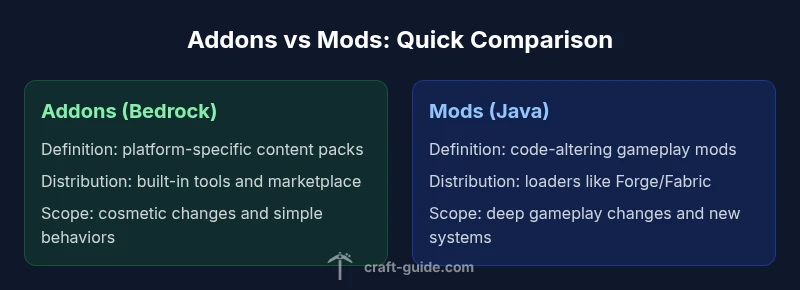
Difference Between Minecraft Addons and Mods
Explore the difference between Minecraft addons and mods with clear definitions, compatibility notes, performance considerations, and practical guidance for Java and Bedrock editions.


Most players find addons a better fit for Bedrock, offering simpler, platform-specific extensions, while mods provide deeper Java Edition customization with broader tooling. If you want easy compatibility and cross-platform sharing, choose addons; if you want advanced features and scripting, opt for mods. For beginners, addons also reduce setup friction and make distribution straightforward.
What qualifies as an addon vs a mod
According to Craft Guide, the difference between minecraft addons and mods stems from edition-specific ecosystems rather than a single universal standard. In practical terms, addons are content packages designed for Bedrock Edition and delivered through built-in systems like behavior packs and resource packs. They modify appearance or behavior without altering core engine code. Mods, by contrast, typically target Java Edition and rely on mod loaders (such as Forge or Fabric) to extend or replace game logic. This distinction—Bedrock versus Java, platform-specific systems versus external tooling—drives most of the practical differences players notice when loading a world, sharing content, or troubleshooting compatibility. Craft Guide’s analysis emphasizes that the terminology reflects workflow and platform constraints more than a universal taxonomy. Here the focus should be on edition, scope, and risk tolerance to guide your choice.
60 words
0
Comparison
| Feature | Minecraft addons (Bedrock) | Minecraft mods (Java Edition) |
|---|---|---|
| Definition and scope | Platform-specific content packs (behavior/resource packs) | Code-altering gameplay mods via mod loaders (Forge/Fabric) |
| Edition compatibility | Bedrock, with ecosystem constraints and marketplace channels | Java Edition, broader tooling and scripting potential |
| Installation/loader | Built-in Bedrock systems; no external loader required | External loaders; depends on Forge/Fabric and compatible mods |
| Performance impact | Typically lightweight and stable within Bedrock limits | Varies widely; depends on mod complexity and loader mods |
| Content depth | Shoestring changes: cosmetics, simple behaviors | Large-scale gameplay changes, new systems, and configurable APIs |
| Update cadence | Tied to Bedrock updates and marketplace cycles | Driven by Java updates and mod loader compatibility |
| Best for | Casual builders, cross‑platform sharing, and marketplace content | Power users needing deep customization and scripting |
Benefits
- Clear platform boundaries: addons for Bedrock, mods for Java
- Easier installation with fewer cross-edition issues
- Safer distribution within official ecosystems
- Faster iteration on Bedrock content via built-in tooling
- Active community and marketplace support for many addons
Negatives
- Limited cross-edition compatibility and content portability
- Mods on Java Edition can introduce instability with core changes
- Bedrock addons may be constrained by platform security and marketplace rules
- Same-name terminology can confuse newcomers across editions
Addons are generally the better starting point for Bedrock players; mods excel on Java for depth and scripting.
The Craft Guide team recommends evaluating your target edition first. If you’re on Bedrock and want quick, safe customization, addons are the practical path. If you’re on Java and crave deeper gameplay changes, mods offer broader APIs and tooling to realize ambitious ideas.
People Also Ask
What is the core difference between addons and mods?
Addons modify behavior or appearance using built-in platform tools on Bedrock, while mods alter core game logic on Java via external loaders. This leads to different workflows, compatibility considerations, and content depth.
Addons use Bedrock’s built-in tools, while mods modify Java with external loaders, so your workflow and compatibility will depend on edition.
Do addons work on Java Edition or work across editions?
Addons are designed for Bedrock; they generally do not work on Java Edition due to different architectures. Conversely, Java-focused mods require loaders and are not compatible with Bedrock components.
Addons are Bedrock-only, and Java mods need specific loaders; they don’t cross-over.
Can content created for addons be ported to mods, or vice versa?
Content is typically edition- and format-specific. Porting between addons and mods requires rebuilding using the target edition’s tools and may not be a direct conversion.
Porting usually means rebuilding for the new system rather than a simple transfer.
Which is easier for beginners to start with?
Addons generally offer a gentler introduction due to built-in tools and marketplace packaging. Java mods involve loaders and potential compatibility concerns but unlock deeper customization.
Addons are easier for beginners; mods are for when you want more control.
Are there performance or stability concerns with mods?
Mods can impact performance if they replace core systems or add many new mechanics. Properly chosen, tested mods with compatible loaders usually run well, but the risk is higher than with addons.
Mods can be heavier; choose well and test for stability.
What’s a quick framework to decide between them?
Identify your edition (Bedrock or Java), your goal (cosmetics vs. gameplay overhaul), and your tolerance for setup (built-in tools vs. loaders). Use this framework to guide whether addons or mods fit best.
Think edition, goal, and setup tolerance to decide.
The Essentials
- Start with addons for Bedrock when you want simplicity
- Use mods on Java for deeper customization and scripting
- Know your edition and loader requirements before choosing
- Expect different ecosystems and update cycles per edition
- Plan maintenance around edition updates and community support