How to Use Minecraft Treasure Maps: A Practical Guide
Learn how to use a Minecraft treasure map with clear, step-by-step instructions. Find buried treasure and interpret map markers with practical tips from Craft Guide for players.


With this guide, you will learn how to use a Minecraft treasure map to locate buried treasure. You’ll discover where maps come from, how to read the markers, and how to follow the map across biomes. The steps below cover preparation, navigation, digging, and safe extraction, with practical tips from Craft Guide to boost your success, according to Craft Guide.
What is a Minecraft treasure map and how it differs from ordinary maps
Treasure maps in Minecraft are specialized map items that point you toward buried treasure rather than simply showing terrain. In most versions, a treasure map depicts the surrounding landscape with your current position marked, and it highlights the approximate location of a buried chest. The visual cues help you navigate across oceans and biomes, translating complex terrain into a navigable route. Understanding these cues is foundational: the map's orientation, the distance scale, and how movement changes your position on the map all matter. As you travel, the map's border rotates to reflect your heading, making it possible to align yourself with the marked area even when you cross vast plains or cliff-heavy terrain. Craft Guide's analysis, 2026, emphasizes that reading a treasure map becomes intuitive with practice and consistent checks against landmarks.
How to obtain a treasure map and prepare to use it
Treasure maps can appear in loot chests found in shipwrecks or underwater ruins, and some maps are available for trade from cartographer villagers. Early in your search, you may want to diversify your approach: explore coastal wrecks, raid sunken ships, and check out village cartographers who offer maps for trade or sale. Once you acquire a treasure map, prepare your loadout and plan a route. Ensure you have a way to defend yourself from mobs, bring any light sources or food, and decide whether you’ll bring a compass for orientation. Also decide how you’ll manage multiple maps if you plan to search more than one site in a single expedition.
Reading and following a treasure map step-by-step
To read a treasure map, hold the map in your hand and observe how your position is shown relative to the map’s border. The map updates as you move, so keep following the route until the marked area closes in. Your goal is to bring yourself to the general vicinity of the buried treasure chest—often marked by a distinct feature on the map and by surrounding landmarks like coastlines, cliffs, or ruins. When the map indicates you are near the target, slow down, check terrain features, and prepare digging tools. Remember that the map is a guide, not a guarantee; wind, water, and terrain can influence the path you take.
Tips for successful digging and verifying the treasure
As you close in on the marked area, verify by inspecting nearby blocks that commonly surround buried chests, such as sandbanks or dirt patches near landmarks. Dig only in reasonable, methodical patterns to avoid damaging the loot or missing the chest—start with a shallow 2x2 hole and expand if needed. When you locate a chest, open it carefully and note the loot. If you don’t find the chest where the map suggested, return to a safe distance, refresh your bearings, and consider creating a fresh map to reorient yourself.
Common mistakes and troubleshooting
Common mistakes include rushing into the map’s destination without verifying landmarks, ignoring terrain that can shift the route, and abandoning the search when mobs appear. If the chest isn’t found where expected, reevaluate your position against the map, consider terrain changes, and re-check the map’s orientation. In some cases, updating or replacing the map helps restore accuracy. For persistent misalignment, take a quick detour to reestablish your bearings, then resume the search with a refreshed map.
Tools & Materials
- Treasure map (found in shipwrecks, underwater ruins, or traded from a cartographer)(Keep in your hotbar and in-hand while tracing the route.)
- Compass (optional)(Helpful for orientation when the map's direction is ambiguous.)
- Shovel or pickaxe(Used to dig at the indicated location.)
- Torches or light sources(Light your path to avoid mobs and locate the dig site more easily.)
- Food for healing(Stay engaged longer during exploration and navigation.)
Steps
Estimated time: 15-25 minutes
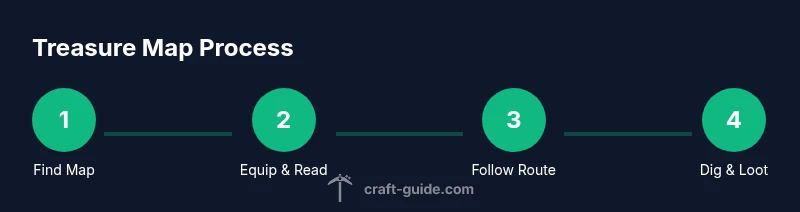
- 1
Find a treasure map
Explore shipwrecks, underwater ruins, or trade with a cartographer to obtain a treasure map. Once you have it, verify you have enough inventory space and a clear path to start your journey. This step sets the foundation for the entire hunt.
Tip: If you can’t locate a map, check coastal areas with shipwrecks and keep an eye on wandering traders for a potential offer. - 2
Equip and inspect the map
Hold the treasure map in your main hand and inspect how the map shows your current position relative to the marked area. Ensure your coordinates on-screen align with the map border, so you can follow the path accurately as you move.
Tip: Keep the map visible at eye level to minimize misreads and stay oriented during long treks. - 3
Orient yourself before moving
Take a moment to identify nearby landmarks shown on the map. Set a baseline by noting cliffs, rivers, or beaches. Establish a simple waypoint you can aim for as you advance toward the marked region.
Tip: If landmarks don’t line up, pause, adjust your route, or use a second map to verify direction. - 4
Move along the marked route
Traverse the terrain while keeping the map in sight. The map’s border rotates as you move, helping you maintain the correct heading toward the treasure. Don’t rush—carry your pace to avoid getting lost in woodland, desert, or ocean.
Tip: Periodically check the map’s orientation and nearby landmarks to prevent drift. - 5
Narrow down the target area
As you approach the area, the map will indicate you’re near the final location. Focus on the general vicinity and closely inspect the nearby blocks where a chest is likely buried. Prepare your digging tools for a careful search.
Tip: If the location seems ambiguous, take a short detour and recheck the map against terrain features. - 6
Dig at the indicated site
Dig a small test hole near the suspected chest site and expand gradually if needed. Buried treasure is typically within a shallow depth, but recheck the map after each digging pass to confirm the right zone.
Tip: Dig at the center of the indicated area, then widen the search outward if nothing is found. - 7
Open the chest and collect loot
Once the chest is found, carefully open it and take the loot. Be mindful of mobs or traps in nearby ruins. Bag any treasure into your inventory and consider leaving markers to help you find the spot again later.
Tip: Take only essential loot first to prevent inventory clutter. - 8
Return with the map and reflect
After securing the treasure, catalog the map in your base stash for future expeditions. If you enjoyed the hunt, try additional treasure maps to practice improved navigation and map-reading ability.
Tip: Share strategies with friends or keep notes on landmarks for faster future hunts.
People Also Ask
What is a treasure map in Minecraft?
A treasure map is a map item that points you toward a buried treasure site. It shows nearby terrain and your position relative to the target location, guiding you to the chest.
A treasure map guides you toward buried loot by showing terrain and your position relative to the treasure.
How do I get a treasure map?
Treasure maps can be found in shipwreck loot, underwater ruins, or traded from cartographers. Once you have one, hold it and follow the directions to reach the treasure.
Find a treasure map in shipwrecks or from a cartographer, then use it to locate the treasure.
Does a treasure map work in all biomes?
Yes, treasure maps work across biomes, but navigation becomes trickier in water-heavy or rugged terrains. Use landmarks and a steady pace to stay on course.
The map works in all biomes, but keep an eye on landmarks to stay on course.
What if the treasure isn’t where the map shows?
Maps occasionally require reorientation. Check your bearings, verify landmarks, and consider rewriting or replacing the map to reestablish accuracy.
If the chest isn’t where you expect, reorient with landmarks and try a refreshed map.
Can I reuse the map after finding treasure?
Yes. The map remains usable for future hunts. You can reuse it or pair it with new maps for multi-site expeditions.
You can reuse the map for future treasure hunts.
Watch Video
The Essentials
- Read the map to orient yourself and follow the route.
- Travel with caution and be ready to dig.
- Verify landmarks before digging to avoid false starts.
- If misaligned, refresh bearings and retry the route.