XP Farm on Minecraft: A Practical Step-by-Step Guide
Learn how to build an XP farm in Minecraft with practical, beginner-friendly steps. This guide covers mob grinders, fishing farms, planning, redstone basics, AFK safety, and troubleshooting for reliable enchantment XP.


You can build an XP farm in Minecraft by selecting a design such as a mob grinder or fishing XP farm, gathering essential materials, and following a safe, AFK-friendly setup. This guide outlines core XP mechanics, funneling mobs to a kill chamber, and optimizing XP collection for reliable enchantments.
Why XP farms matter in Minecraft
Experience farms are a cornerstone of Minecraft progression, enabling faster enchantments, repairs, and level-based progression without endless grinding. A well-designed XP farm converts spawning behavior and mob movement into a steady stream of experience orbs you can harvest from a safe AFK location. According to Craft Guide, the most durable farms rely on reliable spawn surfaces, predictable mob routes, and safe collection points that minimize risk. In this section, we explore why XP farming is a game-changer and how to choose a design that fits your world, playstyle, and resource budget. You will discover how different designs trade off space, maintenance, and XP yield, helping you decide whether to start with a simple mob grinder or a fishing-based setup for a quieter experience.
Core concepts: XP, levels, and machinery
Experience in Minecraft is earned by defeating mobs, mining, fishing, and other actions that cause XP orbs to drop. Levels represent milestones in your enchantment journey, and certain thresholds unlock powerful enchantments and repairs. An XP farm is not just about generating orbs; it’s about creating a repeatable, safe workflow that you can run while you are away from your keyboard. The core mechanics include mob spawning rules, how to maximize spawn density on designated surfaces, and an efficient funnel that guides mobs toward a killing area or instant XP source. Understanding these concepts helps you estimate space needs, select a design, and foresee how changes to game rules can affect performance.
Types of XP farms: mobs, raids, and item-based
There are several archetypes to consider. Mob grinders typically exploit hostile mobs dropping XP when killed, using funnels, water streams, or piston doors to route victims. Fishing farms generate XP through rod fishing, providing a calmer, AFK-friendly option that suits some players better. Item-based farms rely on repairing or enchanting gear in efficient loops but often require more complex logic and redstone. Hybrid designs blend multiple mechanisms to balance XP output with space, safety, and maintenance. Your choice should reflect your server rules, play style, and whether you prefer active farming or passive AFK XP.
Planning your XP farm: choosing a design that fits your world
Before laying a single block, map out where your farm will live relative to your base. Consider how long you intend to AFK, how mobs will spawn, and how you will protect yourself. For beginners, a straightforward mob grinder placed in a flat, unobstructed area is easiest to learn, while advanced players may integrate water channels, bubble columns, or slime blocks to improve mob control. The layout should minimize light leaks, prevent unwanted despawns, and provide a clear path to your XP collection point. Craft Guide recommends starting with a proven, compact design and gradually adding refinements as you gain experience.
Step-by-step build: mob grinder XP farm (classic design)
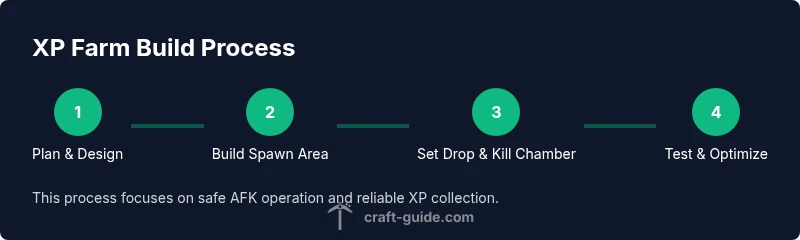
- Plan the footprint: decide on the number of spawning pads, the location of the kill chamber, and access for maintenance. 2) Build the spawn platform: place slabs or other anti-spawn blocks to concentrate mob spawns where you want them. 3) Create the funnel: route mobs toward a central chute using water streams or trapdoors. 4) Install the kill chamber: set up a safe area where mobs can be killed or where you can automatically trigger damage. 5) Set up XP collection: place hoppers and chests to collect items and/or position a drop shaft for XP orbs. 6) Add AFK platform: build a safe area above the farm where you can stay idle while mobs spawn. 7) Shield and safety: ensure doors, lighting, and barriers keep you safe from wandering mobs. 8) Test and refine: spawn mobs, observe their movement, and adjust heights or water currents to improve flow. 9) Fine-tune lighting and reset points: maintain darkness where needed and ensure easy reset after testing. 10) Verify XP flow: stand in the AFK zone and confirm you receive XP consistently.
Redstone basics you need to know
A modern XP farm often uses redstone to automate parts of the process, especially for item transfer or timed activation. Key components include pistons, dispensers, comparators, and repeaters. You do not need every redstone gadget to start, but understanding how to synchronize a kill chamber with an automatic drop or chest collection will dramatically improve reliability. If you are new to redstone, begin with a simple, manual trigger and gradually introduce automatic elements as you gain confidence. Remember that redstone can cause lag on busy servers, so optimize only what you need.
AFK safety and maintenance tips
AFK farming is appealing for long-term XP, but you must stay safe. Build your AFK platform away from hostile mobs and ensure you have solid lighting and secure pathways. Use water currents and barriers to prevent mobs from sneaking into your base, and never place your main base directly above a drop chamber to avoid accessibility issues. Regularly inspect your farm for block updates, item clog, or mob spawns migrating to unintended areas. A little maintenance goes a long way toward stable XP output.
Alternative XP farms: fishing farm and raids
Fishing XP farms offer a gentler, more passive approach, and can be an excellent alternative if you want a calmer playstyle. They depend on the fishing mechanics and rod enchantments, which can yield XP gradually with minimal risk. Raid-based XP farms exploit raiding mechanics for XP, but they require a larger area and a more complex setup. Hybrid farms combine both methods to maximize XP output while spreading risk, letting you tailor a design to your world size and available resources.
Troubleshooting common issues
If XP production feels slow, first check spawn rates in your area—perhaps lighting or block choices are reducing spawns. Confirm the mob funnel is effectively guiding mobs into the kill chamber and that the collection system is not blocked. Lag or desync on servers can suppress XP by slowing entity updates; in such cases, reduce the number of active mobs or simplify the design. Finally, verify there are no safety gaps that allow mobs to reach you, since a breach can end a farming run unexpectedly.
Tools & Materials
- Building blocks (e.g., cobblestone)(For enclosing the farm, platforms, and walls)
- Trapdoors(To control mob movement and spawning surfaces)
- Water buckets(Create transport streams that guide mobs toward the kill area)
- Hoppers and chests(Optional for automatic item/XP collection)
- Redstone components (dust, repeaters, comparators, pistons)(Use only if you plan auto-collection or timed mechanisms)
- Glass or glass panes(For viewing areas or transparent barriers)
Steps
Estimated time: 60-120 minutes
- 1
Choose XP farm design
Decide between a mob grinder, fishing farm, or hybrid approach based on your world size, risk tolerance, and preferred playstyle.
Tip: Start with a proven mob grinder design to learn the basics before adding automation. - 2
Gather essential materials
Collect basic blocks, water sources, trapdoors, and any redstone components you plan to use. Organize your inventory to avoid back-and-forth trips.
Tip: Keep a labeled chest for quickly accessible items during the build. - 3
Prepare the build area
Clear space, set a flat foundation, and plan the spawn pads to maximize mob density while keeping your base protected.
Tip: Lay out the footprint with markers before placing blocks to prevent rework. - 4
Build the spawning platform
Construct the spawning surfaces with anti-spawn blocks where needed and ensure adequate ceiling height to encourage mobs to spawn.
Tip: Use half-slabs on upper levels to prevent unwanted spawns while maintaining flow. - 5
Create the mob funnel
Connect spawn areas to a funnel that channels mobs toward a central chute or kill chamber using water or drop paths.
Tip: Test the funnel with a few mobs first to verify clean movement without jams. - 6
Set up the kill chamber
Secure a safe area where mobs are killed or where automatic mechanisms trigger XP drops, minimizing player risk.
Tip: Keep the kill chamber well-lit and accessible for maintenance checks. - 7
Install XP collection
Place hoppers and chests to capture items and orient xp orb collection toward your desired location.
Tip: If using auto-collection, test for block updates that may prevent transfer. - 8
Add AFK platform
Build a safe balcony or room above the farm where you can stay idle without triggering mobs.
Tip: Ensure there is a secure escape route in case you need to intervene quickly. - 9
Test and optimize
Spawn mobs, observe flow, and adjust block heights, water currents, or barrier positions to maximize XP output.
Tip: Document changes and test each adjustment so you can revert if needed. - 10
Safety and maintenance
Check for lighting leaks, mob escapes, and block updates that can degrade performance over time.
Tip: Schedule occasional checks to keep the farm efficient and safe.
People Also Ask
What is an XP farm in Minecraft?
An XP farm is a design that generates experience points by exploiting mob spawns, fishing, or item-enchanting loops. It provides a steady stream of XP for enchanting tools and repairing gear without manual grinding.
An XP farm is a build that creates experience points through mobs or fishing, giving you easy enchantments without endless grinding.
What is the best XP farm for beginners?
For beginners, a simple mob grinder with an AFK platform is typically the easiest to set up. It teaches core spawn mechanics and funneling before adding automation.
For beginners, start with a basic mob grinder and AFK platform to learn the basics.
Do XP farms work in all game versions?
XP farms rely on core mechanics that exist across major versions, though specific designs may need adaptation for changes in spawning rules or world generation.
XP farms rely on core mechanics and may need tweaks for different game versions.
Are XP farms allowed on servers?
Most servers permit XP farms, but some have restrictions to prevent lag or unfair advantages. Always check server rules before building large farms.
Server rules may restrict farms; check with admins before building large designs.
How can I prevent lag from XP farms?
Keep the design as simple as possible, limit active mobs, and avoid overly complex redstone. Optimize spawn areas to reduce timer updates that can cause lag.
Keep farms simple and avoid heavy redstone to prevent lag on servers.
What is the difference between mob grinders and fishing XP farms?
Mob grinders require combat, are typically higher XP per hour, and can be more resource-intensive. Fishing XP farms are quieter, slower, and easier to set up.
Mob grinders give more XP but require combat; fishing farms are slower but gentler to set up.
Watch Video
The Essentials
- Choose a design that fits your world and playstyle.
- Maximize spawn surfaces and efficient funnels for reliable XP.
- Plan a safe AFK zone and smooth item collection.
- Test, observe, and optimize to improve performance.
- Explore alternative XP farms for variety and resilience.