Minecraft the Game Unblocked: Legit Ways to Play in 2026
Learn safe, policy-friendly ways to play minecraft the game unblocked, including school-approved options, personal devices, and Education Edition. Practical steps, tips, and FAQs for students and players.


minecraft the game unblocked describes accessing Minecraft in environments that normally block it, like schools or workplaces. This guide emphasizes legitimate, policy-friendly options over bypassing security, including admin-approved access, personal devices, and Minecraft Education Edition when available. It also highlights ethical play, device compatibility, licensing, and classroom-aligned approaches to ensure players stay within rules.
Understanding what 'minecraft the game unblocked' means
In the broad sense, minecraft the game unblocked refers to playing Minecraft in places where network rules or device policies restrict access. This isn't a hack or a loophole; it's a prompt to pursue policy-compliant avenues first. According to Craft Guide, the best outcomes come from clear communication with admins and choosing legitimate paths over shortcuts. The goal is to keep learning intact while respecting community guidelines. When access is restricted, focus on official licensing, school-approved options, or personal-device arrangements that align with your environment's rules. By framing your aim around safety, privacy, and responsible use, you position yourself to keep playing without conflict.
Access decisions should balance learning goals, player needs, and community guidelines. When you see unblocked content, treat it as a reminder to explore approved pathways, such as a classroom license, a personal device with permission, or an educational edition tailored for classrooms. Keeping this focus helps you stay productive, curious, and compliant as you explore the world of blocks, biomes, and redstone.
Legitimate pathways to access Minecraft in restricted environments
There are clear, policy-friendly routes to play Minecraft even where blocks exist. Start by asking your network or school administrator for permission to use a personal device or a school-approved platform. If the environment supports it, propose Minecraft Education Edition as part of a curriculum or club activity. Another practical option is offline play on a trusted personal device, which avoids live network constraints while preserving your progress. Finally, leverage school-provided devices or accounts when available, so you remain within the established digital-safety framework. Craft Guide emphasizes that transparent requests and documented justifications increase the chance of a positive outcome, especially when your learning goals tie directly to Minecraft-based activities like geometry, resource gathering, or collaborative building.
By outlining concrete classroom or study use, you demonstrate responsible intent and reduce friction with admins. If permission is granted, you can schedule sessions, set time limits, and align activities with learning objectives so the game supports curriculum goals rather than becoming a distraction.
Minecraft Education Edition and school policies
Minecraft Education Edition (MEE) is a classroom-oriented variant designed to support collaborative learning, teacher-led activities, and safe, controlled play. When schools adopt MEE, they typically provide access through enrolled student accounts and education licenses. This edition offers built-in lesson plans, classroom-friendly controls, and safer networking compared to consumer editions. The Craft Guide team notes that Education Edition can be a legitimate alternative in many schools, streamlining permissions and ensuring privacy protections while keeping the game aligned with educational outcomes. If your institution offers MEE, pursue it as the primary channel for classroom Minecraft activities and verify the available scopes (purchasing, licenses, and supported devices).
Policies vary by district and institution, so contact your administrator for exact steps. If MEE isn't available, discuss a teacher-supervised program using the standard Java or Bedrock editions on approved devices.
Playing Minecraft on personal devices and home networks
Home networks offer the most straightforward path to playing Minecraft legally — provided you own the device and have a valid license. Start by purchasing or verifying your Minecraft edition (Java Edition for PC, Bedrock for cross-platform play), then install the official launcher from minecraft.net. Sign in with a Microsoft account or corresponding credentials, and adjust parental controls or family safety settings as needed. Home play lets you customize worlds, install approved add-ons, and practice building without school-network restrictions. Remember to respect terms of service and avoid sharing credentials or installing unauthorized software.
If you want to keep Minecraft separate from school-approved channels, create a dedicated gaming environment at home where family members can enjoy a safe, supervised experience. Maintain good digital citizenship by setting boundaries, monitoring content, and using age-appropriate settings.
Platform differences and licensing (Java Edition vs Bedrock)
Minecraft comes in several editions, with distinct licensing, features, and cross-platform capabilities. Java Edition is the original PC edition, favored for mods and creativity, while Bedrock Edition emphasizes cross-platform play across consoles, Windows 10/11, and mobile devices. Purchasing or signing in with the correct license is essential to access updates and multiplayer servers. In restricted environments, the platform choice matters because school policies may favor one edition over another. Always check licensing terms and ensure you download from the official source to avoid counterfeit or insecure builds. Craft Guide recommends prioritizing the edition that aligns with your devices and educational goals, then exploring community resources within policy limits.
If you’re on a school network, discuss which edition is allowed by the administration to avoid compatibility issues later.
Common misconceptions about unblocked Minecraft
A common myth is that any form of unblocked access is safe or permitted. In reality, unblocked access should only come from approved channels and with proper authorization. Another misconception is that offline or local play somehow bypasses network restrictions; offline play requires a licensed copy and a device you control. Some players assume Education Edition is the same as Home Edition; while related, MEE is designed for classroom environments and has different licensing and features. Finally, many believe that asking for permission always delays progress; in practice, administrators respect well-prepared proposals that show how Minecraft supports learning objectives and safety.
Safety, ethics, and digital citizenship
Playing Minecraft within policy requires a focus on safety and ethics. Use strong authentication, keep software up to date, and avoid sharing login details. Emphasize respectful collaboration, protect younger players, and follow school or company guidelines for chats and multiplayer interactions. This approach ensures that Minecraft remains a productive, educational, and enjoyable tool rather than a source of policy violations or security concerns. Craft Guide urges players to model responsible digital citizenship by reporting issues, staying compliant with licensing, and using sanctioned platforms whenever possible.
Practical build ideas while waiting for access
If access is temporarily blocked or limited, use the downtime for planning. Sketch a small-scale build, design a redstone concept on paper, or create a block-by-block plan for a future project. You can also study tutorials, world-building guidelines, and lighting strategies to prepare for when access is granted. Use offline practice worlds on permitted devices to refine your skills, then translate those ideas into collaborative projects once you have access to the full game again. The goal is to stay engaged and ready to execute once you’re allowed to play.
Getting started: quick-start checklist
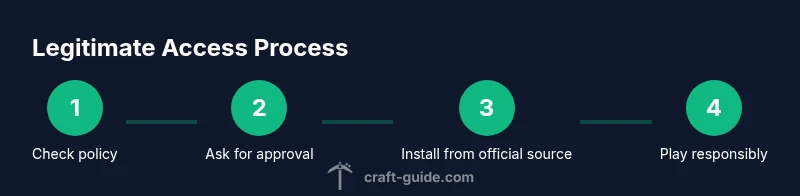
- Verify policy and obtain permission if needed.
- Choose a legitimate access method (personal device, Education Edition, or classroom-approved platform).
- Download the official Minecraft launcher from minecraft.net and install the edition that matches your device.
- Sign in with the appropriate account and configure settings for learning goals.
- Schedule sessions with teachers or admins and set clear time limits.
- Keep your device, game, and safety tools up to date.
- Maintain documentation of approvals and policies for future reference.
Tools & Materials
- Official Minecraft launcher(Download from minecraft.net and install the launcher)
- Minecraft game license (Java Edition or Bedrock)(Purchase or ensure you have a valid license)
- Microsoft account linked to Minecraft(Needed for login and progress syncing)
- Personal device (PC, Mac, tablet)(Ensure device meets minimum system requirements)
- Administrative permission document or email template(Use if you expect to request access on a school network)
- Minecraft Education Edition license/access (if available)(Use where the school provides it; ideal for classrooms)
Steps
Estimated time: 60-120 minutes
- 1
Check policy and seek permission
Review your school or workplace policy on gaming and request approval if needed. Clarify how Minecraft will be used for learning goals and classroom activities.
Tip: Prepare a short, respectful justification with potential learning outcomes. - 2
Decide legitimate access method
Choose between a personal device, school-approved platform, or Minecraft Education Edition where available. Align the choice with policy and device compatibility.
Tip: Have alternatives ready in case approval isn’t granted. - 3
Download official launcher
Go to minecraft.net and download the official launcher for your OS. Install it and ensure you’re using a legitimate copy with current updates.
Tip: Verify system requirements before installing. - 4
Sign in and configure
Sign in with your Microsoft account or the account specified by admin. Set up basic preferences and enable safety features.
Tip: Use a dedicated account for gaming to protect personal data. - 5
If approved, install Education Edition
If your environment supports MEE, install it and follow classroom setup instructions. Use classroom accounts and approved curricula.
Tip: Utilize built-in lesson plans to maximize learning value. - 6
Test on an allowed network
Launch Minecraft on the approved network or at home to verify connectivity and login success. Check for updates and server accessibility.
Tip: Have a backup plan for offline play if network access is limited. - 7
Establish safe play rules
Set time limits, agree on respectful communication, and document usage policies with a supervisor if needed.
Tip: Review safety settings and parental controls before play.
People Also Ask
What does 'minecraft the game unblocked' mean in a school setting?
It means pursuing policy-friendly ways to access Minecraft within school rules, not bypassing protections. Always start with admin-approved channels and licensed editions when possible.
In a school setting, it means finding approved ways to access Minecraft rather than circumventing protections.
Is it legal to use unblocked Minecraft on a school network?
Only if the school policy explicitly allows it and you have authorization. If not, use approved alternatives like Education Edition or play on a personal device outside school networks.
Only if your school permits it and you have authorization.
What are legitimate alternatives if Minecraft remains blocked?
Educational Edition, offline play on a personal device, or supervised school activities using approved platforms are legitimate options. Discuss these with teachers or admins to keep learning on track.
Education Edition or offline play on a device are good alternatives.
Can I play Minecraft on mobile data or personal hotspots?
Yes, if your network policy allows it. Using mobile data avoids school blocks, but ensure you’re within your school’s policy when applicable and mindful of data usage.
You can use mobile data if permitted by policy.
How do I request access from admin?
Prepare a concise proposal outlining learning goals, time, and outcomes. Include how you’ll maintain safety and abide by licensing and privacy rules.
Prepare a brief, goal-oriented proposal for admins.
What should I do if admin denies the request?
Respect the decision and pivot to approved avenues like Education Edition or home play. Revisit the request when policies update or present new classroom benefits.
Respect the decision and try approved options or reapply later.
Watch Video
The Essentials
- Get admin approval before attempting access
- Use official editions and licenses
- Respect school and workplace policies
- Prefer personal devices for at-home play
- Choose education-focused options when available