How to Plant Sugar Cane in Minecraft
Master how to plant sugar cane in Minecraft with a practical, step-by-step guide. Learn water-adjacent placement, farming layouts, and harvesting tips to keep your supply steady.


Goal: Learn how to plant sugar cane in Minecraft and grow the tall, renewable resource for paper and maps. You’ll need access to a water source, sugar cane items, and a solid block to place adjacent to water (sand, dirt, or grass). This quick answer covers placement rules and farming basics so you can start a sugar cane farm today.
Why Sugar Cane Matters for Your Minecraft Farm
According to Craft Guide, sugar cane is one of the most reliable, renewable crops for early-game farms. It grows near water and can be harvested repeatedly without breaking the flow of production. In practical terms, a small cane farm can supply enough sugar for paper, maps, and fireworks if managed carefully. The plant is easy to harvest and replant, making it ideal for beginners and veterans who want a steady, low-effort resource stream. In this section we’ll cover the basics—what sugar cane is, how it grows, and why water-adjacent placement matters. You will learn the essential rules for placement, common layouts, and how to scale your operation as you expand your world. By the end, you'll know where to start with a minimal footprint and how to upgrade to larger, automated or semi-automated farms without complicated setups. Craft Guide’s practical approach focuses on clarity, repeatability, and sustainable yields for any player who wants reliable sugar cane stock.
Choosing the right blocks and water layout
Block selection and water placement form the backbone of any sugar cane setup. Sugar cane must be planted on dirt, sand, or grass blocks, and each planting block must have a water source within the same horizontal plane. This means you can create a shallow water channel beside a row of cane bases or simply place a single water block next to each cane block. The proximity to water determines whether the cane can grow, so plan your layout to minimize the distance between canes and water. A compact, linear layout along a riverbank or a constructed canal is usually easiest to manage, especially for players building in survival mode. When you design your farm, consider accessibility for harvesting and replanting, as well as space for future expansion. If you want to maximize space, you can run sugar cane in long, uninterrupted rows separated by one block of space to allow you to walk and collect the cane without breaking growth.
Basic planting rules
Basic planting rules are simple but essential. Place each sugar cane block directly on a dirt, sand, or grass block that itself is adjacent to a water block. Do not place sugar cane on farmland or on uneven blocks; cane requires a solid base. Do not place more than one cane block on the same base block; each base supports only one cane block. Cane grows in stages, and it can reach a height of up to three blocks. When you harvest, leave the bottom block intact to continue growth. In vanilla Minecraft, bone meal does not speed up sugar cane growth, so patience and water management are the primary levers for production.
Farm layouts: rows and waterways
A practical farm layout uses shallow water channels to ensure every cane block has direct access to water. You can place water blocks at regular intervals along long dirt/sand/grass rows, with cane blocks planted directly on the adjacent blocks. This arrangement minimizes travel time for harvesting and keeps the farm compact. For beginners, a simple two-by-n or three-by-n grid works well, while veterans might expand into multi-tiered rows with automated irrigation features. The key is consistency: predictable growth patterns, easy replanting, and clear water access.
Growth stages and timing
Sugar cane grows in discrete stages, typically one block taller at a time. Growth happens over in-game time and is influenced by factors like light and exposure, but the most reliable driver is consistent water adjacency. In practical terms, you’ll see new growth appear from the base blocks after enough in-game days pass, eventually reaching a maximum height of three blocks. Mature stacks yield multiple cane pieces per plant, providing a dependable supply for crafting and trading. Maintaining a steady water source + regular harvesting cadence is the simplest path to a productive farm.
Harvesting and maintenance
Harvest cane by breaking the top cane blocks while leaving at least one block on the base to continue growing. Collect the cane pieces, then replant on the same base blocks to keep production continuous. If you want to speed up productivity, ensure you periodically clear and replant in a way that preserves at least one block of cane per base. Remember that cane grows with time rather than fertilizer, so regular harvesting and replanting are the core maintenance steps.
Automation and basic redstone tips
For players ready to expand, basic automation is achievable with simple designs. Use water streams or fences to guide harvested cane toward your storage, then replant from nearby stacks. You can add daylight sensors to optimize harvest timing in some world setups, but the core farming approach remains low-tech and reliable. Start with manual harvests, then gradually introduce simple channels and sorted storage so growth cycles don’t bottleneck your inventory. Craft Guide’s approach emphasizes practical, scalable solutions that don’t require complex tricks.
Common mistakes and fixes
The most frequent errors are placing cane on non-supported blocks, failing to maintain adjacent water, and overcrowding rows without space for harvesting. Always check that each cane block sits on dirt, sand, or grass and that a water source sits on the same horizontal plane nearby. Leave space for your character to reach and harvest. If growth stalls, verify water distance, block type, and lighting conditions (cane does best with consistent light, but water adjacency is the primary rule).
Scaling up: planning larger operations
When you’re ready to scale, plan larger, uniform rows with dedicated harvest paths. Use multiple water channels to minimize travel distance and maximize cane density per square block. Consider creating a perimeter fence and a central storage area so you can collect cane efficiently without stepping on your growing beds. As you expand, keep the core rule intact: every sugar cane block must be anchored to a base block next to water. Craft Guide’s guidance helps you build scalable systems that grow with your Minecraft world.
Tools & Materials
- Water source(A flowing water block adjacent to cane bases.)
- Sugar cane blocks(Plant one block high on each base block.)
- Dirt, sand, or grass blocks(Base blocks for planting.)
- Shovel (optional)(Helpful for clearing space and preparing ground.)
Steps
Estimated time: 20-30 minutes
- 1
Gather materials
Collect water sources, dirt/sand/grass blocks, and sugar cane. Gather a shovel if you plan to clear space quickly. Prepare a flat area near a water source for your initial test bed.
Tip: Keep a small, clearly marked water channel to simplify expansion later. - 2
Find a suitable water-adjacent spot
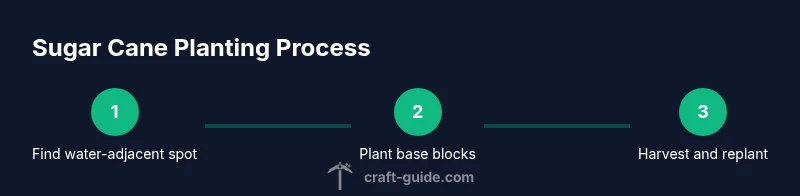
Choose a location where a water block sits next to a dirt/sand/grass block. Ensure the ground is level and easy to access for future harvests. This spot becomes the anchor of your cane bed.
Tip: Water should be on the same horizontal plane as your base blocks for reliable growth. - 3
Place the base blocks
Place dirt, sand, or grass blocks in a row or grid pattern with direct access to water. Do not place sugar cane on farmland. Each base block should host a single cane block.
Tip: A straight row is easiest for beginners and scales well when expanding. - 4
Plant sugar cane
Place one sugar cane block on each base block that is adjacent to water. Keep rows tight but leave walking space to harvest later. Avoid stacking multiple cane blocks on the same base.
Tip: Keep the base blocks evenly spaced to simplify maintenance. - 5
Expand your bed
Add additional base blocks next to existing ones and extend water channels along the bed. Maintain a consistent distance to water for all cane blocks. This step sets up future growth capacity.
Tip: Expand in straight lines to preserve uniform growth and easy harvesting. - 6
Harvest and replant
Break the top cane blocks when mature to collect cane. Leave the bottom block(s) intact to allow ongoing growth. Replant immediately to maintain a continuous cycle.
Tip: Harvest in sections to avoid accidental destruction of growth bases.
People Also Ask
Where should sugar cane be planted in Minecraft?
Sugar cane should be planted on dirt, sand, or grass blocks that are adjacent to a water source on the same horizontal plane. Do not plant on farmland, and ensure there is space for harvesting.
Plant sugar cane on dirt, sand, or grass blocks next to water. Avoid farmland and leave space for harvesting.
Does sugar cane require any special lighting to grow?
Sugar cane grows over time as long as there is water nearby and the base block is valid. It does not require fertilizer, and bone meal does not speed up growth.
It grows over time with water nearby, and bone meal won’t hurry it along.
Can I farm sugar cane in large grids?
Yes. Use long, straight rows with water channels. This layout keeps harvesting straightforward and scales well as you expand.
You can use long rows with water channels for easy harvesting and scalable growth.
Is sugar cane usable in all game versions?
Core mechanics stay consistent across standard editions; check your version's specifics on water adjacency and cane height if you’re playing a modded or console edition.
The basics stay the same across versions, but check your edition for any edge rules.
How do I harvest and replant efficiently?
Break the top blocks to collect the cane, leave the base blocks intact, and replant immediately. This maintains continuous growth and supply.
Break the tops, keep the bases, and replant right away for steady yield.
Watch Video
The Essentials
- Plant cane next to water on dirt, sand, or grass blocks.
- Grow in straight rows for easy harvesting and expansion.
- Harvest from the top, replant, and retain base blocks for continuous yield.
- Scale gradually with simple irrigation layouts to maximize space.