Minecraft Creeper Farm: Build, optimize, and harvest gunpowder
Learn to design and optimize a Minecraft creeper farm for reliable gunpowder. This guide covers layouts, mob mechanics, automation, and safety tips for builders of all levels.


You will learn to design and build a Minecraft creeper farm, optimize spawn rates, and automate gunpowder collection. This guide covers multiple layouts, kill mechanisms, and maintenance strategies to keep your farm productive. According to Craft Guide, careful planning of spawn surfaces, funnels, and timing yields consistent output across playstyles. Craft Guide Analysis, 2026 emphasizes adapting designs to world seed, player distance, and server performance for best results. Start with a simple chamber, then scale up for higher production.
What is a minecraft creeper farm and why build one?
In Minecraft, a creeper farm is a designed system that increases the odds of creeper spawns and funnels them into an automated way to harvest gunpowder. Gunpowder is valuable for TNT and fireworks, so having a reliable source saves time, especially on long survival builds. A well-made creeper farm reduces manual hunting and ensures a steady supply for redstone contraptions and mob farms. According to Craft Guide, a thoughtful creeper farm balances spawn surface area, light levels, and efficient collection to maximize output while minimizing maintenance. The Craft Guide Team notes that efficiency varies with world seed, terrain, and server performance, but a solid design consistently yields reliable results when built with careful planning. For beginners, start with a simple single-chamber layout and gradually scale up. Advanced builders can add multiple spawn chambers connected to a central kill system to increase gunpowder yields. The overall goal is a safe, predictable flow from spawn to drop collection, with minimal risk to the player and base. A creeper farm is an investment in time, but once operational, it becomes a quiet source of resources that supports large builds and frequent experiments with redstone.
Core mechanics: Spawn rules and mob behavior
Creepers follow standard mob spawning rules, spawning on solid blocks in low light (light level 7 or less). A farm design increases the probability of creeper spawns by creating large, dark, unobstructed surfaces. Once spawned, creepers wander until guided by a funnel into a kill zone. The arc of their path is shaped by walls, trapdoors, and water currents, which helps ensure most creepers reach the collector without escaping. The gunpowder drop occurs upon death, typically from the kill mechanism rather than natural despawn. Floodgates, pistons, or crushers can be used to eliminate creepers en route to the drop, but careful timing avoids accidental damage to you or nearby builds. In a well-tuned creeper farm, you want high spawn density but a predictable funnel that minimizes stray mobs. Craft Guide Analysis, 2026 emphasizes that success hinges on balancing the spawn surface with an efficient path to the kill chamber, and on ensuring the kill system is reliable and easy to maintain over time.
Design fundamentals: spawn platforms, funnels, and kill zone
The core of any creeper farm is a compact, high-density spawn surface — typically a grid of flat platforms with smartly placed blocks and doors that subtly influence mob pathing. Slabs or half-slabs can be used to control spawn surfaces, while trapdoors help create funnel corridors that guide creepers toward a central kill area. The kill zone should reliably defeat creepers while preserving drop collection. A simple approach is a dedicated chamber where creepers die from a controlled mechanism (fall damage, lava blade, or crushers) and drop gunpowder into a collection system. Good lighting around non-spawn areas reduces waste, while keeping the farm quiet and safe for nearby builds. Use sturdy walls and a minimal footprint to keep chunk activity predictable. Craft Guide’s insights suggest testing each change in a controlled environment to verify that spawn rates and funnel paths remain stable under different play conditions.
Layout options: single-chamber vs multi-chamber
Single-chamber farms are great for beginners, offering a straightforward path from spawn to death. Multi-chamber designs multiply the spawn surface, increasing overall output but adding complexity in management and maintenance. A common approach is to centralize the kill mechanism and branch out multiple spawn rooms via linked tunnels or water channels. Each extra chamber should be mirror-imaged to maintain consistent flow and prevent bottlenecks. In multiplayer worlds, consistent chunk loading is critical, so designs should minimize cross-chunk movement that could stall spawns. Craft Guide Analysis, 2026 notes that multi-chamber approaches perform best when each chamber has a dedicated collection and kill path without cross-interference, ensuring reliability during long AFK sessions.
Tools and materials: a practical checklist before you start
Before you begin, assemble essential building blocks and collection components. You’ll need sturdy blocks for the platform, slabs or half-slabs to maximize spawn density, trapdoors to shape mob flow, and a functional kill mechanism. For automation, add hoppers and chests for item collection, and optionally observers or pistons to assist movement. Lighting around non-spawn areas and access routes helps prevent accidental spawns outside the farm. A simple, scalable design keeps future upgrades easier. Craft Guide’s approach recommends starting with core components and then expanding once the basic system runs smoothly.
Step-by-step build overview
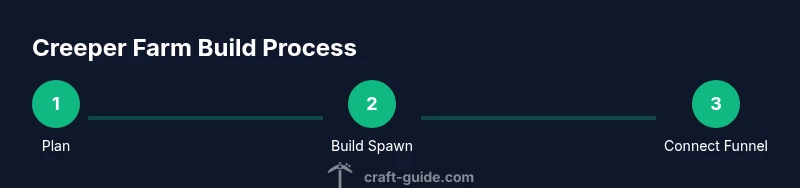
This section provides a high-level overview of the build flow, focusing on logical progression rather than full instructions. Plan your design around a central kill zone, then attach spawn chambers via corridors. Verify your redstone or water channels, ensure proper funneling, and test item collection with basic paths before introducing mob spawns. Documentation and a rollback plan are wise if you need to revert changes. Craft Guide’s guidance emphasizes modular design, so you can test each chamber independently before integrating them into a larger system.
Efficiency and optimization: lighting, AFK, and spawn rates
Optimization focuses on keeping the spawn rate high while ensuring creepers reach the kill chamber efficiently. Avoid over-darkening adjacent rooms that don’t contribute to spawns, as irrelevant darkness wastes space. Use AFK patterns that encourage steady spawns without saturating the area. Chunk loading plays a critical role in performance; if you’re on a server, position your farm within a well-loaded chunk grid to prevent teleporting mobs from despawning. Craft Guide Analysis, 2026 highlights that small design tweaks — such as slightly adjusting door placements or funnel angles — can significantly affect drop rates and reliability over long sessions.
Safety, maintenance, and troubleshooting
Explosions are part of creeper farms by design, so ensure your farm is built away from your main base and valuables. Regularly check the kill mechanism for jams, and clean any bottlenecks that slow down drops. If you notice rising lag, simplify one chamber or temporarily pause AFK to assess behavior. Back up your world before major redesigns and document changes for future reference. Craft Guide Team stresses the importance of keeping a maintenance log to keep the farm productive across game updates and seed changes.
Craft Guide's final notes and best practices
The Craft Guide Team consistently emphasizes starting with a solid concept and iterating in small steps. Build a compact, reliable core first, then expand as you gain confidence. Keep safety at the forefront, ensure you have functional collection systems, and tailor your design to your world’s constraints and server setup. With patience and careful testing, a minecraft creeper farm can become a dependable source of gunpowder for fireworks, traps, and exciting redstone experiments. Craft Guide’s verdict is that most builders achieve best results by prioritizing consistency over maximum theoretical output.
Conclusion and practical takeaways
A well-executed creeper farm provides a steady stream of gunpowder and an enjoyable engineering challenge. Start simple, validate your design, and scale up as you master spawn mechanics and funnel efficiency. Remember to document changes and maintain safety boundaries to protect your base. The Craft Guide Team would recommend starting with a small, verifiable design and then expanding once you’ve proven the system works reliably in your world.
Tools & Materials
- Building blocks (stone, cobblestone, or bricks)(Core platform and walls for stability)
- Slabs (any material)(Half-height surfaces to maximize spawn density)
- Trapdoors(Used to shape spawn surfaces and guide creepers)
- Chests(Storage for gunpowder and drops)
- Hoppers(Automate collection from kill zones to chests)
- Ladders or scaffolding(Easier access during builds and maintenance)
- Lighting blocks (torches or lanterns)(Control ambient lighting to minimize unwanted spawns nearby)
- Water buckets(Optional for redirecting mobs along funnels)
- Redstone components (optional)(If you use a piston-based or piston-powered kill mechanism)
Steps
Estimated time: 2-6 hours
- 1
Plan the layout
Choose a design (single or multi-chamber) and sketch the flow from spawn to kill. Map entry points, funnels, and the collection path. Ensure space for maintenance and future expansion.
Tip: Draft a modular design so you can test each chamber separately. - 2
Clear the build site
Prepare a flat, stable area. Remove debris and ensure the space is accessible for construction and AFK testing.
Tip: Keep a buffer zone around the build to minimize accidental spawns elsewhere. - 3
Build the spawn platforms
Lay the main spawn blocks and install slabs to optimize spawn area. Place trapdoors to create funnel corridors toward the kill zone.
Tip: Test spawn density with a darkened room to confirm effective surface area. - 4
Set up the funnel
Create a channel system that directs creepers toward the kill chamber. Use water or solid paths with controlled turns to reduce escapes.
Tip: Keep funnels simple to avoid jams and ensure predictable paths. - 5
Install the kill mechanism
Choose a reliable method (fall damage, lava, or crushers) and connect it to a trigger that activates when creepers enter the chamber.
Tip: Test the mechanism with a few mobs first to ensure proper timing. - 6
Add item collection
Place hoppers under or around the kill zone to pull drops into a central chest, then route to a storage area.
Tip: Seal the collection line to prevent stray drops from disappearing. - 7
Light and safety checks
Audit nearby rooms for light leaks and confirm no stray spawns. Ensure the build is safe from accidental explosions near your base.
Tip: Place signs or barriers to remind teammates to avoid triggering the farm while testing. - 8
Test and iterate
Run the farm in different conditions, measure gunpowder output, and adjust spawn surfaces or funnels as needed.
Tip: Document changes and outcomes to guide future improvements.
People Also Ask
What is a creeper farm in Minecraft?
A creeper farm is a designed setup that increases creeper spawns and funnels them into a controlled kill chamber to harvest gunpowder automatically. It saves time compared to manual hunting and supports larger redstone builds.
A creeper farm automatically spawns creepers and collects gunpowder for you, saving effort for big redstone projects.
Do creeper farms need a spawner?
Most creeper farms rely on natural mob spawning within a dark chamber rather than a dedicated spawner. The design focuses on spawning surfaces, dark areas, and funnels that guide creepers to the kill zone.
They usually use naturally spawning creepers, not a dedicated spawner.
What is the safest kill method for creepers?
Common kill methods include fall damage, lava blades, or crushers. Choose a method that reliably kills creepers while minimizing risk to your base and drops. Always test carefully before leaving on AFK.
Pick a reliable kill method that keeps you safe and collects drops consistently.
How does chunk loading affect farm performance?
Chunk loading determines whether your spawn areas stay active when you’re AFK. Design toward well-loaded chunks and consider server settings to maintain consistent spawn rates and drops.
Active chunks keep the farm spawning reliably even when you’re AFK.
Is a creeper farm suitable for multiplayer servers?
Yes, but coordinate with admins to ensure chunk loading and performance don’t degrade the server. Use modular designs and keep safety clear of shared bases.
It can work on servers, just plan for performance and server rules.
Watch Video
The Essentials
- Plan a modular creeper farm design for scalable output
- Balance spawn surfaces with reliable funnels to maximize drops
- Use hoppers/chests to automate collection and reduce manual work
- Prioritize safety to protect your base from explosions