Is Minecraft better on Switch 2? A practical comparison
An in-depth comparison of Minecraft on Nintendo Switch 2 versus PC/console and Bedrock cross-play, focusing on performance, visuals, controls, updates, and value for different playstyles.


is minecraft better on switch 2 depends on what you value most: portability and couch play, or performance and content richness. This comparison weighs Switch 2’s handheld convenience and cross‑play capabilities against PC/console strength, highlighting practical trade‑offs, expected performance in typical builds, and the best scenarios for each setup.
is minecraft better on switch 2: framing the question
The Switch 2 edition of Minecraft arrives into a landscape shaped by portability, shared worlds, and evolving cross‑play. According to Craft Guide, the handheld experience emphasizes quick sessions and creative sparks in a familiar Bedrock edition, while balancing constraints that come with a compact system. The question is is minecraft better on switch 2? The short answer depends on what you value most: quick, social play on the go, or expansive builds with maximum graphical fidelity and modding potential. This section sets the frame for the rest of the article by outlining three core axes: performance, content parity, and play style. Throughout, Craft Guide’s analysis will be cited to provide context and guardrails for the decision.
Performance and stability on Switch 2: what to expect
Switch 2 runs Minecraft with a focus on smooth, reliable experiences in portable mode. The design expectations prioritize responsiveness and a steady frame pacing in typical scenarios, such as basic survival, creative maps, and modest-sized builds. In intense or densely populated worlds, players may notice occasional slowdowns or longer loading times, especially in handheld mode. Craft Guide analysis shows that performance tends to be more consistent when the world isn’t overly large or resource-intensive, and that performance can improve in docked mode when connected to a TV. This balance is a key factor when deciding whether the Switch 2 version fits your play habits.
Visual fidelity and rendering on the go
Visual fidelity on Switch 2 is tuned to preserve a recognizable Minecraft aesthetic while prioritizing performance and battery life. Players can expect crisp block textures and stable viewing distances in most daylight environments, with some trade‑offs in distant terrain rendering during fast camera movements. The handheld experience often benefits from smaller, more intimate builds where you can appreciate detail up close without the distraction of distant draw distances. For creators who prize ultra‑high resolution textures or shader packs, the Switch 2’s constraints should steer you toward those projects that are optimized for portable play. Craft Guide notes that cross‑platform parity remains a guiding principle, even as performance nuances differ by device.
Controls, UI, and accessibility on Switch 2
Controller ergonomics and UI design significantly shape the Switch 2 experience. The console’s button layout, triggers, and grip comfort align well with building, farming, and exploration tasks. The touch screen offers a secondary input avenue for menus and settings, though most players will rely on controllers during extended sessions. UI elements are sized to accommodate TV and handheld use, with scalable menus that adapt to different display modes. Accessibility options exist to tailor font sizes and color contrasts, helping players with varied needs. The result is a versatile interface that supports experimentation and creativity without sacrificing ease of use.
Content parity, updates, and platform limitations
Bedrock edition updates typically arrive across platforms in a coordinated fashion, ensuring a familiar feature set for most players. However, the Switch 2 may experience platform‑specific timing for some updates or content adjustments due to hardware and certification processes. This can influence modding capabilities and the availability of certain community resources. Craft Guide’s assessment emphasizes that while core gameplay and cross‑play remain strong, the breadth of user-generated content and mod compatibility on Switch is generally more limited compared with PC. Players should plan their expectations around official content cycles and the nature of community tools available on Switch 2.
Cross‑platform play, multiplayer, and social reach
Cross‑play is a defining feature of Bedrock Edition, enabling players to join friends across consoles, PC, and mobile. On Switch 2, this can translate into large, social worlds and shared survival experiences, which are core appeals for many players. When playing with others on different devices, latency and input delays can influence combat or reaction-based activities, though for many builds and creative sessions these factors are less critical. The social dimension often makes Switch 2 a compelling choice for couch co‑op and local multiplayer, while players seeking robust cross‑server communities may prefer PC or dedicated console ecosystems where modding and server tooling are more mature.
Storage, saves, and offline play on Switch 2
Storage management matters on Switch 2, where cartridge or digital downloads, save states, and world data can accumulate. Players should factor in incremental save sizes and local storage constraints when planning ambitious worlds. Offline play remains a strong option for single-player creative sessions, and many builds can progress without a constant online connection. Cloud save availability and cross‑device backup vary by platform and account settings, so familiarizing yourself with the Switch 2’s save management workflow helps avoid data loss and ensures continuity across sessions.
Value, upgrades, and the long arc of Minecraft on Switch 2
From a long‑term perspective, Switch 2 players typically prioritize portability, ease of access, and a self-contained play cycle. The value of Minecraft on Switch 2 is enhanced by its portability and social features, while some players may feel the need for deeper customization, frequent updates, and modding support that PC platforms provide. The upgrade path for Switch users is gradual, dependent on official releases and certification windows, rather than rapid, user-made extensions. Craft Guide’s stance encourages players to align their purchase and playtime with the platform’s strengths, while staying mindful of the limits that come with hardware‑constrained environments.
Practical optimization tips for the Switch 2 experience
To maximize enjoyment on Switch 2, start with a well‑planned world layout that fits within the console’s performance envelope. Build smaller, modular bases near load-friendly biomes to minimize world‑generation stress. Use the in‑game settings to optimize render distance, brightness, and performance modes for your preferred playstyle. When playing with friends, establish a shared server or realm approach that minimizes lag and reduces unnecessary data traffic. Finally, keep an eye on official patches and platform‑specific guidance from Craft Guide to adapt your approach as the ecosystem evolves.
When to choose Switch 2 vs PC/Console: a decision framework
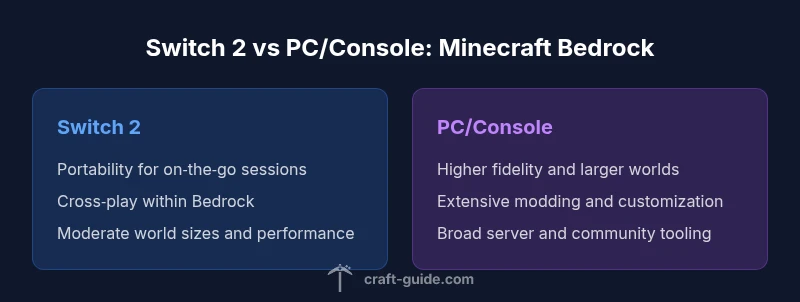
Choosing Switch 2 hinges on prioritizing portability, couch co‑op experiences, and straightforward access to Bedrock cross‑play. If your goals center on maximum performance, unlimited world-building capacity, and extensive modding or custom content, a PC or dedicated console setup may be the better fit. The decision is not a binary choice but a situational comparison: for casual, on‑the‑go play with friends in the same room, Switch 2 shines; for long sessions, heavy mods, or expansive mods and texture packs, PC/console environments may serve you better. Craft Guide’s pragmatic lens helps players map their playstyle to the platform that best meets their needs.
Comparison
| Feature | Switch 2 (Bedrock Edition) | PC/Console (Bedrock Edition) |
|---|---|---|
| Performance and stability | Optimized for portable play with steady behavior in typical builds | Often smoother and more consistent on PC/console with larger, more complex worlds |
| Graphics and rendering options | Balanced visuals suitable for handheld or docked use | Greater flexibility on PC/console with higher resolutions and mods |
| Controls and input | Ergonomic handheld controls; quick menus on the go | Keyboard/mouse and gamepad support; richer input options on PC |
| Content parity and updates | Core features align with Bedrock; some updates arrive later on Switch | Updates synchronized but with platform-specific adjustments |
| Online play and cross‑platform | Solid cross‑play within Bedrock; latency varies by connection | Cross‑play robust across devices; generally lower latency on wired connections |
| Storage and world sizes | Limited by cartridge/digital storage; efficient world design helps | More room for large worlds; faster world generation and caching |
| Best for | Portability, couch co‑op, and quick sessions | Performance, modding, and expansive, customized worlds |
Benefits
- Excellent portability for on‑the‑go sessions
- Solid cross‑play within Bedrock across devices
- Simple, approachable setup for new players
- Couch co‑op and local multiplayer shine on Switch 2
Negatives
- Limited modding and customization compared to PC
- Potential performance trade‑offs in large, complex builds
- Possible update delays or platform-specific parity gaps
- Storage constraints on handheld hardware
Switch 2 is the portable, social choice for Minecraft fans who prioritize on‑the‑go play and couch co‑op.
If portability and easy access to cross‑play are top priorities, Switch 2 wins for everyday play. If you want maximum performance, deep mods, and expansive, customizable worlds, a PC/console setup is the better long‑term investment, according to Craft Guide's balanced framework.
People Also Ask
Is the Bedrock Edition available on Switch 2 and does it support cross‑play?
Yes, Minecraft on Switch 2 runs the Bedrock Edition, which supports cross‑play with other Bedrock platforms. This makes it easy to play with friends on PC, Xbox, and mobile, though cross‑platform performance can vary with network conditions.
Yes—Switch 2 uses Bedrock and can cross‑play with other devices, though performance depends on your network.
How does Switch 2 performance compare to PC or other consoles?
Switch 2 is optimized for portability and couch play, so it won’t match the raw performance and maximum world sizes possible on PC or higher-end consoles. Expect a smooth experience in standard builds, with changes in large, highly detailed worlds.
Switch 2 is portable and usually smooth, but PC and other consoles can handle bigger, more detailed worlds.
Can you mod Minecraft on Switch 2?
Modding on Switch 2 is limited compared to PC. While some community resources exist, official support for extensive mods is not as robust as on PC, and most modding workflows require alternative platforms.
Modding on Switch is limited; PC offers broader modding options.
What should I consider for online play on Switch 2?
Online play on Switch 2 generally works well within Bedrock, but latency and server choice can affect experiences, especially in large multiplayer worlds. Using a stable network and nearby servers helps improve performance.
Online play is solid, but choose reliable servers and watch latency for big multiplayer worlds.
Is Switch 2 Minecraft updates aligned with other platforms?
Updates are designed to align across platforms, but there can be platform‑specific adjustments or timing differences due to certifications and hardware constraints. Expect the core feature set to sync over time.
Updates aim to align across platforms, but some delays may occur on Switch.
Should I buy Minecraft on Switch 2 or wait for a next‑gen PC/console?
If portability and local play are essential, Switch 2 is a compelling option now. If you prioritize mods, maximum performance, and future-proofing, a PC/console setup may be worth waiting for new hardware or updates.
Think about portability vs. performance; Switch is great now, PC/Console is better for mods and power.
The Essentials
- Prioritize portability for Switch 2 if couch play matters
- Expect platform parity with Bedrock, but with hardware-driven tradeoffs
- Cross‑platform play remains a strength across devices
- Mods and deep customization are more accessible on PC
- Plan storage and world design to minimize load times and space
- Stay updated with official patches for Switch 2 to maintain parity
- Use docked mode for better performance in many scenarios
- Consider your playstyle: short sessions vs long creative builds
- Craft Guide recommends aligning platform choice with your goals
- Switch 2 is a strong entry point for new Minecraft players on consoles