How to Use Minecraft Crafter: A Practical Guide
Learn how to use Minecraft Crafter to streamline crafting, automate recipes, and optimize resource flow in your builds with practical steps and tips.


In this guide you'll learn how to use minecraft crafter to transform resources into crafted items, wire inputs and outputs, and troubleshoot common issues in vanilla-like or modded setups. By the end you'll be able to design efficient crafting lines and automate basic recipes. Whether you play in vanilla or modded worlds, this guide keeps steps practical and repeatable.
Understanding the Minecraft Crafter: what it is and where to find it
When players ask how to use minecraft crafter, they are usually looking for a reliable workflow to turn resources into finished items with speed and consistency. In this guide, we treat the Crafter as a flexible automation device that can exist as a block, machine, or component in many packs. Depending on your map or mod, it may appear as a compact machine connected to power networks, storage, and conveyors. The core principle is the same: feed it inputs, choose the correct recipe, and retrieve the output efficiently. This approach shines in survival builds where time matters and in creative maps where you want to demonstrate a process quickly. According to Craft Guide, the best setups use clean input lines and clearly labeled outputs to minimize confusion and maximize throughput.
Required materials and setup
Before you start, gather a handful of essential items. The exact hardware can vary by pack, but a typical setup includes the Crafter block, a stable power source, and at least one storage container nearby. You may also want redstone components for automation triggers or timers to control how often crafting runs. Labeling inputs and outputs helps keep things organized, especially in larger factories. If you are working in a multiplayer world, confirm that the Crafter is allowed by server rules and that you have permission to run automations. The Craft Guide team suggests starting with a simple one to two recipe system to learn the basics before expanding to multi-recipe factories. In most cases, you will not need special tools beyond the basic mining and building kit, but a few items improve reliability. Ensure you have a sturdy placement plan and a power plan before wiring anything up.
Basic workflow: loading recipes and inputs
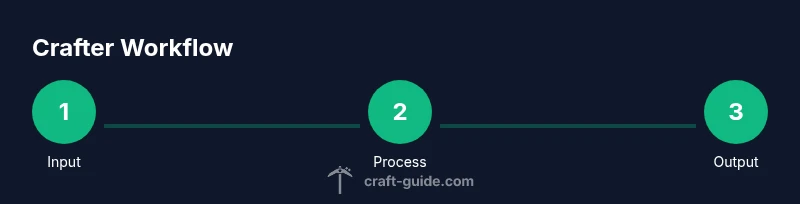
The basic workflow starts with powering the Crafter, then opening its interface to load a recipe. Next, you place the required inputs in the designated slots and verify the recipe match. In many packs, the Crafter will display a preview of the output so you can confirm it is what you expect. Keep input inventories tidy to reduce miscrafts and to speed up future operations. As you become more confident, you can add automation for feeding inputs and pulling outputs, which dramatically reduces manual clicks. Craft guides and pack documentation are good references for identifying which recipes are compatible with your Crafter setup.
Understanding input/output layouts and recipe types
Crafters generally support several recipe formats, including shaped and shapeless recipes. Shaped recipes require items in exact positions in the input grid, while shapeless recipes only require the correct items, regardless of arrangement. Many packs also classify recipes by complexity, requiring auxiliary items like fuels or catalysts. Understanding these distinctions helps you design flexible automation. For example, a shapeless recipe can be fed from multiple input stacks without precise alignment, which makes it ideal for bulk farming scenarios. Labeling input slots and matching outputs help prevent craft errors across long production lines.
Automating your Crafter for a smooth workflow
Automation is the key to modern minecraft crafter workflows. Start by linking a feed system that delivers inputs when slots are empty and a collection system that pulls outputs to a storage area. Use short redstone pulses or automatic timers if your pack supports them to avoid idle cycles. Place your Crafter in a well-lit, accessible area to ease maintenance. If you are automating multiple recipes, consider dedicating separate Crafter units for different outputs to keep throughput high and errors low. Regularly verify that the automation chain remains synchronized as you expand.
Modded vs vanilla Crafter differences
In vanilla Minecraft you may not see a Crafter by default, but many modpacks introduce variants with enhanced speed, buffering, and multi-slot inputs. The core concept remains the same, yet modded Crafter units can offer extra features like bulk processing, integrated inventories, or energy networks. When transitioning from vanilla to modded Crafter setups, read the pack’s documentation to understand how power, inputs, and outputs are wired. The Craft Guide team has found that starting with a single Crafter and a basic recipe helps you map the limitations and capabilities before scaling up to multi-block factories.
Troubleshooting common problems and performance tips
If a Crafter stops producing items, check input availability, recipe compatibility, and output capacity. Overloading the system can cause lag or slowdowns, so keep an eye on energy and belt speeds. Ensure that the correct recipe is selected and that required catalysts or fuels are present. If outputs appear stuck, verify that your storage or hopper system is not full and that extraction paths are not blocked. For large factories, enable chunk loading on the Crafter’s area to keep the automation responsive when you move around the world. Regular maintenance tasks like clearing inventories and updating connections help prevent bottlenecks.
Aesthetics and placement in builds
Placement matters for both performance and visuals. Place the Crafter in a centralized location to minimize walking distance for operators, and align inputs and outputs with the rest of the factory to create a clean, readable workflow. Use walls or glass panels to separate the automation line from farming or storage areas while keeping access for maintenance. Aesthetically, consider color-coded item lines and using consistent block types to reflect different production lines. Craft Guide tips emphasize labeling and modular design to simplify future upgrades and expansions.
Real-world example: building a simple auto-crafter farm
Let us walk through a concrete example: building a small auto crafter farm that crafts planks from logs, then transfers them to a chest. Start by placing the Crafter, connect it to a power source, and load a plank recipe. Add a log feeder using a simple hopper line from a log storage area. Attach a short output line from the Crafter to a nearby chest. Run a test cycle with a few blocks of wood to verify that inputs are consumed and outputs are collected automatically. If the cycle runs smoothly, scale up by adding more Crafter blocks and doubling the input lines. This hands-on project solidifies the concepts in a practical, tangible setup.
Scaling with multiple Crafters and networks
As you grow your automation network, dedicate separate Crafter blocks to specific recipes to maximize fidelity and throughput. Use power rails and bus lines to prevent bottlenecks and ensure consistent energy supply. Consider implementing a master controller that toggles whole sections on or off, enabling you to control resource budgets and conserve power. Keep a running log of performance metrics, such as cycles completed per hour and average wait times, to guide future expansions. Craft Guide’s experience shows that modular, documented systems scale most reliably across different worlds and play styles.
AUTHORITY SOURCES
- US Department of Education: https://www.ed.gov/
- National Science Foundation: https://www.nsf.gov/
- The New York Times Science: https://www.nytimes.com/section/science
Tools & Materials
- Minecraft Crafter block(Core device to process recipes and produce outputs.)
- Power source compatible with your pack(Provide stable energy; ensure capacity matches load.)
- Storage container (chest or barrel)(Nearby storage to feed inputs and collect outputs.)
- Conveyor or hopper system(Helps automate input feeding and output collection.)
- Redstone components (dust, repeater, comparator)(Optional for timing and triggers.)
- Recipe guide or in-game book(Helpful for tracking complex recipes across packs.)
Steps
Estimated time: 15-40 minutes
- 1
Place and power the Crafter
Set the Crafter on a solid surface and connect it to a stable power source. Verify that the power connection is live before attempting any crafting to avoid interruptions.
Tip: Test with a simple recipe first to confirm power flow. - 2
Open the Crafter interface
Right-click or activate the Crafter to open its user interface. Take note of input slots, the recipe selector, and the output slot.
Tip: Familiarize yourself with the layout to speed up future operations. - 3
Load the first recipe
From the recipe panel, choose the recipe you want to run and confirm the required inputs. Some packs show a preview of the output.
Tip: Start with a common recipe like planks to verify flow. - 4
Add required inputs
Place the exact items and quantities into their designated input slots. Ensure accuracy to avoid failed crafts.
Tip: Use labeled storage to keep items organized. - 5
Verify the output slot
Check the output slot for the expected item. If needed, adjust slot order or recipe selection.
Tip: A wrong slot can lead to mis-timed collection. - 6
Start or trigger the craft
Activate the crafting process. Some setups auto-run while inputs are present, others require a trigger.
Tip: Avoid running recipes with missing inputs to prevent waste. - 7
Collect the product
Retrieve the finished item from the output and clear used input slots. Move items to storage as needed.
Tip: Keep outputs organized to prevent mixups. - 8
Automate feed and collection
Attach a feeding line from storage and output line to a chest or sorting system. Ensure timing aligns with consumption.
Tip: Use simple timers if your pack supports them. - 9
Test and iterate
Run multiple cycles with different recipes to confirm reliability. Document issues and adjust wiring as needed.
Tip: Maintain a small test log for quick reference.
People Also Ask
What is a Minecraft Crafter and how does it differ from a crafting table?
A Crafter is designed for automation and faster production, often supporting multiple inputs and automated feeding. A crafting table is manual and used for one-off recipes. In packs with a Crafter, you can run many recipes with minimal interaction.
A Crafter automates recipes that would normally require manual crafting.
Can I automate multiple recipes with one Crafter?
Most Crafter variants support one recipe at a time, but you can switch recipes quickly or dedicate separate Crafter blocks to different outputs. Check your pack’s documentation for exact capabilities.
Yes, but often you switch recipes rather than run them all at once.
Do I always need a power source for a Crafter?
Power is common in many packs for Crafters. In vanilla-like setups, some variants run on a timer or redstone signals instead. Always verify the power needs in your specific pack.
Power or a control signal is typically required.
What are common performance issues with a Crafter?
Common issues include input shortages, misaligned recipes, full output storage, and power bottlenecks. Address these by checking inputs, confirming recipes, expanding storage, and balancing energy supply.
Bottlenecks and wrong recipes cause most problems.
Is the Crafter compatible with multiplayer worlds?
Yes, provided server settings allow automation and players have appropriate permissions. Coordinate with admins to ensure safety and prevent abuse.
Usually fine in multiplayer if server rules allow it.
What should I do if the Crafter stops producing items?
Check inputs, verify recipe selection, inspect power, and ensure outputs aren’t blocked. Reboot the setup or test with a simple recipe before scaling up.
Check inputs and power first, then test with a simple recipe.
Watch Video
The Essentials
- Plan your Crafter layout for clean input/output flow
- Start small, then scale up with modular units
- Automate inputs and outputs to maximize throughput
- Keep power and storage balanced to avoid bottlenecks
- Document recipes and wiring for easier upgrades